2001 Honda CR250R
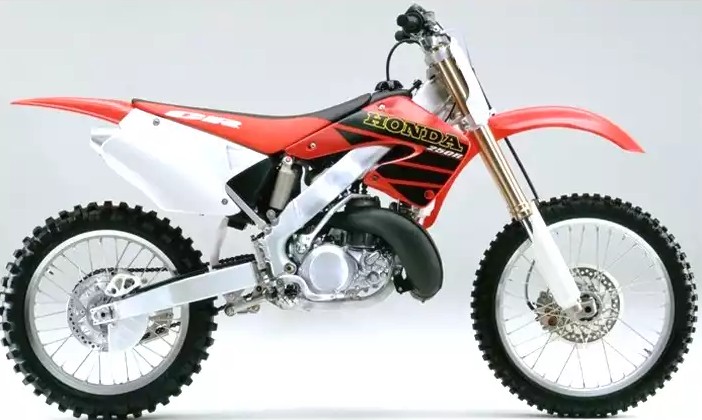
General Specifications
| Model | CR250R |
| Year | 2001 |
| Category | Motocross |
| Engine Type | Liquid-cooled, 2-stroke, single-cylinder, reed-valve |
| Weight | 96.2 kg dry |
Engine
| Displacement | 249 cc |
| Bore x Stroke | 66.4 x 72.0 mm |
| Compression Ratio | 8.5:1 |
| Fuel System | 38 mm Mikuni TMX carburettor | Replacement Options |
| Ignition | CDI |
| Spark Plug | NGK BR8EG |
| Spark Plug Gap | 0.5-0.6 mm |
| Cooling System | Liquid-cooled |
| Starting System | Kick starter |
Transmission
| Transmission | 5-speed constant-mesh |
| Clutch | Wet multi-plate |
| Final Drive | Chain |
Dimensions
| Overall Length | 2189 mm |
| Overall Width | 827 mm |
| Overall Height | 1278 mm |
| Wheelbase | 1481 mm |
| Ground Clearance | 343 mm |
| Seat Height | 942 mm |
| Fuel Capacity | 7.5 L |
Chassis
Suspension
| Front Suspension | 47 mm inverted Showa cartridge fork | Fork Oil Levels |
| Front Suspension Travel | 305 mm |
| Rear Suspension | Pro-Link single shock |
| Rear Suspension Travel | 320 mm |
| Fork Oil | Honda SS-7 suspension fluid or equivalent; oil level adjustable to rider setup |
Brakes & Wheels
| Front Brake | Hydraulic single disc |
| Rear Brake | Hydraulic single disc |
| Front Wheel Size | 21 inch |
| Rear Wheel Size | 19 inch |
Service Data
| Fuel Type | Premium unleaded petrol |
| Premix Information | Premix lubrication | Premix Calculator |
| Gearbox Oil | SAE 10W-40 motorcycle oil; approximately 0.65 L after draining |
| Air Filter | Oiled foam element |
| Service Notes | Competition motorcycle; regularly service the air filter, transmission oil, chain, suspension linkage and top end |
2001 Honda CR250R – The Final Evolution of Honda’s Second-Generation Aluminium CR250
The 2001 Honda CR250R was an important evolutionary model rather than an entirely new generation. It represented the final development of Honda’s second-generation aluminium-framed CR250R before the substantially redesigned 2002 machine arrived. By 2001 Honda had spent several years refining the aluminium chassis concept first introduced to the CR250R in 1997, producing a motorcycle that combined formidable two-stroke performance with a much more developed chassis and suspension package.
At its heart was Honda’s 249 cc liquid-cooled two-stroke single, with a 66.4 mm bore and 72.0 mm stroke. Fuel was supplied through a 38 mm Mikuni TMX carburettor, and the engine used Honda’s exhaust power-valve system to broaden the power delivery. Carburettor condition is particularly important on an older CR250R because wear, incorrect jetting and previous modifications can dramatically alter starting and throttle response. Owners working on the fuel system can refer to the MXOwners carburettor information and replacement options.
One of the defining features of this era of CR250R was Honda’s aluminium twin-spar frame. Honda had been refining aluminium motocross chassis construction since the controversial first-generation 1997 CR250R, which earned a reputation for being exceptionally rigid. By 2001 the concept was considerably more mature, giving the CR250R a distinctive combination of precise steering, strength and lightweight construction.
Suspension consisted of a 47 mm inverted Showa cartridge fork at the front and Honda’s Pro-Link system with a single rear shock. With roughly 305 mm of front travel and 320 mm at the rear, the CR250R had serious competition suspension for its time. More than two decades later, fork seals, bushings, shock condition and linkage bearings deserve careful inspection on any surviving example. Owners servicing the front end can also use the MXOwners fork oil level reference when checking suspension information.
The CR250R used the familiar motocross combination of a 21-inch front wheel and 19-inch rear wheel, carrying 80/100-21 and 110/90-19 tyres. Modern tyre availability is generally good, and owners comparing replacements can use the MXOwners motorcycle tyre size guide.
Routine servicing remains critical on these machines. A clean and correctly oiled foam air filter, fresh transmission oil, correctly adjusted chain and properly prepared two-stroke fuel all contribute to reliability. Owners preparing fuel can use the MXOwners two-stroke premix calculator to calculate the required oil quantity for their chosen fuel volume and mixing ratio.
The 2001 CR250R occupies an interesting place in Honda motocross history. It was not the beginning of a new generation, but rather the culmination of several years spent developing Honda’s second-generation aluminium chassis and proven 250 cc two-stroke engine. With the major 2002 redesign immediately following it, the 2001 model effectively closes one chapter of CR250R development and remains a distinctive machine for riders and restorers interested in Honda’s classic two-stroke motocross era.