2001 Kawasaki KX250
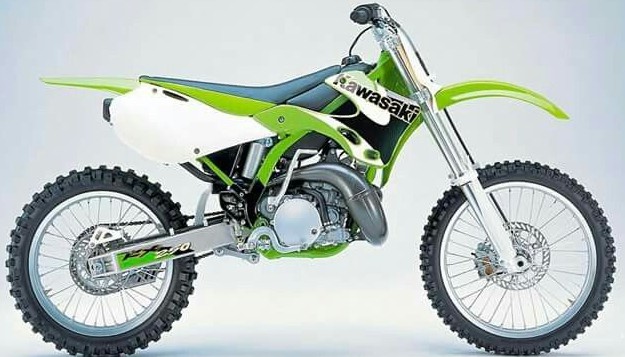
General Specifications
| Model | KX250 |
| Year | 2001 |
| Category | Motocross |
| Engine Type | Liquid-cooled, 2-stroke, single-cylinder, reed-valve |
| Weight | 97 kg dry |
Engine
| Displacement | 249 cc |
| Bore x Stroke | 66.4 x 72.0 mm |
| Compression Ratio | 10.4:1 low speed / 8.7:1 high speed |
| Fuel System | Keihin PWK38 carburettor | Replacement Options |
| Ignition | Digital CDI |
| Spark Plug | NGK BR8EG |
| Spark Plug Gap | 0.5-0.6 mm |
| Cooling System | Liquid-cooled |
| Starting System | Kick starter |
Transmission
| Transmission | 5-speed constant-mesh |
| Clutch | Wet multi-plate |
| Final Drive | Chain |
Dimensions
| Overall Length | 2185 mm |
| Overall Width | 815 mm |
| Overall Height | 1255 mm |
| Wheelbase | 1475 mm |
| Ground Clearance | 385 mm |
| Seat Height | 955 mm |
| Fuel Capacity | 8.2 L |
Chassis
Suspension
| Front Suspension | 46 mm Kayaba inverted telescopic cartridge fork | Fork Oil Levels |
| Front Suspension Travel | 305 mm |
| Rear Suspension | Uni-Trak linkage with Kayaba gas-charged single shock |
| Rear Suspension Travel | 330 mm |
| Fork Oil | Kayaba 01 fork oil or equivalent |
Brakes & Wheels
| Front Brake | Hydraulic single disc |
| Rear Brake | Hydraulic single disc |
| Front Wheel Size | 21 inch |
| Rear Wheel Size | 19 inch |
Service Data
| Fuel Type | Premium unleaded petrol |
| Premix Information | Premix two-stroke lubrication | Premix Calculator |
| Gearbox Oil | SAE 10W-40 motorcycle oil |
| Air Filter | Oiled foam element |
| Service Notes | Competition motorcycle; regularly inspect and service the air filter, transmission oil, drive chain, cooling system, KIPS power-valve system, suspension linkage and engine top end |
2001 Kawasaki KX250 – Refining Kawasaki’s Hard-Hitting Two-Stroke
The 2001 Kawasaki KX250 was primarily an evolutionary development rather than an entirely new generation. Kawasaki continued refining its established 249cc two-stroke motocross platform, concentrating on the engine, suspension and chassis characteristics that had made the KX250 a formidable open-class race bike. At the beginning of the new millennium, the 250cc two-stroke category was still fiercely competitive, and Kawasaki’s KX250 remained aimed squarely at experienced motocross racers.
The liquid-cooled engine retained the familiar 66.4 mm bore and 72.0 mm stroke and used Kawasaki’s KIPS exhaust power-valve system to broaden the usable power range. A Keihin PWK38 carburettor supplied the mixture through reed-valve induction. More than two decades later, carburettor wear, jetting changes and previous modifications can significantly affect how a KX250 starts and runs, making the MXOwners carburettor information and replacement options useful when assessing the induction system.
The KX250 used Kawasaki’s high-tensile steel perimeter-style frame with long-travel Kayaba suspension. The 46 mm inverted cartridge fork provided approximately 305 mm of travel, while the Uni-Trak linkage rear suspension provided approximately 330 mm. On surviving bikes, fork bushings and seals, shock condition and linkage bearings deserve careful inspection before suspension settings are altered. Owners rebuilding the front end can also consult the MXOwners fork oil level reference for additional service information.
A 21-inch front wheel and 19-inch rear wheel carried the standard full-size motocross tyre combination of 80/100-21 and 110/90-19. Owners comparing current replacement tyres can use the MXOwners motorcycle tyre size guide. Regular air-filter servicing, fresh transmission oil and careful maintenance of the KIPS system and engine top end remain particularly important on an older competition two-stroke.
Although the 2001 KX250 was not a ground-up redesign, it represents an important period in Kawasaki motocross history. The bike came from the final years when Japanese 250cc two-strokes were still the dominant machines in their class, immediately before four-stroke development began reshaping motocross. Its powerful engine, straightforward mechanical layout and distinctive Kawasaki chassis make the 2001 KX250 an appealing machine for riders and owners interested in the peak era of traditional 250cc two-stroke motocross.