| Model | MX400 |
| Year | 2001 |
| Category | Motocross |
| Engine Type | Single-cylinder, 4-stroke, DOHC, 4-valve, liquid-cooled |
| Weight | 260 lb (118 kg) without fuel |
| Displacement | 432 cc |
| Bore x Stroke | 95 x 61 mm |
| Compression Ratio | 12.5:1 |
| Fuel System | Electronic fuel injection |
| Ignition | Digital electronic mapped ignition |
| Spark Plug | NGK CR9EK |
| Spark Plug Gap | 0.7 mm (0.028 in) |
| Cooling System | Liquid cooled |
| Starting System | Electric start |
| Transmission | 5-speed cassette-type manual |
| Clutch | Wet multi-plate clutch |
| Final Drive | Chain |
| Overall Length | |
| Overall Width | |
| Overall Height | |
| Wheelbase | |
| Ground Clearance | |
| Seat Height | |
| Fuel Capacity | 8 litres |
| Frame | Aluminium twin-spar perimeter frame with bolt-on aluminium lower frame rails and subframe |
| Front Tyre | 80/100-21 | Tyre Size Guide |
| Rear Tyre | 110/100-19 | Tyre Size Guide |
| Front Suspension | Öhlins FG9910 upside-down fork, adjustable compression and rebound damping | Fork Oil Levels |
| Front Suspension Travel | 11.8 in (300 mm) |
| Rear Suspension | Öhlins Position Sensitive Damping (PSD) monoshock, direct-acting linkageless system, adjustable preload, compression and rebound damping |
| Rear Suspension Travel | |
| Fork Oil | Öhlins Fork Fluid |
| Front Brake | Hydraulic single disc |
| Rear Brake | Hydraulic single disc |
| Front Wheel Size | 21 inch |
| Rear Wheel Size | 19 inch |
| Fuel Type | Premium unleaded petrol |
| Premix Information | Not applicable - 4-stroke engine |
| Gearbox Oil | Separate transmission/clutch lubrication system; refer to Cannondale service specifications for approved oil grade and quantity |
| Air Filter | Dual-filter intake system |
| Service Notes | Competition four-stroke with separate engine and transmission lubrication systems. Early-production MX400s require careful attention to EFI, electrical starting system, oil circulation and air-filter maintenance. Parts availability can be limited due to the short Cannondale motorcycle production run. |
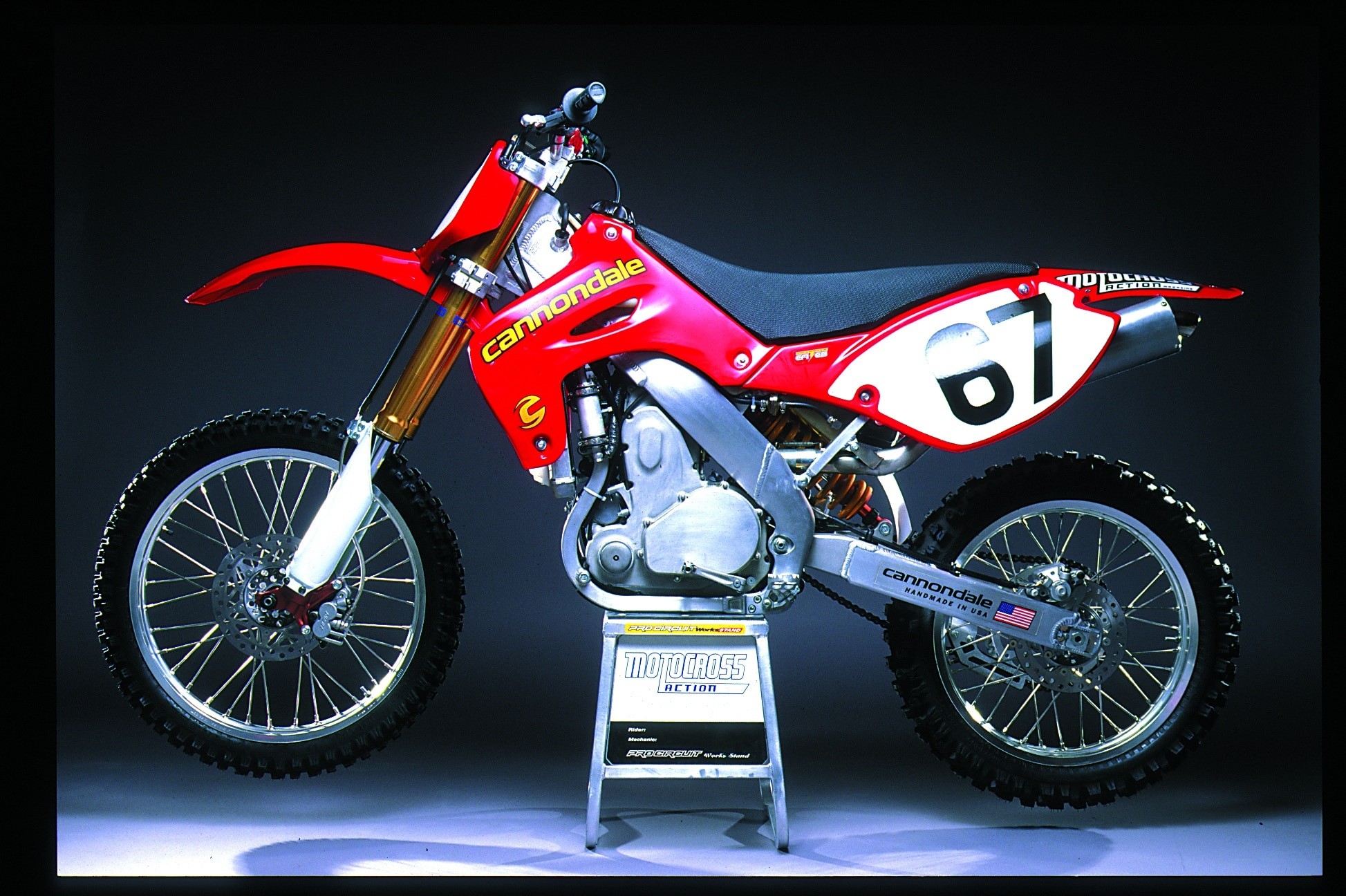
Few motocross bikes have a story quite like the 2001 Cannondale MX400. Cannondale was already famous for high-end aluminium bicycles when it decided to enter the motorcycle business and challenge established manufacturers such as Honda, Yamaha, Kawasaki, Suzuki and KTM. Instead of starting with a simple conventional design, the American company attempted to leap straight to the front of motocross technology. The result was the MX400, one of the most ambitious, unusual and ultimately troubled motocross machines of its era.
Although its name said MX400, the production motorcycle actually displaced approximately 432 cc. The project had originally been developed around a smaller 397 cc engine, but displacement increased before production. By then the MX400 name and graphics had effectively been established, so the name remained. Its liquid-cooled four-stroke single used a 95 mm bore and 61 mm stroke, double overhead camshafts and four valves. At a time when carburettors still dominated motocross, Cannondale went straight to electronic fuel injection and digitally mapped ignition.
The engineering ambition did not stop there. The MX400 featured electric starting with no conventional kick-starter backup, a cassette-style five-speed transmission, aluminium perimeter frame and a highly unconventional intake arrangement. Cannondale placed considerable emphasis on mass centralisation and packaging, creating a motorcycle that looked and worked differently from the Japanese machines surrounding it. Owners comparing the MX400 with other machines from 2001 can use the MXOwners motocross bike specifications to see just how unusual its specification was for the period.
Cannondale also spent heavily on suspension. Premium Swedish Öhlins components were fitted front and rear. The FG9910 upside-down fork provided approximately 300 mm of travel with adjustable compression and rebound damping. At the rear, Cannondale eliminated the conventional rising-rate linkage and used an Öhlins Position Sensitive Damping shock mounted directly between the swingarm and chassis. The concept reduced linkage components and followed a similar philosophy to the linkageless systems appearing on KTM and other European motorcycles. Owners rebuilding the front suspension can use the MXOwners fork oil reference as an additional suspension reference.
Unfortunately, ambitious engineering did not produce a polished first-year race bike. Contemporary testing exposed several problems. The MX400 was substantially heavier than Cannondale's early development targets, with production machines weighing around 260 pounds without fuel. The electric starter could be troublesome, which became particularly serious because there was no kick-starter. Testers also encountered EFI and electrical problems, while the original suspension balance was criticised for combining very soft front forks with a stiff rear setup.
The motorcycle's development was unusually public. Cannondale entered prototype machinery in competition before the production design had been completely sorted, including appearances in AMA racing during 2000. Reliability problems suffered in public did little to reassure potential buyers. Yet the underlying ideas were remarkably forward-looking. Electronic fuel injection and electric starting would eventually become normal on four-stroke motocross motorcycles, while aluminium frames and sophisticated engine-management systems now dominate the class.
For today's owner, keeping an MX400 running presents a different challenge from maintaining a mass-produced Japanese motocrosser. Cannondale's motorcycle operation was short-lived, so original components can be difficult to locate. Identifying compatible service parts is particularly important, making resources such as the MXOwners motorcycle parts finder useful when researching alternatives. The unusual EFI, electrical and lubrication systems also reward careful maintenance rather than assumptions based on more conventional four-strokes.
Cannondale continued developing its motorcycles after the MX400, with later 440-based machines carrying revised names and numerous changes, but the enormous cost of the motorcycle project contributed to serious financial problems and Cannondale's motorcycle adventure ended after only a few years. That failure has made the original MX400 more historically interesting rather than less. The 2001 Cannondale MX400 was flawed, heavy and notoriously difficult to perfect, but it was also astonishingly ambitious. Two decades later, many of the technologies that seemed unnecessarily complicated on the Cannondale have become ordinary motocross equipment. It remains one of the great what-if motorcycles in MX history: an American company trying to reinvent the modern four-stroke motocross bike in one enormous leap.