2001 Suzuki RM250
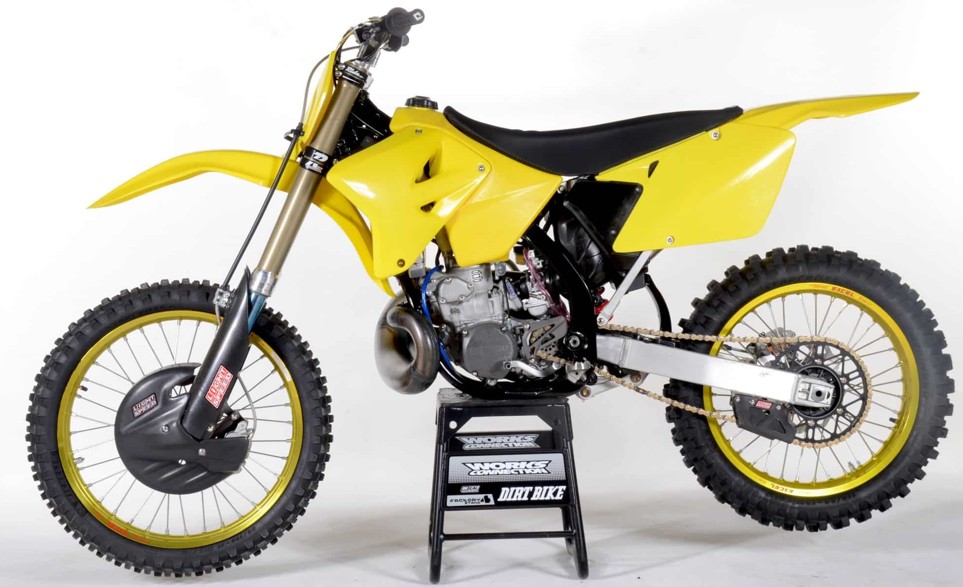
General Specifications
| Model | RM250 |
| Year | 2001 |
| Category | Motocross |
| Engine Type | Liquid-cooled, 2-stroke, single-cylinder, reed-valve |
| Weight | 96 kg dry |
Engine
| Displacement | 249 cc |
| Bore x Stroke | 66.4 x 72.0 mm |
| Compression Ratio | 8.5:1 |
| Fuel System | Keihin PWK38 carburettor | Replacement Options |
| Ignition | Electronic CDI |
| Spark Plug | NGK BR8EG |
| Spark Plug Gap | 0.5-0.6 mm |
| Cooling System | Liquid-cooled |
| Starting System | Kick starter |
Transmission
| Transmission | 5-speed constant-mesh |
| Clutch | Wet multi-plate |
| Final Drive | Chain |
Dimensions
| Overall Length | 2175 mm |
| Overall Width | 835 mm |
| Overall Height | 1275 mm |
| Wheelbase | 1470 mm |
| Ground Clearance | 350 mm |
| Seat Height | 955 mm |
| Fuel Capacity | 8.0 L |
Chassis
Suspension
| Front Suspension | Showa inverted telescopic cartridge fork | Fork Oil Levels |
| Front Suspension Travel | 310 mm |
| Rear Suspension | Showa link-type single shock |
| Rear Suspension Travel | 320 mm |
| Fork Oil | Showa SS-05 or equivalent suspension fluid |
Brakes & Wheels
| Front Brake | Hydraulic single disc |
| Rear Brake | Hydraulic single disc |
| Front Wheel Size | 21 inch |
| Rear Wheel Size | 19 inch |
Service Data
| Fuel Type | Premium unleaded petrol |
| Premix Information | Premix two-stroke lubrication | Premix Calculator |
| Gearbox Oil | SAE 10W-40 motorcycle oil |
| Air Filter | Oiled polyurethane foam element |
| Service Notes | Competition motorcycle; inspect and service the air filter, transmission oil, drive chain, cooling system, power valve, suspension linkage and engine top end regularly |
2001 Suzuki RM250 – A Major Step Forward for Suzuki’s Two-Stroke Racer
The 2001 Suzuki RM250 represented a significant development of Suzuki’s 250cc two-stroke motocross machine rather than simply another colour-and-graphics update. Suzuki entered the new season with substantial changes aimed at producing a lighter, sharper and more competitive RM250. At a time when the Japanese manufacturers were locked in an intense 250cc two-stroke battle, the RM250 was being developed around the traits that would become closely associated with Suzuki motocross bikes: quick steering, responsive handling and a strong race-focused engine.
At the heart of the bike was Suzuki’s 249cc liquid-cooled two-stroke single, using the familiar 66.4 mm bore and 72.0 mm stroke dimensions. A large Keihin carburettor supplied the mixture while Suzuki’s exhaust power-valve system helped broaden the usable power range. For owners working on an older RM today, carburettor condition and jetting are particularly important because worn slides, needles, jets and previous owner modifications can dramatically change the way a two-stroke runs. MXOwners has additional carburettor information and replacement options for owners investigating the original induction system or suitable alternatives.
The RM250’s chassis was designed firmly around motocross competition. Suzuki continued to pursue agile steering and a responsive front end, backed by long-travel Showa suspension. The inverted cartridge fork provided approximately 310 mm of travel, while the linkage-equipped Showa rear shock provided approximately 320 mm. On a motorcycle now more than two decades old, suspension condition can make a much larger difference than the original settings. Fork bushings, seals, shock servicing and linkage bearings should therefore be checked before attempting to tune clicker settings. Owners servicing the front end can also consult the MXOwners fork oil level reference.
Like most full-size motocross machines of the period, the RM250 used a 21-inch front wheel and 19-inch rear wheel. The standard motocross tyre sizes were 80/100-21 at the front and 110/90-19 at the rear. Modern tyre availability has changed considerably since 2001, so the MXOwners motorcycle tyre size guide can help when comparing replacement sizes.
Routine maintenance remains critical to keeping a 2001 RM250 reliable. The air filter should be cleaned and correctly oiled frequently, gearbox oil changed regularly, and the cooling system, drive chain, wheel bearings, suspension linkage and brakes inspected as part of normal race-bike maintenance. Top-end condition and the exhaust power-valve mechanism also deserve close attention on any used example. Correct fuel and two-stroke oil preparation is equally important, and owners calculating fuel mixtures can use the MXOwners two-stroke premix calculator.
Today the 2001 RM250 sits at an interesting point in Suzuki motocross history. It belongs to an era when the 250cc two-stroke was still the premier production motocross weapon for many riders, before four-strokes transformed the class. Its combination of a powerful, simple two-stroke engine, lightweight competition chassis and famously agile Suzuki handling makes it both a capable vintage-era racer and a worthwhile machine to preserve.