
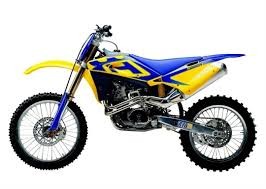
| Model | Husqvarna TC570 |
| Year | 2001 |
| Category | Motocross |
| Engine Type | Single-cylinder, liquid-cooled, 4-stroke, SOHC, 4-valve |
| Weight | 115 kg dry |
| Displacement | 576.28 cc |
| Bore x Stroke | 98.0 x 76.4 mm |
| Compression Ratio | 10.0:1 |
| Fuel System | Mikuni TMR 41 mm flat-slide carburettor | Replacement Options |
| Ignition | Electronic capacitor-discharge ignition with variable digitally controlled advance |
| Spark Plug | NGK CR7EB; NGK C8E for competition use |
| Spark Plug Gap | 0.6-0.7 mm |
| Cooling System | Liquid cooled |
| Starting System | Kick starter |
| Transmission | 4-speed constant-mesh manual |
| Clutch | Wet multi-plate, cable operated |
| Final Drive | Chain; 14-tooth transmission sprocket |
| Overall Length | 2190 mm |
| Overall Width | 820 mm |
| Overall Height | 1270 mm |
| Wheelbase | 1495 mm |
| Ground Clearance | 345 mm |
| Seat Height | 985 mm |
| Fuel Capacity | 9.0 L |
| Frame | Steel single-backbone off-road frame |
| Front Tyre | 80/100-21 | Tyre Size Guide |
| Rear Tyre | 110/90-19 | Tyre Size Guide |
| Front Suspension | 45 mm Marzocchi upside-down hydraulic fork, adjustable for compression and rebound | Fork Oil Levels |
| Front Suspension Travel | 300 mm |
| Rear Suspension | Sachs hydraulic monoshock with progressive linkage, adjustable for compression, rebound and spring preload |
| Rear Suspension Travel | 296 mm |
| Fork Oil | Fork oil to Marzocchi specification; factory oil level 80 mm with fork compressed and spring removed |
| Front Brake | Hydraulic single disc |
| Rear Brake | Hydraulic single disc |
| Front Wheel Size | 21 in |
| Rear Wheel Size | 19 in |
| Fuel Type | Premium unleaded petrol |
| Premix Information | Not applicable - 4-stroke engine |
| Gearbox Oil | Engine, gearbox and primary drive share AGIP Racing 4T 5W-40 oil; 1.6 L crankcase capacity, 1.25 L specified for competition use |
| Air Filter | Oiled foam air filter |
| Service Notes | Competition motocross model. Cold valve clearance is 0.10 mm inlet and 0.15 mm exhaust. Check engine oil frequently, clean and oil the air filter after dusty use, inspect valve clearances, cam-chain condition, wheel and linkage bearings, chain adjustment and cooling system regularly. |
The 2001 Husqvarna TC570 was a significant redesign rather than a routine update. Although its 576.28cc engine still traced its ancestry back through Husqvarna's long-running 510 and 610 four-stroke family, the 2001 motocross bike received enough changes to transform its character. Husqvarna reduced rotating mass, revised the engine tuning, changed the chassis geometry and introduced completely new bodywork. Contemporary testers regarded it as the biggest improvement to Husqvarna's large four-stroke motocrosser in many years.
Despite the new 570 name, displacement remained 576.28cc, produced by a 98.0 mm bore and 76.4 mm stroke. The engine used a chain-driven single overhead camshaft operating four valves and a 10.0:1 compression ratio. For 2001 Husqvarna fitted a significantly lighter crankshaft, which reduced the heavy gyroscopic feel associated with the older TC610 and allowed the engine to respond faster to throttle input. Revised cam timing and ignition mapping also sharpened response while retaining the immense low-rpm torque for which the big Husky was known.
Fuel was supplied by a 41 mm Mikuni TMR flat-slide carburettor, a serious competition component for the period. Correct jetting, accelerator-pump operation and slide condition are important on surviving bikes, particularly because many TC570s have been modified during their racing lives. Owners working on incomplete or worn induction systems can compare replacement carburettor options when assessing alternatives.
One of the TC570's most unusual features was its four-speed motocross gearbox. That sounds limited compared with modern machines, but the engine produced such a broad spread of torque that riders could often circulate much of a motocross track in only one or two gears. The motocross transmission distinguished the TC from the wider-ratio TE enduro models and reinforced the bike's purpose as an open-class competition machine rather than a trail bike.
The chassis was also substantially revised. Husqvarna altered the steering geometry and fitted a shorter, lighter swingarm, while completely new fuel tank, seat, airbox and number-panel bodywork replaced the dated ergonomics of the previous generation. The result allowed riders to move around the motorcycle far more easily. A 45 mm Marzocchi inverted fork provided approximately 300 mm of travel, with a Sachs linkage shock controlling the rear. Owners servicing the original front suspension can use the MXOwners fork oil reference when checking oil setup and servicing information.
The engine and gearbox share the same lubricant, with Husqvarna specifying AGIP Racing 4T 5W-40. The factory specification lists a 1.6-litre crankcase quantity for normal use and 1.25 litres for competition conditions. Valve clearances are also important on this large SOHC engine, with the factory cold settings of 0.10 mm inlet and 0.15 mm exhaust. Regular oil changes, valve checks and meticulous air-filter maintenance are particularly important on a machine designed to spend much of its life under racing loads.
Historically, the TC570 is important because it represented Husqvarna refusing to abandon an engine architecture whose origins stretched back to the company's pioneering four-stroke motocross machines of the 1980s. Rather than replacing it completely, the Italian Husqvarna engineers modernised the existing concept just as four-strokes were beginning to dominate motocross. The result was immensely powerful, distinctive and still unmistakably Husqvarna. For owners today, identifying correct chassis and engine components is especially important, and the MXOwners Parts Finder can assist when rebuilding these increasingly uncommon machines.
The 2001 TC570 was never the easiest motocross bike to ride. It was large, powerful and demanded commitment, but compared with the TC610 it replaced it was dramatically more modern and manageable. Its combination of huge four-stroke torque, a four-speed gearbox, Italian chassis hardware and distinctive engineering makes it one of the more interesting big-bore motocross motorcycles from the period when the four-stroke revolution was gathering serious momentum.