
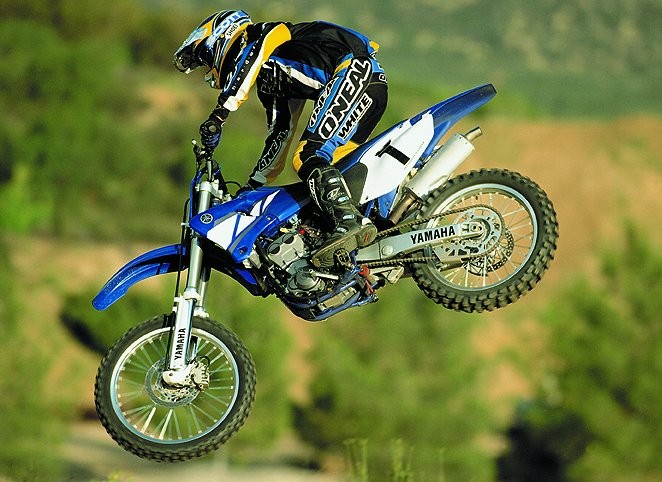
| Model | Yamaha YZ250F |
| Year | 2001 |
| Category | Motocross |
| Engine Type | Liquid-cooled, 4-stroke, DOHC, 5-valve single-cylinder |
| Weight | 96.5 kg dry; 104.5 kg with oil and full fuel tank |
| Displacement | 249 cc |
| Bore x Stroke | 77.0 x 53.6 mm |
| Compression Ratio | 12.5:1 |
| Fuel System | Keihin FCR-MX37 flat-slide carburettor | Replacement Options |
| Ignition | CDI magneto |
| Spark Plug | NGK CR8E / Denso U24ESR-N |
| Spark Plug Gap | 0.7-0.8 mm (0.028-0.031 in) |
| Cooling System | Liquid cooled |
| Starting System | Kick starter with manual decompression system |
| Transmission | 5-speed constant-mesh |
| Clutch | Wet multi-plate coil-spring clutch |
| Final Drive | Chain, 13/48 final sprockets (3.692:1) |
| Overall Length | 2,165 mm |
| Overall Width | 827 mm |
| Overall Height | 1,303 mm |
| Wheelbase | 1,475 mm |
| Ground Clearance | 382 mm |
| Seat Height | 998 mm |
| Fuel Capacity | 8.0 L |
| Frame | Steel semi-double-cradle |
| Front Tyre | 80/100-21 51M, tube type | Tyre Size Guide |
| Rear Tyre | 100/90-19 57M, tube type | Tyre Size Guide |
| Front Suspension | 46 mm telescopic coil-spring/oil-damped fork | Fork Oil Levels |
| Front Suspension Travel | 300 mm (11.8 in) |
| Rear Suspension | Link-type Monocross swingarm, coil spring/gas-oil shock |
| Rear Suspension Travel | 315 mm (12.4 in) wheel travel |
| Fork Oil | Yamaha Suspension Oil 01; 568 cc per fork; standard oil level 140 mm from top with fork compressed, spring removed |
| Front Brake | Hydraulic single disc |
| Rear Brake | Hydraulic single disc |
| Front Wheel Size | 21 in |
| Rear Wheel Size | 19 in |
| Fuel Type | Unleaded petrol; premium unleaded 95 RON or higher specified outside Australia |
| Premix Information | Not applicable - 4-stroke engine |
| Gearbox Oil | Engine and transmission share the same oil supply; 1.5 L periodic change, 1.6 L with oil filter replacement, 1.7 L total capacity. API SH or higher non-friction-modified 4-stroke motorcycle oil; viscosity according to ambient temperature. |
| Air Filter | Wet-type foam element |
| Service Notes | Dry-sump lubrication. Check engine oil frequently, keep the foam air filter clean and correctly oiled, maintain valve clearances, and follow the correct manual-decompression starting procedure. Standard tyre pressure is 100 kPa (15 psi) front and rear. |
The 2001 Yamaha YZ250F was not simply another new motocross model. It was the first production year of a motorcycle that helped reshape modern motocross. Yamaha had already demonstrated with the YZ400F and YZ426F that a lightweight four-stroke could compete seriously against established two-strokes, but the YZ250F took the idea into the smaller-capacity class where the 125cc two-stroke had long been king.
At the centre of the new machine was an extremely compact 249 cc liquid-cooled DOHC single-cylinder engine using Yamaha's five-valve cylinder-head design. Three intake valves and two exhaust valves were operated through a high-revving valve train, while the engine used a 77.0 mm bore and short 53.6 mm stroke with a substantial 12.5:1 compression ratio. Yamaha quoted 30.5 kW, or 41.5 PS, at 10,500 rpm for the Japanese-market specification, remarkable output for a production 250 four-stroke at the beginning of the century.
Fuel was supplied by a 37 mm Keihin FCR-MX flat-slide carburettor, a component that became familiar to a generation of four-stroke motocross owners. Correct jetting, accelerator-pump operation and hot-start setup remain important on surviving bikes, and owners working through carburettor problems can compare options in the MXOwners carburettor reference.
The YZ250F was designed to compete directly with lightweight racing machinery rather than behave like a traditional trail-bike four-stroke. It weighed about 96.5 kg dry and used a steel semi-double-cradle frame, 21-inch front and 19-inch rear wheels, long-travel suspension and hydraulic disc brakes at both ends. The front fork provided 300 mm of travel while rear wheel travel was 315 mm. For owners rebuilding or servicing the original suspension, the MXOwners fork oil reference is useful when checking oil and setup information.
The engine used dry-sump lubrication and a five-speed constant-mesh gearbox. Unlike a two-stroke motocrosser, there is no separate premix system and no separate gearbox oil compartment: the engine and transmission share the four-stroke engine oil supply. Yamaha specified 1.5 litres for a normal oil change, 1.6 litres with filter replacement and 1.7 litres total capacity. Frequent oil and air-filter servicing was particularly important on a high-revving competition four-stroke like this.
Starting the first-generation YZ250F is also part of its character. The 2001 machine predates the automatic decompression system introduced on later models, so starting technique matters. The rider uses the manual decompression lever to position the piston correctly before delivering a full kick. When hot, the carburettor's hot-start system leans the mixture temporarily to help the engine restart. Owners accustomed to modern electric-start motocross bikes can find the procedure unusual, but once understood a correctly tuned YZ250F starts reliably.
The historical importance of the bike quickly became obvious in competition. Under the displacement rules of the period, the 250 cc four-stroke could race against 125 cc two-strokes in AMA competition. Ernesto Fonseca raced the YZ250F to the 2001 AMA 125cc West Supercross championship, immediately proving that Yamaha's new concept was not experimental machinery but a genuine championship-level production platform.
That success accelerated one of motocross's biggest technical shifts. During the years that followed, competing manufacturers developed their own 250 four-strokes and the once-dominant 125 two-stroke gradually lost its position at the top level of the class. Modern 250F motocross racing can trace much of its lineage directly back to this first YZ250F.
Today the 2001 model is particularly interesting because it captures the YZ250F at the very beginning: steel frame, carburettor, kick start, manual decompression and Yamaha's original five-valve engine architecture. Owners restoring one should pay close attention to model-year-specific components, bearings and chassis parts, and the MXOwners Parts Finder can help when identifying replacement components. For tyre replacements, the original sizes were 80/100-21 front and 100/90-19 rear, which can also be compared using the MXOwners Tyre Size Guide.
More than two decades later, the first YZ250F remains significant because it established the basic formula that still defines the 250 four-stroke motocross class: a lightweight chassis wrapped around a compact, high-revving four-stroke racing engine. The technology has changed enormously since 2001, but the concept proved itself almost immediately.