2002 KTM 125SX
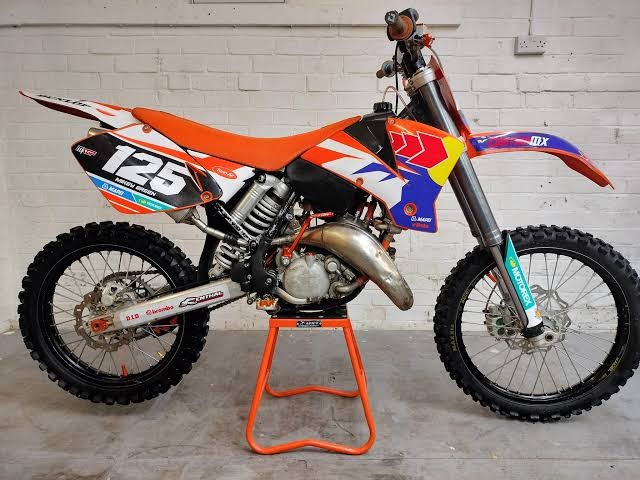
General Specifications
| Model | KTM 125 SX |
| Year | 2002 |
| Category | Motocross |
| Engine Type | Liquid-cooled single-cylinder two-stroke with intake and exhaust control |
| Weight | 92 kg dry, without fuel |
Engine
| Displacement | 124.8 cc |
| Bore x Stroke | 54.0 x 54.5 mm |
| Compression Ratio | |
| Fuel System | Keihin PWK 39 mm flat-slide carburettor | Replacement Options |
| Ignition | Kokusan 2K-1 CDI ignition |
| Spark Plug | NGK BR9EVX |
| Spark Plug Gap | 0.60 mm |
| Cooling System | Liquid cooling; 1.2 L coolant capacity |
| Starting System | Kick starter |
Transmission
| Transmission | 6-speed constant-mesh, claw-actuated manual |
| Clutch | Wet multi-disc clutch, hydraulically operated |
| Final Drive | Chain, 13:50 standard final-drive ratio |
Dimensions
| Overall Length | |
| Overall Width | |
| Overall Height | |
| Wheelbase | 1461 ± 10 mm |
| Ground Clearance | 385 mm unloaded |
| Seat Height | 925 mm unloaded |
| Fuel Capacity | 7.5 L |
Chassis
Suspension
| Front Suspension | WP 4860 MXMA 48 mm upside-down telescopic fork | Fork Oil Levels |
| Front Suspension Travel | 295 mm |
| Rear Suspension | WP PDS 5018 Progressive Damping System monoshock with aluminium swingarm |
| Rear Suspension Travel | 320 mm |
| Fork Oil | SAE 5; standard air chamber length 100 mm |
Brakes & Wheels
| Front Brake | 260 mm hydraulic disc, floating caliper |
| Rear Brake | 220 mm hydraulic disc, floating caliper |
| Front Wheel Size | 21 in |
| Rear Wheel Size | 19 in |
Service Data
| Fuel Type | 95 RON unleaded premium petrol mixed with high-quality two-stroke oil |
| Premix Information | 1:40 to 1:60 with high-quality two-stroke oil | Premix Calculator |
| Gearbox Oil | 0.7 L SAE 80W gear oil |
| Air Filter | Washable oiled foam element |
| Service Notes | Competition two-stroke requiring frequent air-filter servicing, gearbox-oil checks, spark-plug inspection and regular piston, ring and power-valve inspection according to operating hours and race use. |
2002 KTM 125 SX: Works Suspension Reaches the Production Bike
The 2002 KTM 125 SX was a significant development year, although its engine architecture remained closely related to the heavily revised 2001 model. The big story was suspension. KTM transferred technology developed on its factory race bikes into the production 125 SX, most visibly with a new 48 mm WP upside-down fork replacing the previous 43 mm unit. The rear WP PDS system was also revised, bringing production suspension closer to the equipment KTM had been developing through its international and American racing programme.
That mattered because suspension had been one of the main criticisms of earlier KTM motocross machines. The 125 SX already had one of the strongest engines in its class, but riders and testers often found the chassis harder to set up than the Japanese competition. Factory rider Grant Langston had raced with 48 mm WP forks during the 2001 season, and KTM's move to a similar production fork for 2002 was an important sign of how quickly racing development was feeding back into showroom motorcycles. The 2002 fork provided 295 mm of travel, while the WP PDS rear shock delivered 320 mm. Owners servicing the front end can compare settings and oil information using the MXOwners fork oil reference.
The 124.8 cc engine retained the 54.0 x 54.5 mm bore and stroke introduced the previous year. It remained a liquid-cooled, reed-inducted two-stroke with KTM's exhaust-control system and a large 39 mm Keihin PWK carburettor. Standard jetting used a 185 main jet as the baseline specification, although correct jetting naturally depends on temperature, altitude, fuel and engine condition. For machines whose original carburettor is badly worn or missing, the MXOwners carburettor replacement guide provides useful comparison information.
KTM continued with its hydraulic wet multi-plate clutch, something that still helped distinguish the Austrian machine from many rivals. The gearbox was a six-speed unit with a 13:50 final-drive ratio, and the complete bike weighed approximately 92 kg without fuel. A 7.5-litre fuel tank kept the machine narrow and compact, while the 925 mm seat height and 1461 mm wheelbase reflected its serious competition focus rather than trail-bike comfort.
The engine used premixed fuel rather than oil injection. KTM specified high-quality two-stroke oil at ratios between 1:40 and 1:60 depending on the oil and operating conditions. Accurate mixing is particularly important on a high-revving 125, and the MXOwners premix calculator is useful when preparing smaller or unusual fuel quantities. The transmission required 0.7 litres of SAE 80W gear oil, while the standard NGK BR9EVX spark plug used a 0.60 mm electrode gap.
The 2002 KTM 125 SX therefore sits in an interesting place in KTM history. The major engine and ergonomic rethink had already occurred for 2001, but 2002 addressed one of the remaining weaknesses by bringing larger, race-developed WP suspension hardware to the production bike. It was part of the period when KTM was changing from an unconventional European alternative into a genuine front-running motocross manufacturer. For owners today, the 2002 machine combines the light weight and hard-hitting character expected of an early-2000s 125 with several features that would become trademarks of KTM motocross bikes for years to come.