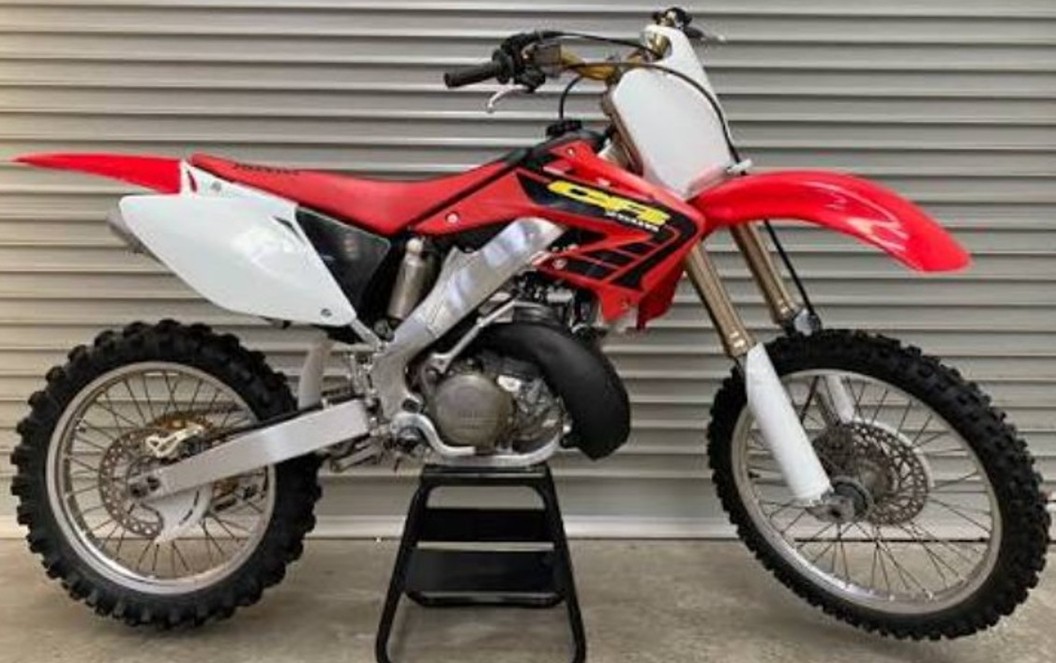
2002 Honda CR250R
General Specifications
| Model | CR250R |
| Year | 2002 |
| Category | Motocross |
| Engine Type | Liquid-cooled, 2-stroke, single-cylinder, reed-valve |
| Weight | 96.6 kg dry |
Engine
| Displacement | 249 cc |
| Bore x Stroke | 66.4 x 72.0 mm |
| Compression Ratio | 8.5:1 |
| Fuel System | 38 mm Mikuni TMX carburettor | Replacement Options |
| Ignition | CDI |
| Spark Plug | NGK BR8EG |
| Spark Plug Gap | 0.5-0.6 mm |
| Cooling System | Liquid-cooled |
| Starting System | Kick starter |
Transmission
| Transmission | 5-speed constant-mesh |
| Clutch | Wet multi-plate |
| Final Drive | Chain |
Dimensions
| Overall Length | 2189 mm |
| Overall Width | 827 mm |
| Overall Height | 1278 mm |
| Wheelbase | 1481 mm |
| Ground Clearance | 343 mm |
| Seat Height | 942 mm |
| Fuel Capacity | 7.5 L |
Chassis
Suspension
| Front Suspension | 47 mm inverted Showa cartridge fork | Fork Oil Levels |
| Front Suspension Travel | 305 mm |
| Rear Suspension | Pro-Link single shock |
| Rear Suspension Travel | 320 mm |
| Fork Oil | Honda SS-7 suspension fluid or equivalent |
Brakes & Wheels
| Front Brake | Hydraulic single disc |
| Rear Brake | Hydraulic single disc |
| Front Wheel Size | 21 inch |
| Rear Wheel Size | 19 inch |
Service Data
| Fuel Type | Premium unleaded petrol |
| Premix Information | Premix lubrication | Premix Calculator |
| Gearbox Oil | SAE 10W-40 motorcycle oil; approximately 0.65 L after draining |
| Air Filter | Oiled foam element |
| Service Notes | Competition motorcycle; regularly service the air filter, transmission oil, drive chain, suspension linkage and engine top end |
2002 Honda CR250R – A New Generation for Honda’s Two-Stroke Motocrosser
The 2002 Honda CR250R was a major redesign and one of the most significant model-year changes in the long history of Honda’s 250cc two-stroke motocrosser. Rather than simply refining the 2001 machine, Honda introduced a new-generation CR250R built around its third-generation aluminium frame and a substantially revised engine package. The result was a lighter-feeling, more compact motorcycle that marked the beginning of the final major chapter in CR250R development.
The new aluminium twin-spar chassis was central to the redesign. Honda had introduced aluminium construction to the CR250R in 1997, but those early frames became known for their considerable rigidity. Several years of development followed, and the 2002 chassis represented another major step in Honda's effort to combine aluminium's strength and low weight with better rider feedback and controlled flex. Revised geometry and packaging contributed to a motorcycle designed to feel narrower and easier to move around on than the preceding generation.
The 249cc liquid-cooled two-stroke engine retained the familiar 66.4 mm bore and 72.0 mm stroke, but 2002 brought major internal and induction changes. Honda redesigned the engine and introduced an electronically controlled exhaust power-valve system intended to improve power delivery across a broader operating range. Fuel mixture continued to be handled by a 38 mm Mikuni TMX carburettor. On machines now more than two decades old, carburettor wear, jetting changes and previous owner modifications can have a major effect on performance, making the MXOwners carburettor information and replacement options useful when returning the fuel system to a known setup.
Suspension remained competition-focused, with a 47 mm inverted Showa cartridge fork providing approximately 305 mm of travel and Honda's Pro-Link rear suspension providing approximately 320 mm. Correct suspension maintenance is particularly important on an older motocross machine. Fork seals and bushings, shock condition and linkage bearings can all deteriorate with age, even when the motorcycle has seen relatively little recent use. Owners rebuilding the front suspension can consult the MXOwners fork oil level reference while checking service information for their setup.
The CR250R retained the established motocross wheel combination of a 21-inch front and 19-inch rear, with 80/100-21 and 110/90-19 tyres. Those sizes remain widely used, although modern tyre designs offer considerably different compounds and carcass characteristics from the original equipment. The MXOwners motorcycle tyre size guide can help owners compare replacement sizes while retaining appropriate overall dimensions.
As with any competition two-stroke, maintenance has a large influence on reliability. The oiled foam air filter needs frequent attention, particularly in dusty riding conditions, while transmission oil, chain adjustment, cooling-system condition and top-end wear should be monitored regularly. Correct fuel and two-stroke oil preparation is equally important. Owners mixing fuel can use the MXOwners two-stroke premix calculator to calculate oil quantities for different fuel volumes and ratios.
Historically, the 2002 CR250R is especially interesting because it launched the generation that carried Honda's legendary 250cc two-stroke through its final production years. Its radically revised chassis and engine distinguished it clearly from the 2001 model and make the two years much more than cosmetic variations of the same motorcycle. For today's owner or restorer, the 2002 model represents a genuine turning point: a new-generation CR250R combining Honda's increasingly sophisticated aluminium chassis technology with the simplicity, sound and character of a full-size two-stroke motocross engine.