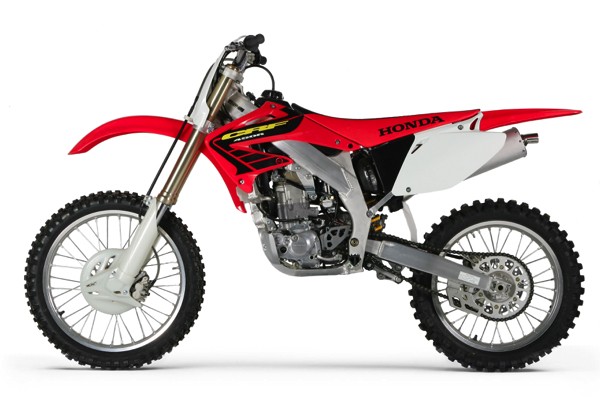
2002 Honda CRF450R
General Specifications
| Model | Honda CRF450R |
| Year | 2002 |
| Category | Motocross |
| Engine Type | Liquid-cooled, four-stroke, single-cylinder, SOHC, 4-valve |
| Weight | 102.0 kg dry (225 lb) |
Engine
| Displacement | 449.4 cc |
| Bore x Stroke | 96.0 x 62.1 mm |
| Compression Ratio | 11.5:1 |
| Fuel System | Keihin FCR 40 mm flat-slide carburettor | Replacement Options |
| Ignition | CDI (Capacitive Discharge Ignition) |
| Spark Plug | NGK IFR8H11 or Denso VK24PRZ11; NGK IFR9H11 / Denso VK27PRZ11 for extended high-speed riding |
| Spark Plug Gap | 1.0-1.1 mm (0.039-0.043 in) |
| Cooling System | Liquid cooled |
| Starting System | Kick start |
Transmission
| Transmission | 5-speed constant mesh |
| Clutch | Wet multi-plate, cable operated |
| Final Drive | Chain |
Dimensions
| Overall Length | 2,187 mm |
| Overall Width | 825 mm |
| Overall Height | 1,254 mm |
| Wheelbase | 1,488 mm |
| Ground Clearance | 331 mm |
| Seat Height | 945 mm |
| Fuel Capacity | 7.4 litres |
Chassis
Suspension
| Front Suspension | 47 mm Showa inverted twin-chamber telescopic fork, adjustable compression and rebound damping | Fork Oil Levels |
| Front Suspension Travel | 305 mm (12.0 in) fork cushion stroke; 270 mm (10.63 in) axle travel |
| Rear Suspension | Showa Pro-Link single shock, adjustable spring preload, compression and rebound damping |
| Rear Suspension Travel | 314 mm (12.36 in) rear wheel travel |
| Fork Oil | Pro Honda HP Fork Oil 5W or equivalent; 425 cc per fork tube (2002 service specification) |
Brakes & Wheels
| Front Brake | Hydraulic single disc |
| Rear Brake | Hydraulic single disc |
| Front Wheel Size | 21 in |
| Rear Wheel Size | 19 in |
Service Data
| Fuel Type | Premium unleaded petrol |
| Premix Information | Not applicable - four-stroke engine |
| Gearbox Oil | Pro Honda HP Transmission Oil, or SAE 10W-40 JASO MA equivalent; 0.59 L after draining, 0.67 L after disassembly |
| Air Filter | Oiled polyurethane foam element |
| Service Notes | Separate engine and transmission oil systems. Engine oil capacity: 0.66 L after draining, 0.69 L with filter change, 0.85 L after disassembly. Competition motorcycle requiring frequent oil, air-filter, valve-clearance and chassis servicing. |
2002 Honda CRF450R - The Four-Stroke That Changed Honda Motocross
The 2002 Honda CRF450R was not a routine model update. It was the first CRF450R and the beginning of one of Honda's most important modern motocross families. Arriving as high-performance four-strokes were rapidly changing motocross, the new 449 cc Honda represented a major shift away from an era in which open-class racing had been dominated by two-strokes. For owners and collectors today, that makes the 2002 machine much more than simply an early CRF: it is the first chapter of a model line that would become central to Honda's motocross programme.
Honda built the CRF450R around a liquid-cooled 449.4 cc four-stroke single with a 96.0 mm bore and relatively short 62.1 mm stroke. A Keihin FCR 40 mm flat-slide carburettor supplied the fuel, and the engine used Honda's Unicam-style valve-train concept to keep the cylinder head compact and weight down. Riders restoring an original bike should remember that carburettor condition and setup matter enormously on these early machines; the MXOwners carburettor replacement and reference information can help when dealing with worn or troublesome fuel-system components.
The engine was matched to a five-speed gearbox and wet multi-plate clutch, with separate engine and transmission oil compartments. That separation is an important servicing detail on an early CRF450R. The transmission side takes approximately 0.59 litre after a normal drain, while the engine side takes approximately 0.66 litre after draining or 0.69 litre when the oil filter is also replaced. Regular oil and filter maintenance is particularly important on a competition four-stroke of this generation.
The chassis was just as significant as the engine. Honda used an aluminium twin-tube frame and kept dry weight to about 102 kg, giving the big four-stroke a much more serious motocross feel than the heavy four-strokes riders had known in earlier decades. The 2002 model used 47 mm Showa inverted twin-chamber forks and a Pro-Link Showa rear shock. The original 2002 fork specification is worth noting because later CRF450R specifications changed: Honda's service data lists 425 cc of 5W fork oil per fork tube for the 2002 model. Owners rebuilding the suspension can also use the MXOwners fork oil levels and suspension reference when checking setup information.
Wheel sizes followed established full-size motocross practice, with a 21-inch front and 19-inch rear. Original tyre sizing was 80/100-21 at the front and 110/90-19 at the rear. Modern tyre choices are extensive, but keeping the correct dimensions is a sensible starting point when restoring the handling and geometry Honda intended. The MXOwners motocross tyre size guide is useful when comparing replacement sizes.
For anyone buying a surviving 2002 CRF450R, condition and maintenance history are now more important than outright performance. These were competition motorcycles, and many examples accumulated hard hours. Valve-train condition, starting behaviour, cam-chain wear, oil consumption, gearbox operation, clutch condition, cooling-system health and previous engine work all deserve careful inspection. The aluminium frame should also be checked around the steering head, engine mounts and footpeg areas, while linkage, swingarm and wheel bearings should not be assumed healthy simply because the bike looks tidy. The MXOwners motorcycle bearing finder can help when planning a chassis rebuild.
Historically, the 2002 CRF450R matters because it marked Honda's commitment to the new generation of lightweight four-stroke motocross machinery. The CR250R two-stroke did not disappear immediately, but the direction of top-level motocross development was becoming obvious. The CRF450R would evolve rapidly over the following years with chassis, suspension and engine refinements, eventually becoming one of the defining 450-class motocross bikes. That makes the original 2002 model especially interesting today: it is recognisably the ancestor of the modern CRF450R, yet still carries the raw, mechanical character of the first generation that started the whole line.