2002 Kawasaki KX250
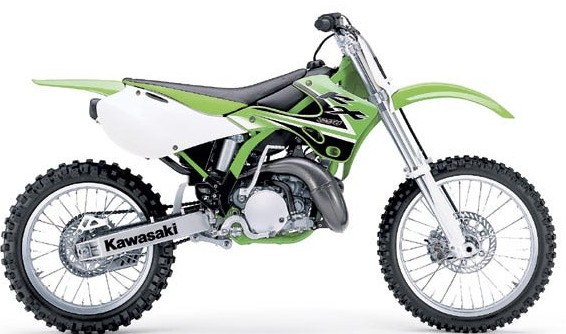
General Specifications
| Model | KX250 |
| Year | 2002 |
| Category | Motocross |
| Engine Type | Liquid-cooled, 2-stroke, single-cylinder, reed-valve |
| Weight | 97 kg dry |
Engine
| Displacement | 249 cc |
| Bore x Stroke | 66.4 x 72.0 mm |
| Compression Ratio | 10.4:1 low speed / 8.7:1 high speed |
| Fuel System | Keihin PWK38 carburettor | Replacement Options |
| Ignition | Digital CDI |
| Spark Plug | NGK BR8EG |
| Spark Plug Gap | 0.5-0.6 mm |
| Cooling System | Liquid-cooled |
| Starting System | Kick starter |
Transmission
| Transmission | 5-speed constant-mesh |
| Clutch | Wet multi-plate |
| Final Drive | Chain |
Dimensions
| Overall Length | 2185 mm |
| Overall Width | 815 mm |
| Overall Height | 1255 mm |
| Wheelbase | 1475 mm |
| Ground Clearance | 385 mm |
| Seat Height | 955 mm |
| Fuel Capacity | 8.2 L |
Chassis
Suspension
| Front Suspension | 46 mm Kayaba inverted telescopic cartridge fork | Fork Oil Levels |
| Front Suspension Travel | 305 mm |
| Rear Suspension | Uni-Trak linkage with Kayaba gas-charged single shock |
| Rear Suspension Travel | 330 mm |
| Fork Oil | Kayaba 01 fork oil or equivalent |
Brakes & Wheels
| Front Brake | Hydraulic single disc |
| Rear Brake | Hydraulic single disc |
| Front Wheel Size | 21 inch |
| Rear Wheel Size | 19 inch |
Service Data
| Fuel Type | Premium unleaded petrol |
| Premix Information | Premix two-stroke lubrication | Premix Calculator |
| Gearbox Oil | SAE 10W-40 motorcycle oil |
| Air Filter | Oiled foam element |
| Service Notes | Competition motorcycle; regularly inspect and service the air filter, transmission oil, drive chain, cooling system, KIPS power-valve system, suspension linkage and engine top end |
2002 Kawasaki KX250 – Kawasaki Refines Its Proven 250 Two-Stroke
The 2002 Kawasaki KX250 was primarily an evolutionary update rather than a completely new generation. Kawasaki retained the established 249cc two-stroke engine and steel perimeter-frame layout while continuing to refine a motocross package known for strong power and serious race-bike character.
The liquid-cooled engine retained its 66.4 mm bore and 72.0 mm stroke, with reed-valve induction, a Keihin PWK38 carburettor and Kawasaki's KIPS exhaust power-valve system. On a surviving KX250, carburettor wear, jetting and previous modifications can have a substantial effect on starting and throttle response. Owners investigating the induction system can consult the MXOwners carburettor information and replacement options.
The chassis combined Kawasaki's high-tensile steel perimeter frame with long-travel Kayaba suspension. The 46 mm inverted cartridge fork provided approximately 305 mm of travel, while the Uni-Trak rear suspension offered approximately 330 mm. Fork seals and bushings, rear shock condition and linkage bearings are important inspection points on a machine of this age. Owners servicing the front suspension can also consult the MXOwners fork oil level reference.
The KX250 continued with the established 21-inch front and 19-inch rear motocross wheel combination, carrying 80/100-21 and 110/90-19 tyres. Owners comparing modern replacements can use the MXOwners motorcycle tyre size guide. Although the 2002 KX250 was not a ground-up redesign, it remains representative of Kawasaki's mature 250cc two-stroke platform from the period immediately before four-strokes began transforming top-level motocross.