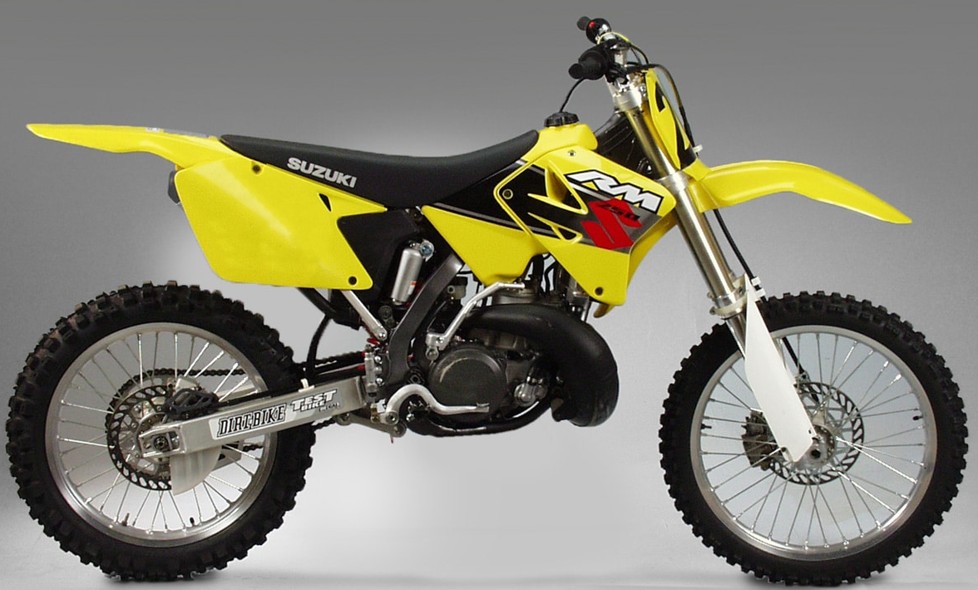
2002 Suzuki RM250
General Specifications
| Model | RM250 |
| Year | 2002 |
| Category | Motocross |
| Engine Type | Liquid-cooled, 2-stroke, single-cylinder, reed-valve |
| Weight | 96 kg dry |
Engine
| Displacement | 249 cc |
| Bore x Stroke | 66.4 x 72.0 mm |
| Compression Ratio | 8.5:1 |
| Fuel System | Keihin PWK38 carburettor | Replacement Options |
| Ignition | Electronic CDI |
| Spark Plug | NGK BR8EG |
| Spark Plug Gap | 0.5-0.6 mm |
| Cooling System | Liquid-cooled |
| Starting System | Kick starter |
Transmission
| Transmission | 5-speed constant-mesh |
| Clutch | Wet multi-plate |
| Final Drive | Chain |
Dimensions
| Overall Length | 2175 mm |
| Overall Width | 835 mm |
| Overall Height | 1275 mm |
| Wheelbase | 1470 mm |
| Ground Clearance | 350 mm |
| Seat Height | 955 mm |
| Fuel Capacity | 8.0 L |
Chassis
Suspension
| Front Suspension | Showa inverted telescopic cartridge fork | Fork Oil Levels |
| Front Suspension Travel | 310 mm |
| Rear Suspension | Showa link-type single shock |
| Rear Suspension Travel | 320 mm |
| Fork Oil | Showa SS-05 or equivalent suspension fluid |
Brakes & Wheels
| Front Brake | Hydraulic single disc |
| Rear Brake | Hydraulic single disc |
| Front Wheel Size | 21 inch |
| Rear Wheel Size | 19 inch |
Service Data
| Fuel Type | Premium unleaded petrol |
| Premix Information | Premix two-stroke lubrication | Premix Calculator |
| Gearbox Oil | SAE 10W-40 motorcycle oil |
| Air Filter | Oiled polyurethane foam element |
| Service Notes | Competition motorcycle; regularly service the air filter, transmission oil, drive chain, cooling system, exhaust power valve, suspension linkage and engine top end |
2002 Suzuki RM250 – Refining Suzuki’s Sharp-Handling Two-Stroke
The 2002 Suzuki RM250 was primarily an evolutionary development of the heavily revised 2001 machine rather than another complete redesign. Suzuki retained the basic 249cc two-stroke engine and steel chassis package while refining a motorcycle already known for responsive handling and an aggressive race-oriented character.
Its liquid-cooled engine used a 66.4 mm bore and 72.0 mm stroke, with a Keihin PWK38 carburettor feeding the reed-valve induction system. Suzuki’s exhaust power-valve system helped spread the engine’s power across a wider operating range. More than two decades later, carburettor wear and previous jetting changes can have a major effect on performance, so owners diagnosing an older machine may find the MXOwners carburettor information and replacement options useful.
Long-travel Showa suspension remained central to the RM250’s competition chassis. The inverted cartridge fork provided approximately 310 mm of travel, while the linkage-type rear suspension offered approximately 320 mm. Age-related wear in fork bushings, seals, shock components and linkage bearings should be addressed before attempting suspension tuning. The MXOwners fork oil level reference provides additional information for owners servicing motocross forks.
The familiar 21-inch front and 19-inch rear wheel combination carried 80/100-21 and 110/90-19 motocross tyres. Owners choosing modern replacements can consult the MXOwners motorcycle tyre size guide. Although the 2002 RM250 was not a new generation, it continued the development of Suzuki’s lightweight, quick-steering 250 two-stroke at a time when the class remained one of the most competitive categories in motocross.