
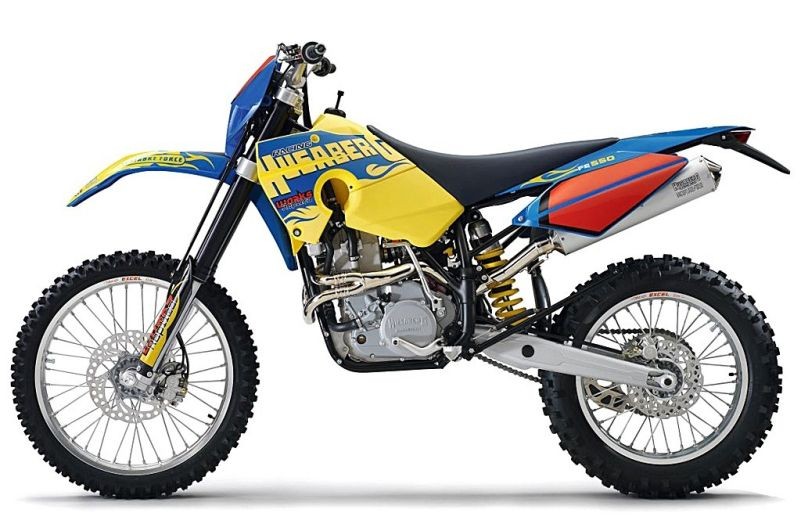
| Model | Husqvarna TC570 |
| Year | 2002 |
| Category | Motocross |
| Engine Type | Single-cylinder, liquid-cooled, 4-stroke, SOHC, 4-valve |
| Weight | 115 kg dry |
| Displacement | 576.28 cc |
| Bore x Stroke | 98.0 x 76.4 mm |
| Compression Ratio | 10.0:1 |
| Fuel System | Mikuni TMR 41 mm flat-slide carburettor | Replacement Options |
| Ignition | Electronic capacitor-discharge ignition with digitally controlled advance |
| Spark Plug | NGK CR7EB or Champion G59C |
| Spark Plug Gap | 0.6-0.7 mm |
| Cooling System | Liquid cooled with twin radiators |
| Starting System | Kick starter |
| Transmission | 4-speed constant-mesh manual |
| Clutch | Wet multi-plate clutch |
| Final Drive | Chain; 14-tooth front / 52-tooth rear sprockets |
| Overall Length | 2190 mm |
| Overall Width | 820 mm |
| Overall Height | 1270 mm |
| Wheelbase | 1495 mm |
| Ground Clearance | 345 mm |
| Seat Height | 985 mm |
| Fuel Capacity | 9.0 L |
| Frame | Single-beam steel frame with circular-section tubing and removable light-alloy rear subframe |
| Front Tyre | 80/100-21 Pirelli 51R-MT32A | Tyre Size Guide |
| Rear Tyre | 110/90-19 Pirelli MT32 | Tyre Size Guide |
| Front Suspension | 45 mm Marzocchi upside-down hydraulic fork with advanced axle, adjustable compression and rebound damping | Fork Oil Levels |
| Front Suspension Travel | 300 mm |
| Rear Suspension | Progressive-linkage Sachs hydraulic monoshock |
| Rear Suspension Travel | 320 mm |
| Fork Oil | Fork oil to Marzocchi specification; factory oil level 80 mm with fork compressed and spring removed |
| Front Brake | 260 mm fixed hydraulic disc with floating caliper |
| Rear Brake | 220 mm floating hydraulic disc with floating caliper |
| Front Wheel Size | 1.60 x 21 in Takasago Excel light-alloy rim |
| Rear Wheel Size | 2.15 x 19 in Takasago Excel light-alloy rim |
| Fuel Type | Premium unleaded petrol |
| Premix Information | Not applicable - 4-stroke engine |
| Gearbox Oil | Engine, gearbox and primary drive share AGIP Racing 4T 5W-40 oil; 1.6 L specified capacity, with 1.25 L specified for competition use |
| Air Filter | Oiled foam air filter |
| Service Notes | Cold valve clearance: 0.10 mm inlet and 0.15 mm exhaust. Competition motocross model; check engine oil frequently, clean and oil the air filter after dusty riding and regularly inspect valve clearances, cam chain, cooling system, drive chain, wheel bearings and suspension linkage. |
The 2002 Husqvarna TC570 was a significant update rather than a simple continuation of the 2001 motorcycle. The previous year's TC570 had already transformed Husqvarna's old 610-based big-bore four-stroke with a lighter crankshaft, sharper engine response and improved ergonomics. For 2002 Husqvarna turned its attention to the chassis, introducing a more compact frame layout influenced by the company's two-stroke competition machines and making substantial changes to suspension, wheels and component packaging.
At the heart of the TC570 remained Husqvarna's remarkable 576.28cc four-stroke single. Despite the 570 name, the engine retained its 98.0 x 76.4 mm bore and stroke and 10.0:1 compression ratio. A chain-driven single overhead cam operated four valves, while a 41 mm Mikuni TMR flat-slide carburettor supplied the mixture. The big engine was famous for producing enormous usable torque, allowing Husqvarna to retain an unusual four-speed motocross gearbox. Owners rebuilding a worn fuel system can compare replacement carburettor options when original TMR components are difficult to source.
The major story for 2002 was underneath the motorcycle. Husqvarna introduced a revised steel frame using a more compact layout inspired by its two-stroke chassis. The rear subframe was now a removable light-alloy assembly, while the swingarm was also aluminium. The goal was to improve the stiffness-to-weight relationship and make the large four-stroke feel less cumbersome. Although a 115 kg dry motocross bike was still substantial by modern standards, the changes represented another important step away from the heavy, old-school character of earlier Husqvarna big-bore four-strokes.
Suspension also received serious attention. The 45 mm Marzocchi upside-down fork gained revised internal cartridges made extensively from aluminium to reduce weight and improve sensitivity. Compression and rebound damping remained adjustable, with 300 mm of front-wheel travel. At the rear, Husqvarna revised the progression of the linkage and matched it with new Sachs shock settings, providing 320 mm of wheel travel. Owners maintaining the original Marzocchi equipment can use the MXOwners fork oil reference when checking service information; the factory procedure specifies an 80 mm oil level with the fork compressed and spring removed.
Husqvarna also strengthened and refined the rolling chassis. The TC570 used Takasago Excel aluminium rims with variable-section spokes, while the wheel axles were increased to 25 mm diameter to improve rigidity. Aluminium spacers helped keep unsprung weight under control. Standard motocross tyre sizes were 80/100-21 at the front and 110/90-19 at the rear, sizes that can be cross-checked against current options using the MXOwners tyre size guide.
The big Husky remained mechanically demanding compared with a casual trail bike. Engine, gearbox and primary drive shared the same lubricant, with AGIP Racing 4T 5W-40 specified by the factory. Cold valve clearances were 0.10 mm inlet and 0.15 mm exhaust. Regular oil changes, valve-clearance checks and meticulous foam-filter maintenance were essential on an engine intended for competition. The large piston, substantial valve train and huge torque output meant neglected servicing could quickly become expensive.
Historically, the 2002 TC570 is an interesting machine because it combined one of motocross's longest-lived four-stroke engine designs with a much more modern chassis. Yamaha's YZ400F and YZ426F had already changed expectations for four-stroke motocross bikes, and manufacturers were rapidly adapting. Husqvarna's answer was not to throw away its proven big single, but to continue refining it while modernising everything around it.
The result was a motorcycle with enormous character: a 576cc four-stroke, kick-start only, breathing through a 41 mm flat-slide carburettor and driving through just four gears. It was still a serious physical motorcycle, but the redesigned chassis and suspension made the 2002 TC570 one of the most developed versions of Husqvarna's traditional big-bore motocross concept. Today it represents an important point between the brutally powerful European four-strokes of the 1990s and the lighter, more sophisticated four-stroke motocross machines that would soon become the industry standard.