2003 KTM 250SX
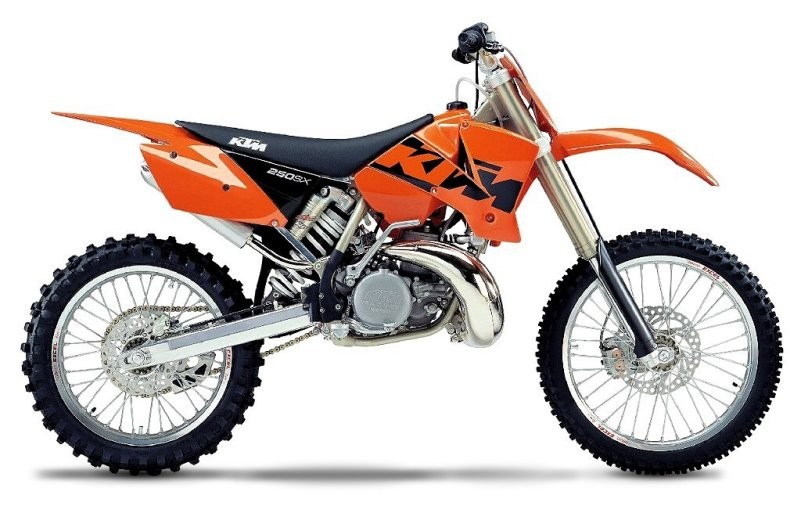
General Specifications
| Model | KTM 250 SX |
| Year | 2003 |
| Category | Motocross |
| Engine Type | Single-cylinder, 2-stroke |
| Weight | Approximately 101 kg dry |
Engine
| Displacement | 249 cc |
| Bore x Stroke | 66.4 x 72 mm |
| Compression Ratio | |
| Fuel System | Keihin PWK 38 carburettor | Replacement Options |
| Ignition | Kokusan electronic CDI |
| Spark Plug | NGK BR8ECM |
| Spark Plug Gap | 0.6 mm |
| Cooling System | Liquid cooled |
| Starting System | Kick starter |
Transmission
| Transmission | 5-speed manual |
| Clutch | Wet multi-disc clutch, Magura hydraulic operation |
| Final Drive | Chain |
Dimensions
| Overall Length | |
| Overall Width | |
| Overall Height | |
| Wheelbase | Approximately 1481 mm |
| Ground Clearance | |
| Seat Height | Approximately 925 mm |
| Fuel Capacity | Approximately 7.5 litres |
Chassis
Suspension
| Front Suspension | WP 48 mm upside-down telescopic fork | Fork Oil Levels |
| Front Suspension Travel | 300 mm |
| Rear Suspension | WP PDS monoshock, linkage-less |
| Rear Suspension Travel | 335 mm |
| Fork Oil | SAE 5 fork oil; air chamber/oil level set according to WP 48 mm fork specification |
Brakes & Wheels
| Front Brake | Brembo hydraulic single disc, 260 mm |
| Rear Brake | Brembo hydraulic single disc, 220 mm |
| Front Wheel Size | 21 inch |
| Rear Wheel Size | 19 inch |
Service Data
| Fuel Type | Premium unleaded petrol with 2-stroke oil premix |
| Premix Information | 1:40 (2.5%) using high-quality synthetic 2-stroke motorcycle oil | Premix Calculator |
| Gearbox Oil | 0.7 litre SAE 15W-50 motorcycle engine oil |
| Air Filter | Washable oiled foam element |
| Service Notes | Competition motorcycle requiring frequent maintenance. Clean and re-oil the air filter after dusty riding, replace transmission oil regularly, inspect piston and rings at racing service intervals, and periodically clean and inspect the exhaust power-valve mechanism. |
2003 KTM 250 SX – A Major Step Forward for KTM's Two-Stroke
The 2003 KTM 250 SX represented a more significant development than the relatively evolutionary 2001 and 2002 machines. KTM was rapidly strengthening its motocross programme in the early 2000s, and the 2003 SX range received important chassis and suspension changes intended to make the Austrian bikes more competitive with Honda, Yamaha, Kawasaki and Suzuki. The 250 SX retained the familiar basic engine architecture, but the motorcycle surrounding it moved another substantial step toward the modern KTM motocross formula.
The heart of the 250 SX remained KTM's 249 cc liquid-cooled two-stroke single, using the long-established 66.4 x 72 mm bore and stroke. A 38 mm Keihin PWK carburettor supplied the mixture and KTM's exhaust power-valve system helped broaden the delivery of an engine capable of producing the aggressive midrange and top-end performance expected from a competition 250. Owners working on surviving examples should pay particular attention to jetting, float level, reed condition and wear in the original carburettor. The MXOwners carburettor information and replacement options provides a useful starting point when an ageing PWK needs rebuilding or replacing.
One of the most noticeable changes for 2003 was at the front of the motorcycle. KTM moved the SX range to larger 48 mm WP upside-down forks, replacing the 43 mm units used previously. The larger forks increased rigidity and formed the basis of a WP front suspension design that would become familiar on KTMs for many years. Front wheel travel was around 300 mm, while the rear WP PDS system offered approximately 335 mm of wheel travel. Owners servicing these forks today can use the MXOwners fork oil level reference as an additional maintenance resource.
KTM continued with its distinctive PDS rear suspension rather than adopting the conventional linkage systems used by the Japanese manufacturers. The shock mounted directly between the swingarm and chassis, eliminating the linkage and its collection of bearings below the swingarm. The concept reduced parts and ground-level maintenance but placed considerable importance on shock setup, spring rate and sag. Correct adjustment of the rear suspension and race sag is therefore particularly worthwhile on an older 250 SX.
The chrome-molybdenum steel chassis, lightweight bodywork and quality European components gave the KTM a character of its own. Brembo hydraulic disc brakes provided the stopping power, while the Magura hydraulic clutch was still an unusual premium feature in a motocross market where cable-operated clutches remained common. The 21-inch front and 19-inch rear wheel combination followed established full-size motocross practice, and the bike remained impressively light at roughly 101 kg dry.
For modern owners, the condition of a 2003 250 SX matters far more than chasing additional performance. A properly rebuilt top end, clean power-valve mechanism, correctly jetted carburettor and fresh transmission oil can transform a tired example. Suspension condition is equally important: fork bushings and seals, steering bearings, wheel bearings and the PDS shock may all be overdue for attention after more than two decades.
The 2003 KTM 250 SX is historically interesting because it sits at a point where KTM's motocross machines were becoming increasingly sophisticated while retaining the raw simplicity of a carburetted 250 two-stroke. The larger WP forks, PDS suspension, Brembo brakes and hydraulic clutch gave it equipment that stood apart from much of its Japanese competition. Restored and correctly set up today, it remains a light, powerful and unmistakably Austrian motocross bike from an important period in KTM's rise.