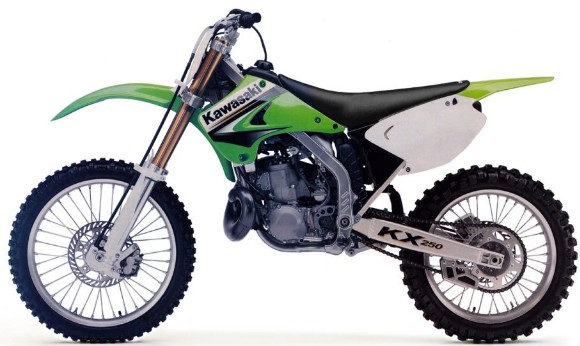
2003 Kawasaki KX250
General Specifications
| Model | KX250 |
| Year | 2003 |
| Category | Motocross |
| Engine Type | Liquid-cooled, 2-stroke, single-cylinder, reed-valve |
| Weight | 97 kg dry |
Engine
| Displacement | 249 cc |
| Bore x Stroke | 66.4 x 72.0 mm |
| Compression Ratio | 10.5:1 low speed / 8.9:1 high speed |
| Fuel System | Keihin PWK38 carburettor | Replacement Options |
| Ignition | Digital CDI |
| Spark Plug | NGK BR8EG |
| Spark Plug Gap | 0.5-0.6 mm |
| Cooling System | Liquid-cooled |
| Starting System | Kick starter |
Transmission
| Transmission | 5-speed constant-mesh |
| Clutch | Wet multi-plate |
| Final Drive | Chain |
Dimensions
| Overall Length | 2185 mm |
| Overall Width | 815 mm |
| Overall Height | 1255 mm |
| Wheelbase | 1475 mm |
| Ground Clearance | 385 mm |
| Seat Height | 955 mm |
| Fuel Capacity | 8.2 L |
Chassis
Suspension
| Front Suspension | 48 mm Kayaba inverted cartridge fork | Fork Oil Levels |
| Front Suspension Travel | 305 mm |
| Rear Suspension | Uni-Trak linkage with Kayaba gas-charged single shock |
| Rear Suspension Travel | 330 mm |
| Fork Oil | Kayaba 01 fork oil or equivalent |
Brakes & Wheels
| Front Brake | Hydraulic single disc |
| Rear Brake | Hydraulic single disc |
| Front Wheel Size | 21 inch |
| Rear Wheel Size | 19 inch |
Service Data
| Fuel Type | Premium unleaded petrol |
| Premix Information | Premix two-stroke lubrication | Premix Calculator |
| Gearbox Oil | SAE 10W-40 motorcycle oil |
| Air Filter | Oiled foam element |
| Service Notes | Competition motorcycle; regularly service the air filter, transmission oil, drive chain, cooling system, KIPS power-valve system, suspension linkage and engine top end |
2003 Kawasaki KX250 – A Major Step Forward for Kawasaki’s Two-Stroke
The 2003 Kawasaki KX250 was more than a routine colour-and-graphics update. Kawasaki substantially revised its 250cc two-stroke motocrosser for the new season, concentrating on making the bike lighter-feeling, more responsive and easier to control while retaining the strong engine character that had long defined the KX250. It arrived during a particularly important period in motocross history, when increasingly competitive four-strokes were forcing manufacturers to extract everything possible from their established two-stroke designs.
At the heart of the 2003 machine remained Kawasaki's 249cc liquid-cooled single-cylinder two-stroke. Its 66.4 mm bore and 72.0 mm stroke were familiar, but Kawasaki continued developing the intake, exhaust and KIPS power-valve systems to improve the usable spread of power. A 38 mm Keihin PWK carburettor supplied the reed-valve induction system. Today, the condition and setup of that carburettor are especially important because many surviving KX250s have been re-jetted, modified or fitted with aftermarket exhaust systems. Owners working through these issues can consult the MXOwners carburettor information and replacement options.
Chassis and suspension development was a major part of Kawasaki's effort to keep the KX250 competitive. The high-tensile steel perimeter-frame concept remained, but Kawasaki revised the package to improve handling and rider control. The front suspension moved to a large 48 mm Kayaba inverted cartridge fork with approximately 305 mm of travel, matched to the familiar Uni-Trak rear linkage and Kayaba shock providing approximately 330 mm of rear-wheel travel. These components offered extensive adjustment for competition use and were intended to cope with increasingly demanding modern motocross tracks.
For owners restoring or recommissioning a 2003 KX250, suspension condition is now just as important as the original settings. Worn fork bushings, hardened seals, contaminated fork oil and neglected linkage bearings can completely change how the motorcycle handles. Before experimenting with clicker settings, it is worth ensuring that the suspension is mechanically sound. The MXOwners fork oil level reference and rear suspension information provide useful starting points when working through these areas.
The KX250 retained the established full-size motocross wheel combination of a 21-inch front and 19-inch rear, with an 80/100-21 front tyre and 110/90-19 rear. Hydraulic disc brakes were fitted at both ends. The overall package remained deliberately simple and competition-focused: no electric starter, no battery-dependent engine management and no separate engine-oil lubrication system. Fuel and two-stroke oil were premixed before entering the tank, while the transmission and wet multi-plate clutch used their own gearbox lubricant.
The 2003 KX250 is significant because it shows how far the traditional Japanese 250 two-stroke had evolved by the early 2000s. Kawasaki was refining a mature design rather than abandoning it, producing a fast, relatively light and mechanically straightforward race motorcycle just as four-strokes were beginning to dominate development attention. For modern owners, that combination remains part of the attraction. A properly maintained 2003 KX250 still delivers the sharp throttle response, distinctive power delivery and direct mechanical character that made the 250cc two-stroke motocross class one of the defining categories of its era.