
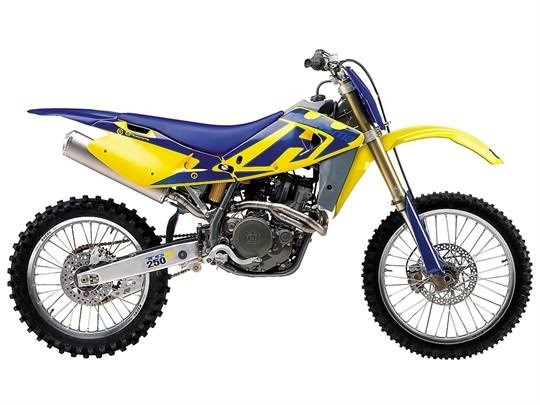
| Model | Husqvarna TC250 |
| Year | 2003 |
| Category | Motocross |
| Engine Type | Single-cylinder, liquid-cooled, 4-stroke, DOHC, 4-valve |
| Weight | 110.4 kg dry |
| Displacement | 249.5 cc |
| Bore x Stroke | 76.0 x 55.0 mm |
| Compression Ratio | 12.5:1 |
| Fuel System | Mikuni TMR 38 mm flat-slide carburettor | Replacement Options |
| Ignition | Digital electronic ignition |
| Spark Plug | NGK CR8EB |
| Spark Plug Gap | 0.7 mm |
| Cooling System | Liquid cooled |
| Starting System | Kick starter |
| Transmission | 5-speed constant-mesh manual |
| Clutch | Wet multi-plate clutch |
| Final Drive | Chain |
| Overall Length | 2200 mm |
| Overall Width | 820 mm |
| Overall Height | 1270 mm |
| Wheelbase | 1485 mm |
| Ground Clearance | 335 mm |
| Seat Height | 965 mm |
| Fuel Capacity | 7.7 L |
| Frame | High-strength steel single-beam frame with light-alloy rear subframe |
| Front Tyre | 80/100-21 | Tyre Size Guide |
| Rear Tyre | 110/90-19 | Tyre Size Guide |
| Front Suspension | 45 mm Marzocchi upside-down hydraulic fork, adjustable for compression and rebound damping | Fork Oil Levels |
| Front Suspension Travel | 300 mm |
| Rear Suspension | Progressive Soft Damp linkage with adjustable Sachs hydraulic monoshock |
| Rear Suspension Travel | 320 mm |
| Fork Oil | AGIP Fork 7.5 (SAE 7.5); SAE 5 for very cold conditions; 100 mm oil level |
| Front Brake | 260 mm hydraulic single disc with 2-piston caliper |
| Rear Brake | 220 mm hydraulic single disc with 1-piston caliper |
| Front Wheel Size | 21 in |
| Rear Wheel Size | 19 in |
| Fuel Type | Premium unleaded petrol |
| Premix Information | Not applicable - 4-stroke engine |
| Gearbox Oil | Engine, gearbox and primary drive share AGIP Racing 4T SAE 10W-60; approximately 1.5 L for an oil change |
| Air Filter | Oiled foam air filter |
| Service Notes | Competition motocross model. Maintain engine oil and filter at short competition intervals, clean and oil the air filter frequently and regularly inspect valve clearances, cam-chain tension, cooling system, clutch, drive chain, wheel bearings and suspension linkage. |
The 2003 Husqvarna TC250 was a major model for the Italian-built Husqvarna range. Although development and pre-production versions had appeared during 2002, the 2003 machine marked the arrival of Husqvarna's completely new generation of compact 250cc four-stroke competition engines in regular production. Rather than shrinking the architecture of the company's traditional big-bore singles, Husqvarna developed a dedicated small-capacity engine aimed directly at the emerging 250 four-stroke motocross category.
The new engine displaced 249.5cc from a 76.0 mm bore and short 55.0 mm stroke. It used dual overhead camshafts operating four valves and a high 12.5:1 compression ratio, giving it a very different personality from Husqvarna's older torque-heavy 570-class machines. The TC version used a lightweight five-speed gearbox and was designed specifically for motocross, while related TE models received wider-ratio six-speed transmissions for enduro use.
Fuel was supplied by a 38 mm Mikuni TMR flat-slide carburettor. Like other high-performance 250 four-strokes of the era, correct jetting, accelerator-pump operation and intake sealing were important for clean starting and throttle response. Owners dealing with an incomplete or worn original fuel system can compare replacement carburettor options when assessing modern alternatives.
The chassis followed Husqvarna's established European formula, using a high-strength steel frame with a removable light-alloy rear subframe. A 45 mm Marzocchi inverted fork provided 300 mm of front-wheel travel, while a Sachs hydraulic shock worked through Husqvarna's Progressive Soft Damp linkage to give approximately 320 mm at the rear. Both ends offered competition-level adjustment. Owners rebuilding the original front end can use the MXOwners fork oil reference when checking oil specifications and service setup.
Braking was handled by a 260 mm front disc with a two-piston caliper and a 220 mm rear disc. The bike used the conventional motocross combination of a 21-inch front and 19-inch rear wheel, originally fitted with 80/100-21 and 110/90-19 tyres. Owners choosing current replacements can cross-check these dimensions with the MXOwners tyre size guide.
The new engine also brought a more modern maintenance regime. Engine, gearbox and primary drive shared the same lubricant, with Husqvarna specifying AGIP Racing 4T SAE 10W-60. Regular oil and filter changes, valve-clearance inspection and meticulous foam-air-filter maintenance were essential because the small engine achieved its performance through high compression and high engine speed rather than the sheer capacity of Husqvarna's older four-strokes.
Historically, the 2003 TC250 arrived at exactly the right moment. Yamaha's success with modern four-stroke motocross machines had already changed the sport, and manufacturers were beginning to develop lighter four-strokes for the 125-class replacement category. Husqvarna's response was not a modified trail engine but a purpose-designed competition motor combined with the company's proven European chassis philosophy.
That makes the 2003 TC250 particularly significant to Husqvarna owners. It established an engine family that would continue to evolve through subsequent TC and TE models and marked a clear break from the large-displacement four-stroke architecture that had defined Husqvarna for many years. For restorers, early TC250-specific components are worth identifying carefully, and the MXOwners Parts Finder can help when tracking down parts for these first-generation machines. More than two decades later, the 2003 TC250 remains an important milestone in Husqvarna's transition into the modern four-stroke motocross era.