2003 Yamaha YZ250
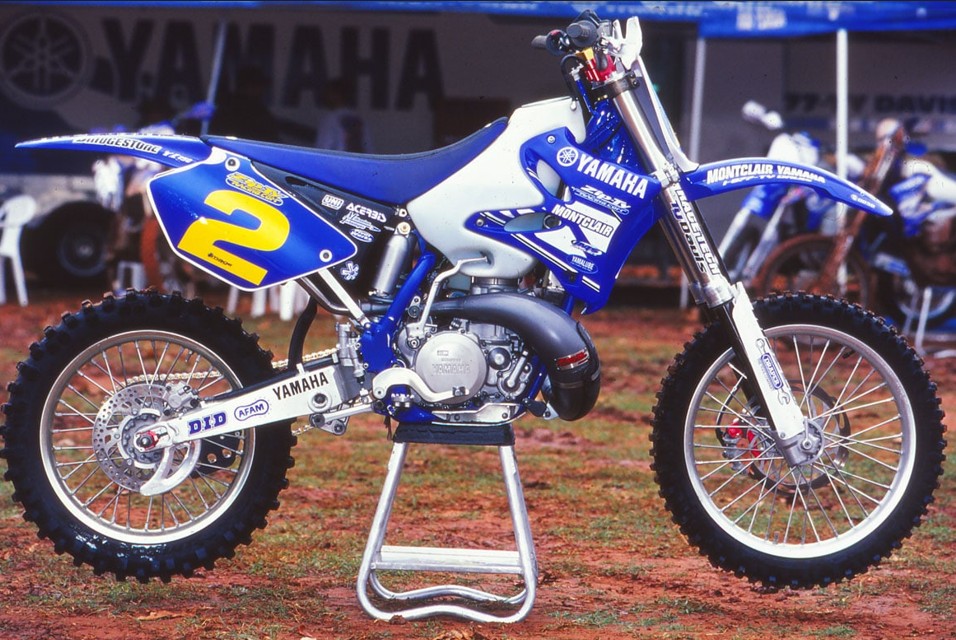
General Specifications
| Model | YZ250 |
| Year | 2003 |
| Category | Motocross |
| Engine Type | Liquid-cooled, 2-stroke, single-cylinder, reed-valve |
| Weight | 97.5 kg dry |
Engine
| Displacement | 249 cc |
| Bore x Stroke | 66.4 x 72.0 mm |
| Compression Ratio | 8.9-10.6:1 |
| Fuel System | Keihin PWK38S carburettor | Replacement Options |
| Ignition | CDI magneto |
| Spark Plug | NGK BR8EG |
| Spark Plug Gap | 0.5-0.6 mm |
| Cooling System | Liquid-cooled |
| Starting System | Kick starter |
Transmission
| Transmission | 5-speed constant-mesh |
| Clutch | Wet multi-plate |
| Final Drive | Chain |
Dimensions
| Overall Length | 2176 mm |
| Overall Width | 827 mm |
| Overall Height | 1292 mm |
| Wheelbase | 1481 mm |
| Ground Clearance | 391 mm |
| Seat Height | 988 mm |
| Fuel Capacity | 8.0 L |
Chassis
Suspension
| Front Suspension | 46 mm inverted telescopic cartridge fork | Fork Oil Levels |
| Front Suspension Travel | 300 mm |
| Rear Suspension | Linkage-type Monocross single shock |
| Rear Suspension Travel | 315 mm |
| Fork Oil | Yamaha Suspension Oil 01; standard oil level 135 mm |
Brakes & Wheels
| Front Brake | Hydraulic single disc |
| Rear Brake | Hydraulic single disc |
| Front Wheel Size | 21 inch |
| Rear Wheel Size | 19 inch |
Service Data
| Fuel Type | Premium unleaded petrol |
| Premix Information | Premix lubrication | Premix Calculator |
| Gearbox Oil | SAE 10W-30 motorcycle engine oil |
| Air Filter | Oiled foam element |
| Service Notes | Competition motorcycle; regularly service the air filter, transmission oil, drive chain, cooling system, suspension linkage and engine top end |
2003 Yamaha YZ250 – Refining Yamaha’s Proven Two-Stroke Package
The 2003 Yamaha YZ250 was primarily an evolutionary update rather than a completely new generation. Following the substantial development of the preceding models, Yamaha retained the proven 249cc two-stroke engine and steel chassis concept while continuing to refine a package that had already established the YZ250 as a serious motocross competitor.
The liquid-cooled engine retained its 66.4 mm bore and 72.0 mm stroke and used a Keihin PWK38S carburettor. Yamaha’s exhaust power-valve system helped give the 250 a broader spread of usable power than a simple fixed-port two-stroke design. On a machine of this age, carburettor wear, jetting and previous modifications can substantially change how the engine performs, making the MXOwners carburettor information and replacement options useful when servicing the induction system.
The 2003 YZ250 continued with long-travel competition suspension, using an inverted cartridge fork with approximately 300 mm of travel and Yamaha’s linkage-type Monocross rear suspension with approximately 315 mm. Owners restoring or maintaining these machines should pay particular attention to fork seals, bushings, shock condition and linkage bearings. The MXOwners fork oil level reference can also assist when checking available suspension service information.
A 21-inch front and 19-inch rear wheel remained standard motocross equipment, carrying 80/100-21 and 110/90-19 tyres. Owners comparing current replacements can use the MXOwners motorcycle tyre size guide. Regular air-filter servicing, fresh transmission oil and correctly prepared premix remain essential for preserving the engine. Although the 2003 model was not a ground-up redesign, it represents Yamaha steadily refining the YZ250 formula that would eventually make the model one of the most enduring 250cc two-stroke motocross motorcycles.