
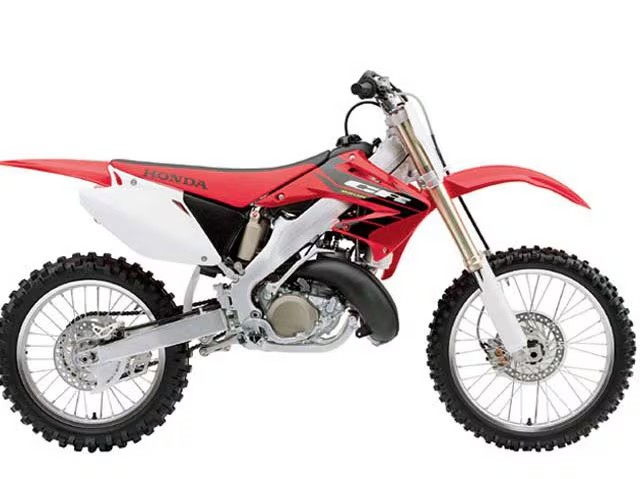
| Model | Honda CR250R |
| Year | 2004 |
| Category | Motocross |
| Engine Type | 249 cc single-cylinder, liquid-cooled two-stroke with electronically controlled RC exhaust valve |
| Weight | 96.5 kg dry |
| Displacement | 249.3 cc |
| Bore x Stroke | 66.4 x 72.0 mm |
| Compression Ratio | 8.5:1 |
| Fuel System | 38 mm Mikuni TMX flat-slide carburettor with throttle position sensor and crankcase reed-valve induction | Replacement Options |
| Ignition | CDI with three-dimensional mapping and electronic advance |
| Spark Plug | NGK BR8EG |
| Spark Plug Gap | 0.5-0.6 mm |
| Cooling System | Liquid-cooled |
| Starting System | Primary kick starter |
| Transmission | Close-ratio 5-speed constant-mesh |
| Clutch | Wet multi-plate, cable operated |
| Final Drive | #520 chain; 13/50 gearing |
| Overall Length | 2,180 mm |
| Overall Width | 823 mm |
| Overall Height | 1,263 mm |
| Wheelbase | 1,482 mm |
| Ground Clearance | 339 mm |
| Seat Height | 950 mm |
| Fuel Capacity | 7.7 L |
| Frame | Aluminium twin-tube motocross frame with aluminium swingarm |
| Front Tyre | 80/100-21 51M | Tyre Size Guide |
| Rear Tyre | 110/90-19 62M | Tyre Size Guide |
| Front Suspension | 47 mm Showa inverted cartridge fork with 16-position compression and 16-position rebound damping adjustment | Fork Oil Levels |
| Front Suspension Travel | 315 mm |
| Rear Suspension | Pro-Link Showa single shock with spring preload, 17-position rebound, 13-position low-speed compression and high-speed compression adjustment |
| Rear Suspension Travel | 320 mm |
| Fork Oil | Pro Honda HP Fork Oil 5W or equivalent; standard outer-tube oil capacity 387 ml per leg with standard spring, fork damper recommended fill 195 ml |
| Front Brake | Single 240 mm hydraulic disc, twin-piston caliper |
| Rear Brake | Single 240 mm hydraulic disc |
| Front Wheel Size | 21 x 1.60 in |
| Rear Wheel Size | 19 x 2.15 in |
| Fuel Type | Premium unleaded petrol, 92 pump octane or higher |
| Premix Information | 32:1 fuel-to-oil ratio using Pro Honda HP2 two-stroke oil or equivalent | Premix Calculator |
| Gearbox Oil | Pro Honda HP Trans Oil, Pro Honda GN4/HP4 10W-40 without molybdenum additives or equivalent JASO MA oil; 650 ml after draining, 700 ml after disassembly |
| Air Filter | Washable oiled polyurethane foam element |
| Service Notes | Competition two-stroke motocross machine. Maintain 32:1 premix, service the air filter frequently and inspect piston, rings, reed valve, RC valve, gearbox oil, chain, brakes and suspension at race-service intervals. |
The 2004 Honda CR250R was not an entirely new generation, but it received substantial engine development that made it considerably more than a routine year-to-year update. Honda retained the third-generation aluminium chassis and the case-reed engine architecture introduced in 2002, then concentrated its effort on improving the power delivery of the 249 cc two-stroke.
The engine kept its 66.4 x 72.0 mm bore and stroke, but Honda extensively revised the intake and exhaust systems. The crankcases were altered to improve mixture flow, the intake passage was reshaped, and the reed-valve arrangement was redesigned. Honda also revised the cylinder exhaust-port shape and height in an effort to strengthen the transition from low to mid rpm while preserving top-end performance.
Fuel continued to be delivered by a 38 mm Mikuni TMX flat-slide carburettor, now working with a throttle-position sensor and Honda’s three-dimensional CDI mapping. The electronic system used throttle position and engine speed to control ignition characteristics and the electronically operated RC exhaust valve. Owners restoring the original induction system can compare replacement carburettor options when worn or missing parts need replacing.
Honda’s electronically controlled RC valve remained one of the technically interesting features of this generation. Instead of relying solely on a conventional mechanical governor, the system allowed Honda to alter exhaust-port timing according to operating conditions. Combined with the revised porting and intake tract, the aim for 2004 was a stronger and more responsive engine without giving up the high-rpm performance expected from a 250 motocrosser.
The aluminium twin-tube chassis was largely retained because handling was already one of the CR250R’s strengths. The 47 mm Showa inverted cartridge fork received internal surface honing derived from Honda’s works race machines to reduce friction, along with revised damping settings. The Pro-Link rear suspension also received revised damping. Owners rebuilding the front suspension can refer to the MXOwners fork oil reference when checking oil type and setup information.
The CR250R remained a traditional premix two-stroke, with Honda specifying a 32:1 fuel-to-oil ratio using suitable high-quality two-stroke oil. Its separate five-speed transmission used its own lubricant, making gearbox-oil changes independent of the premix lubrication used by the engine. This straightforward mechanical layout is one reason late-model CR250Rs remain attractive to owners who prefer maintaining a competition two-stroke rather than a high-revving four-stroke.
Standard motocross wheels were 21 inches at the front and 19 inches at the rear, carrying an 80/100-21 front tyre and 110/90-19 rear. Owners checking modern replacements can use the MXOwners tyre size guide, while the MXOwners Parts Finder can assist with replacement components for restoration and maintenance.
Historically, the 2004 CR250R sits in an interesting part of Honda’s motocross story. The company was still investing in development of its flagship 250 two-stroke, but the CRF four-strokes were rapidly becoming the focus of motocross racing. The 2004 model therefore represents one of Honda’s final serious rounds of development on the case-reed CR250R platform before the line entered its last few years of production.