| Model | Kawasaki KX250F |
| Year | 2004 |
| Category | Motocross |
| Engine Type | 249 cc single-cylinder, four-stroke, DOHC, 4-valve, liquid-cooled |
| Weight | Approximately 93 kg dry |
| Displacement | 249 cc |
| Bore x Stroke | 77.0 x 53.6 mm |
| Compression Ratio | 12.6:1 |
| Fuel System | Keihin FCR 37 mm flat-slide carburettor | Replacement Options |
| Ignition | Digital CDI |
| Spark Plug | NGK CR8E |
| Spark Plug Gap | 0.7-0.8 mm |
| Cooling System | Liquid-cooled |
| Starting System | Primary kick starter with automatic decompression |
| Transmission | 5-speed constant-mesh, return shift |
| Clutch | Wet multi-disc |
| Final Drive | Chain, 520 size |
| Overall Length | Approximately 2,175 mm |
| Overall Width | Approximately 820 mm |
| Overall Height | Approximately 1,275 mm |
| Wheelbase | Approximately 1,475 mm |
| Ground Clearance | Approximately 345 mm |
| Seat Height | Approximately 965 mm |
| Fuel Capacity | Approximately 7.5 L |
| Frame | High-tensile steel perimeter motocross frame with aluminium swingarm |
| Front Tyre | 80/100-21 51M | Tyre Size Guide |
| Rear Tyre | 100/90-19 57M | Tyre Size Guide |
| Front Suspension | 48 mm Kayaba inverted cartridge fork, adjustable compression and rebound damping | Fork Oil Levels |
| Front Suspension Travel | Approximately 300 mm |
| Rear Suspension | Uni-Trak linkage with Kayaba gas-charged shock, adjustable spring preload, compression and rebound damping |
| Rear Suspension Travel | Approximately 310 mm |
| Fork Oil | Kayaba 01 or equivalent high-performance fork oil |
| Front Brake | Single hydraulic disc |
| Rear Brake | Single hydraulic disc |
| Front Wheel Size | 21 x 1.60 in |
| Rear Wheel Size | 19 x 1.85 in |
| Fuel Type | Premium unleaded petrol |
| Premix Information | Not applicable - four-stroke engine with separate engine lubrication |
| Gearbox Oil | Engine and transmission share the same oil; SAE 10W-40 motorcycle oil meeting API SG/SH/SJ and JASO MA specification |
| Air Filter | Washable oiled polyurethane foam element |
| Service Notes | Competition four-stroke motocross engine. Check engine oil frequently and inspect valve clearance, air filter, coolant, drive chain, brakes and controls at short competition-service intervals. |
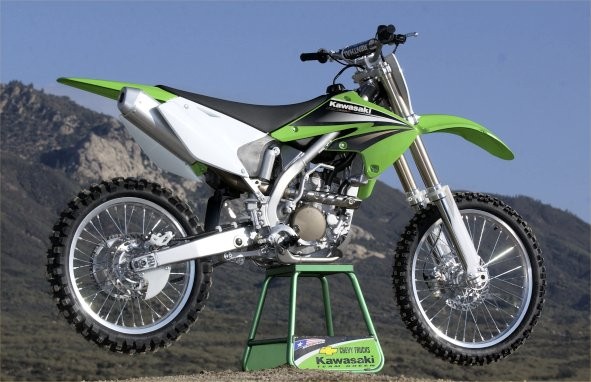
The 2004 Kawasaki KX250F was a genuinely important model because it marked Kawasaki’s entry into the rapidly growing 250 four-stroke motocross class. It was a first-year machine rather than a refinement of an existing KX250F, and it arrived at a time when four-strokes were beginning to transform motocross racing. Kawasaki developed the bike in cooperation with Suzuki, with the closely related Suzuki RM-Z250 appearing from the same joint development program.
At the heart of the new KX250F was a compact 249 cc liquid-cooled DOHC four-stroke engine using a 77.0 mm bore and 53.6 mm stroke. The short-stroke layout allowed the engine to rev high, which was essential for producing competitive power from a 250 four-stroke. A four-valve cylinder head, high compression ratio and lightweight valvetrain gave the new Kawasaki a very different character from the KX250 two-stroke that remained in Kawasaki’s range.
Fuel was supplied by a 37 mm Keihin FCR flat-slide carburettor. The FCR became a familiar sight on early four-stroke motocross bikes, offering strong response but also requiring careful jetting, accelerator-pump setup and fuel-screw adjustment. Owners restoring an original machine can compare replacement carburettor options if the original unit is worn, damaged or missing.
The 2004 model used a high-tensile steel perimeter frame rather than the aluminium chassis Kawasaki would introduce later in the KX250F’s development. The frame was designed to provide a familiar Kawasaki feel while packaging the taller and more complex four-stroke engine. Kayaba suspension was fitted at both ends, with an inverted cartridge fork at the front and Kawasaki’s Uni-Trak linkage system at the rear.
Suspension setup was especially important because early 250 four-strokes were heavier and delivered power differently from the two-strokes riders were used to. Correct oil condition, damping adjustment and spring setup could dramatically change how the bike behaved through braking bumps and rutted turns. Owners servicing the front end can use the MXOwners fork oil reference when checking suitable oil information.
The KX250F also introduced a new maintenance routine for many Kawasaki motocross owners. Instead of mixing fuel and oil, riders now had to monitor engine oil, oil-filter condition and valve clearances closely. The highly tuned engine was designed for competition use, so maintenance intervals were much shorter than those of a trail motorcycle.
Standard motocross wheel sizing remained familiar, with a 21-inch front wheel and 19-inch rear wheel. Owners replacing tyres can check fitments using the MXOwners tyre size guide, while the MXOwners Parts Finder can help when identifying replacement components for older bikes.
Historically, the 2004 KX250F was the beginning of a completely new chapter for Kawasaki. It did not replace the KX250 two-stroke immediately; both models existed together for several years. Instead, the KX250F gave Kawasaki riders a choice between traditional two-stroke performance and the emerging high-revving four-stroke formula that would soon dominate the 250 motocross class.