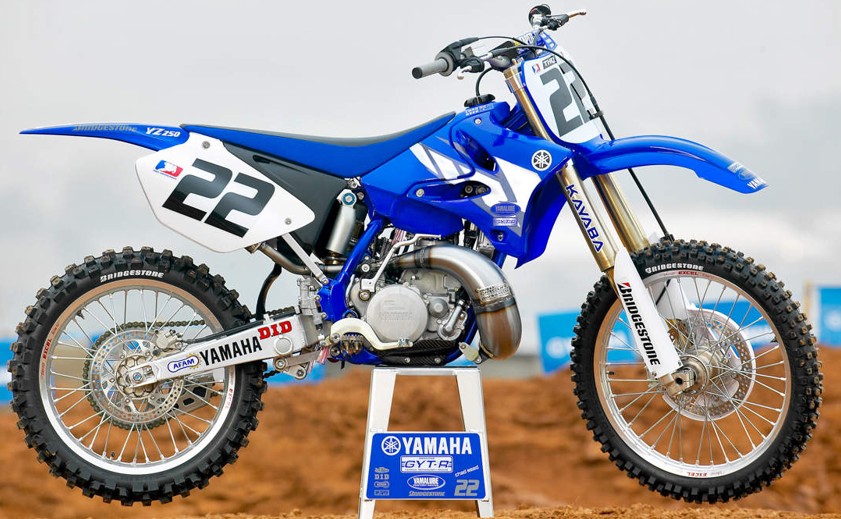
2004 Yamaha YZ250
General Specifications
| Model | YZ250 |
| Year | 2004 |
| Category | Motocross |
| Engine Type | Liquid-cooled, 2-stroke, single-cylinder, reed-valve |
| Weight | 96.5 kg dry |
Engine
| Displacement | 249 cc |
| Bore x Stroke | 66.4 x 72.0 mm |
| Compression Ratio | 8.9-10.6:1 |
| Fuel System | Keihin PWK38S carburettor | Replacement Options |
| Ignition | CDI magneto |
| Spark Plug | NGK BR8EG |
| Spark Plug Gap | 0.5-0.6 mm |
| Cooling System | Liquid-cooled |
| Starting System | Kick starter |
Transmission
| Transmission | 5-speed constant-mesh |
| Clutch | Wet multi-plate |
| Final Drive | Chain |
Dimensions
| Overall Length | 2176 mm |
| Overall Width | 827 mm |
| Overall Height | 1292 mm |
| Wheelbase | 1481 mm |
| Ground Clearance | 391 mm |
| Seat Height | 988 mm |
| Fuel Capacity | 8.0 L |
Chassis
Suspension
| Front Suspension | 46 mm inverted telescopic cartridge fork | Fork Oil Levels |
| Front Suspension Travel | 300 mm |
| Rear Suspension | Linkage-type Monocross single shock |
| Rear Suspension Travel | 315 mm |
| Fork Oil | Yamaha Suspension Oil 01; oil level adjustable to rider and suspension setup |
Brakes & Wheels
| Front Brake | Hydraulic single disc |
| Rear Brake | Hydraulic single disc |
| Front Wheel Size | 21 inch |
| Rear Wheel Size | 19 inch |
Service Data
| Fuel Type | Premium unleaded petrol |
| Premix Information | Premix lubrication | Premix Calculator |
| Gearbox Oil | SAE 10W-30 motorcycle engine oil |
| Air Filter | Oiled foam element |
| Service Notes | Competition motorcycle; regularly service the air filter, transmission oil, drive chain, cooling system, suspension linkage and engine top end |
2004 Yamaha YZ250 – The Final Steel-Frame YZ250
The 2004 Yamaha YZ250 was primarily an evolutionary update to Yamaha's established two-stroke motocross platform, but history has given the model particular significance. It became the final steel-framed YZ250 before Yamaha introduced its aluminium-frame generation for 2005. That makes the 2004 machine an interesting endpoint in the development of a chassis and engine combination Yamaha had refined over many seasons.
Power came from the familiar 249cc liquid-cooled two-stroke single with a 66.4 mm bore and 72.0 mm stroke. A Keihin PWK38S carburettor supplied the mixture, while Yamaha's power-valve system helped broaden the engine's usable power delivery. Owners maintaining an original or restored machine can consult the MXOwners carburettor information and replacement options when investigating worn components, jetting or replacement carburettors.
The 2004 chassis retained Yamaha's steel semi-double-cradle construction, combined with an inverted cartridge fork and linkage-type Monocross rear suspension. Approximately 300 mm of front wheel travel and 315 mm at the rear provided the long-travel suspension expected of a competition motocrosser. On surviving examples, worn fork bushings, seals, shock components and linkage bearings can dramatically alter the handling. The MXOwners fork oil level reference can assist owners checking suspension service information.
The YZ250 continued with the established 21-inch front and 19-inch rear motocross wheel combination, using 80/100-21 and 110/90-19 tyres. Owners comparing modern replacements can use the MXOwners motorcycle tyre size guide. Although the 2004 model was not a ground-up redesign, its position as the last steel-frame YZ250 makes it historically distinctive. A year later the aluminium chassis would change the construction of the YZ250 considerably, leaving the 2004 model as the final expression of Yamaha's long-developed steel-frame two-stroke formula.