2005 Honda CR250R
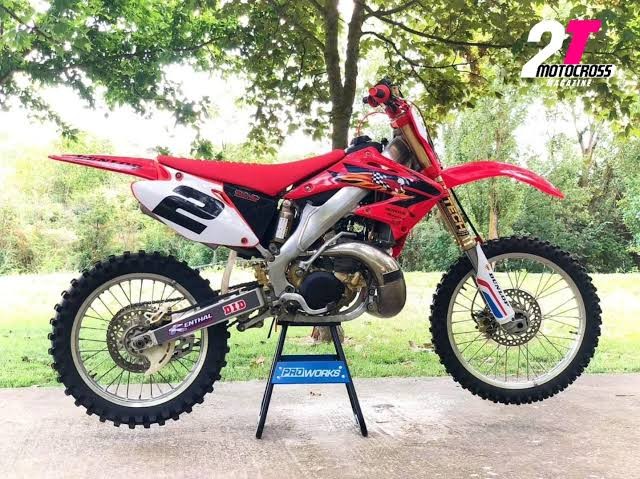
General Specifications
| Model | Honda CR250R |
| Year | 2005 |
| Category | Motocross |
| Engine Type | Liquid-cooled 2-stroke single-cylinder with electronically controlled RC exhaust valve |
| Weight | 96.4 kg dry |
Engine
| Displacement | 249.3 cc |
| Bore x Stroke | 66.4 x 72.0 mm |
| Compression Ratio | 9.0:1 |
| Fuel System | 38 mm Mikuni TMX piston-valve carburettor with throttle-position sensor, 6-petal crankcase reed valve | Replacement Options |
| Ignition | CDI with three-dimensional mapping and electronic advance |
| Spark Plug | NGK BR9EG-N-8 |
| Spark Plug Gap | 0.7-0.8 mm |
| Cooling System | Liquid cooled |
| Starting System | Kickstarter |
Transmission
| Transmission | 5-speed constant-mesh, 1-N-2-3-4-5 |
| Clutch | Wet multi-plate |
| Final Drive | D.I.D. 520DMA2 chain, 13T/49T final gearing |
Dimensions
| Overall Length | 2,185 mm |
| Overall Width | 821 mm |
| Overall Height | 1,275 mm |
| Wheelbase | 1,487 mm |
| Ground Clearance | 347 mm |
| Seat Height | 950 mm |
| Fuel Capacity | 7.7 L |
Chassis
Suspension
| Front Suspension | 47 mm Showa inverted twin-chamber cartridge fork with adjustable compression and rebound damping | Fork Oil Levels |
| Front Suspension Travel | 280 mm front wheel travel; 315 mm fork stroke |
| Rear Suspension | Honda Pro-Link with Showa single shock, adjustable spring preload, rebound, low-speed compression and high-speed compression damping |
| Rear Suspension Travel | 316 mm |
| Fork Oil | Honda fork oil or equivalent; standard outer chamber capacity 394 cc per leg, excluding fork damper | Fork Oil Levels |
Brakes & Wheels
| Front Brake | Hydraulic single 240 mm disc with twin-piston caliper |
| Rear Brake | Hydraulic single 240 mm disc |
| Front Wheel Size | 21 in |
| Rear Wheel Size | 19 in |
Service Data
| Fuel Type | Unleaded petrol, minimum 91 pump octane (R+M/2) |
| Premix Information | 32:1 petrol-to-2-stroke oil using Pro Honda HP2 or equivalent | Premix Calculator |
| Gearbox Oil | Pro Honda HP Trans Oil, Pro Honda GN4 or HP4 without molybdenum additives, or equivalent SAE 10W-40 JASO MA oil; 0.65 L after draining, 0.70 L after disassembly |
| Air Filter | Washable oiled dual-stage foam air cleaner |
| Service Notes | Competition-only 2-stroke. Standard carburettor settings are based on a 32:1 premix ratio, sea level and approximately 20°C ambient temperature. Inspect transmission oil, air filter, spark plug, drive chain, piston and rings frequently under competition use. |
2005 Honda CR250R: Honda's Major Two-Stroke Refinement
The 2005 Honda CR250R was more than a graphics-and-jetting update. Although it retained the third-generation aluminium-frame platform introduced earlier in the decade, Honda substantially reworked the 249 cc two-stroke engine, intake system, transmission and chassis setup. The objective was clear: improve the low-to-midrange response that had been a weakness of the earlier case-reed CR250R while retaining the strong top-end performance expected from Honda's premier 250 motocrosser.
Much of the development focused inside the engine. Honda revised the cylinder port shape and port timing, reshaped the combustion chamber and piston crown, and replaced the previous two flat piston rings with a single half-keystone ring. The lighter ring arrangement reduced reciprocating mass and friction. The RC exhaust-valve installation was also redesigned to improve sealing, helping the engine produce cleaner response at lower rpm without sacrificing its high-rpm performance.
The intake system received equally serious attention. Honda changed from an eight-petal reed assembly to a six-petal design with sub-reeds, revised the intake opening and reshaped the crankcase intake passage. Fuel continued to come from a 38 mm Mikuni TMX carburettor with throttle-position sensing, so correct jetting remained important. Owners working on ageing examples can use the MXOwners carburettor reference when investigating replacement or repair options.
Durability and shifting were also targeted. Honda increased crankcase rigidity around the crankshaft, heat-treated the connecting rod and used a special steel alloy for the piston pin. Changes within the five-speed transmission, including treatment of the shift-fork shaft, were intended to improve shift feel. For owners rebuilding a twenty-year-old CR250R today, identifying the correct year-specific components is important because apparently similar parts are not always interchangeable; the MXOwners parts finder can help with that process.
The chassis was refined rather than replaced. Honda altered the front axle offset to improve cornering and steering control, while changes to the swingarm, rear hub and chain-guide components reduced unsprung weight. The 47 mm Showa twin-chamber fork and Pro-Link Showa rear shock remained fully adjustable competition components. Fork servicing is particularly sensitive to correct oil volume, and the MXOwners fork oil reference is useful when checking suspension information before a rebuild.
For owners, one of the most important details is that the 2005 CR250R remained a conventional premix two-stroke. Honda specified a 32:1 petrol-to-oil ratio using its HP2 two-stroke oil or an equivalent quality lubricant. Unlike a four-stroke CRF, the gearbox has its own separate oil supply, with approximately 0.65 litres required after a normal drain. Keeping the foam air filter properly cleaned and oiled is equally important, because dirt entering a two-stroke engine can quickly damage the piston, rings and cylinder.
Historically, the 2005 model represents Honda's continuing effort to perfect the CR250R late in the Japanese 250 two-stroke development era. Four-stroke motocross machines were rapidly taking over top-level competition, but Honda was still putting substantial engineering effort into the CR. The 2005 machine therefore stands as one of the most developed versions of the aluminium-framed, case-reed CR250R and remains an interesting model for riders and restorers who want one of Honda's final generations of open-class two-stroke motocross machinery.