2005 Honda CRF450R
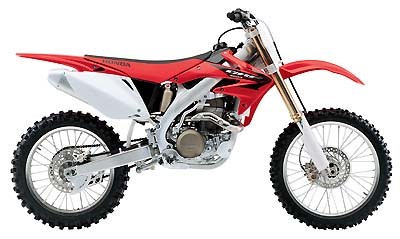
General Specifications
| Model | Honda CRF450R |
| Year | 2005 |
| Category | Motocross |
| Engine Type | Liquid-cooled, four-stroke, single-cylinder, SOHC Unicam, 4-valve |
| Weight | 99.8 kg dry (220 lb) |
Engine
| Displacement | 449.4 cc |
| Bore x Stroke | 96.0 x 62.1 mm |
| Compression Ratio | 12.0:1 |
| Fuel System | Keihin FCR 40 mm flat-slide carburettor with accelerator pump | Replacement Options |
| Ignition | CDI (Capacitive Discharge Ignition) |
| Spark Plug | NGK IFR8H11 or Denso VK24PRZ11; NGK IFR9H11 or Denso VK27PRZ11 for extended high-speed riding |
| Spark Plug Gap | 1.0-1.1 mm (0.039-0.043 in) |
| Cooling System | Liquid cooled |
| Starting System | Kick start |
Transmission
| Transmission | 5-speed constant mesh |
| Clutch | Wet multi-plate, cable operated |
| Final Drive | Chain |
Dimensions
| Overall Length | 2,191 mm (86.3 in) |
| Overall Width | 827 mm (32.6 in) |
| Overall Height | 1,273 mm (50.1 in) |
| Wheelbase | 1,491 mm (58.7 in) |
| Ground Clearance | 345 mm (13.6 in) |
| Seat Height | 958 mm (37.7 in) |
| Fuel Capacity | 7.2 litres (1.9 US gal) |
Chassis
Suspension
| Front Suspension | 47 mm Showa inverted twin-chamber telescopic fork with adjustable compression and rebound damping | Fork Oil Levels |
| Front Suspension Travel | 315 mm (12.4 in) fork stroke; approximately 281 mm (11.1 in) axle travel |
| Rear Suspension | Showa Pro-Link single shock with adjustable spring preload, compression and rebound damping |
| Rear Suspension Travel | 318 mm (12.5 in) |
| Fork Oil | Pro Honda HP Fork Oil 5W or equivalent; Showa twin-chamber fork, oil quantity varies with spring and desired air-gap/setup |
Brakes & Wheels
| Front Brake | Hydraulic single disc, 240 mm |
| Rear Brake | Hydraulic single disc, 240 mm |
| Front Wheel Size | 21 in |
| Rear Wheel Size | 19 in |
Service Data
| Fuel Type | Premium unleaded petrol |
| Premix Information | Not applicable - four-stroke engine |
| Gearbox Oil | Pro Honda HP Trans Oil, Pro Honda GN4/HP4 without molybdenum additives, or equivalent SAE 10W-40 JASO MA motorcycle oil; approximately 0.59 L after draining and 0.67 L after disassembly |
| Air Filter | Oiled polyurethane foam element |
| Service Notes | Separate engine and transmission oil systems. Engine oil capacity approximately 0.66 L after draining, 0.69 L with filter change and 0.85 L after disassembly. Valve clearance: intake 0.16 ± 0.03 mm; exhaust 0.28 ± 0.03 mm. Competition motorcycle requiring frequent engine oil, transmission oil, air-filter, valve-clearance and chassis servicing. |
2005 Honda CRF450R - A Major Step Forward for Honda's 450
The 2005 Honda CRF450R represented a significant redesign rather than the minor year-to-year refinement seen between some of the earlier CRF450R models. Honda's original 2002 machine had already proved that a lightweight four-stroke could become the centrepiece of its motocross range, but for 2005 Honda concentrated heavily on reducing weight, improving mass centralisation and making the big 450 easier to control. The result was a CRF450R that retained the basic character of the original while moving the platform noticeably closer to the modern motocross bike.
At the centre remained Honda's liquid-cooled 449.4 cc Unicam four-stroke single, with its familiar 96.0 mm bore and 62.1 mm stroke. Compression remained at 12.0:1 and fuel was supplied by a 40 mm Keihin FCR flat-slide carburettor. The FCR offered excellent throttle response when correctly adjusted, but age, worn components and blocked passages can now make carburettor condition a major factor on surviving bikes. Owners working on an original fuel system can use the MXOwners carburettor replacement and reference information when considering repair or replacement options.
The major story for 2005 was the chassis. Honda introduced its fourth-generation aluminium frame, designed to reduce weight and improve handling while maintaining the rigidity required for a powerful 450 motocrosser. Changes to the frame and associated components helped bring dry weight down to around 99.8 kg, breaking the psychologically important 100 kg barrier. Honda also revised the motorcycle's weight distribution and ergonomics, producing a machine that felt slimmer and more manageable than its displacement suggested.
Suspension remained Showa at both ends, with a 47 mm inverted twin-chamber fork at the front and Pro-Link single shock at the rear. Both offered extensive damping adjustment for competition use. Correct servicing is increasingly important as these motorcycles age, particularly because many have accumulated years of hard motocross use. Owners rebuilding the front suspension can consult the MXOwners fork oil levels and suspension reference, while linkage, swingarm and steering-head bearings should also be inspected rather than assumed serviceable.
The CRF450R retained its five-speed transmission and separate engine and gearbox lubrication systems. This is an important maintenance point for anyone new to early CRFs: changing the engine oil does not change the transmission oil. The gearbox side takes approximately 0.59 litre during a normal drain and refill, while the engine side requires approximately 0.66 litre after draining or 0.69 litre when the filter is replaced. Frequent servicing was expected because the CRF450R was designed as a competition motorcycle rather than a low-maintenance trail bike.
Honda continued with the established motocross combination of a 21-inch front and 19-inch rear wheel, using 80/100-21 and 110/90-19 tyres. Owners wanting to compare original sizing with currently available replacements can use the MXOwners motocross tyre size guide. When inspecting a used 2005 CRF450R, valve clearances, starting behaviour, cam-chain condition, oil consumption, clutch and gearbox operation, cooling-system condition and suspension bearings are all worth close attention.
Historically, the 2005 model stands out as an important stage in the development of Honda's 450 motocross platform. The first CRF450R had arrived only three years earlier, yet Honda was already aggressively reducing weight and refining the chassis around the four-stroke engine. Those changes helped establish the basic philosophy that would define later CRF450Rs: strong but controllable power combined with a light, responsive aluminium chassis. For today's owner or collector, the 2005 CRF450R is therefore more than another early carburetted 450. It represents one of the first major evolutionary jumps in a model family that would go on to become a cornerstone of Honda motocross.