| Model | Kawasaki KX250 |
| Year | 2005 |
| Category | Motocross |
| Engine Type | 249 cc single-cylinder, two-stroke, piston reed-valve, liquid-cooled with KIPS |
| Weight | 97 kg dry |
| Displacement | 249 cc |
| Bore x Stroke | 66.4 x 72.0 mm |
| Compression Ratio | 10.5:1 low speed / 9.1:1 high speed |
| Fuel System | Keihin PWK38S 38 mm short-body carburettor with Power Jet | Replacement Options |
| Ignition | Digital CDI |
| Spark Plug | NGK BR8ECMVX |
| Spark Plug Gap | 0.7-0.8 mm |
| Cooling System | Liquid-cooled |
| Starting System | Primary kick starter |
| Transmission | 5-speed constant-mesh, return shift |
| Clutch | Wet multi-disc |
| Final Drive | Chain, 13/51 final gearing |
| Overall Length | 2,185 mm |
| Overall Width | 815 mm |
| Overall Height | 1,265 mm |
| Wheelbase | 1,480 mm |
| Ground Clearance | 340 mm |
| Seat Height | 965 mm |
| Fuel Capacity | 8.2 L |
| Frame | High-tensile steel perimeter frame with aluminium subframe and aluminium swingarm |
| Front Tyre | 80/100-21 51M | Tyre Size Guide |
| Rear Tyre | 110/90-19 62M | Tyre Size Guide |
| Front Suspension | 48 mm Kayaba inverted twin-chamber cartridge fork, adjustable compression and rebound damping | Fork Oil Levels |
| Front Suspension Travel | 300 mm |
| Rear Suspension | Uni-Trak linkage system with Kayaba gas-charged shock, adjustable preload, compression and rebound damping |
| Rear Suspension Travel | 310 mm |
| Fork Oil | KHL15-10 / Kayaba 01 or equivalent; adjustable fork oil quantity approximately 280-320 ml per fork leg |
| Front Brake | Single 250 mm hydraulic disc |
| Rear Brake | Single 240 mm hydraulic disc |
| Front Wheel Size | 21 in |
| Rear Wheel Size | 19 in |
| Fuel Type | Premium unleaded petrol, minimum 95 RON / 90 pump octane |
| Premix Information | 32:1 fuel/oil mixture using high-quality two-stroke racing oil | Premix Calculator |
| Gearbox Oil | SAE 10W-40, API SE/SF/SG or SH/SJ with JASO MA; 0.85 L capacity |
| Air Filter | Washable oiled polyurethane foam element |
| Service Notes | Competition motocross machine. Ignition timing 14° BTDC at 7,090 rpm. Maintain correct premix ratio and inspect the air filter, spark plug, transmission oil, coolant, drive chain and KIPS exhaust-valve system frequently. |
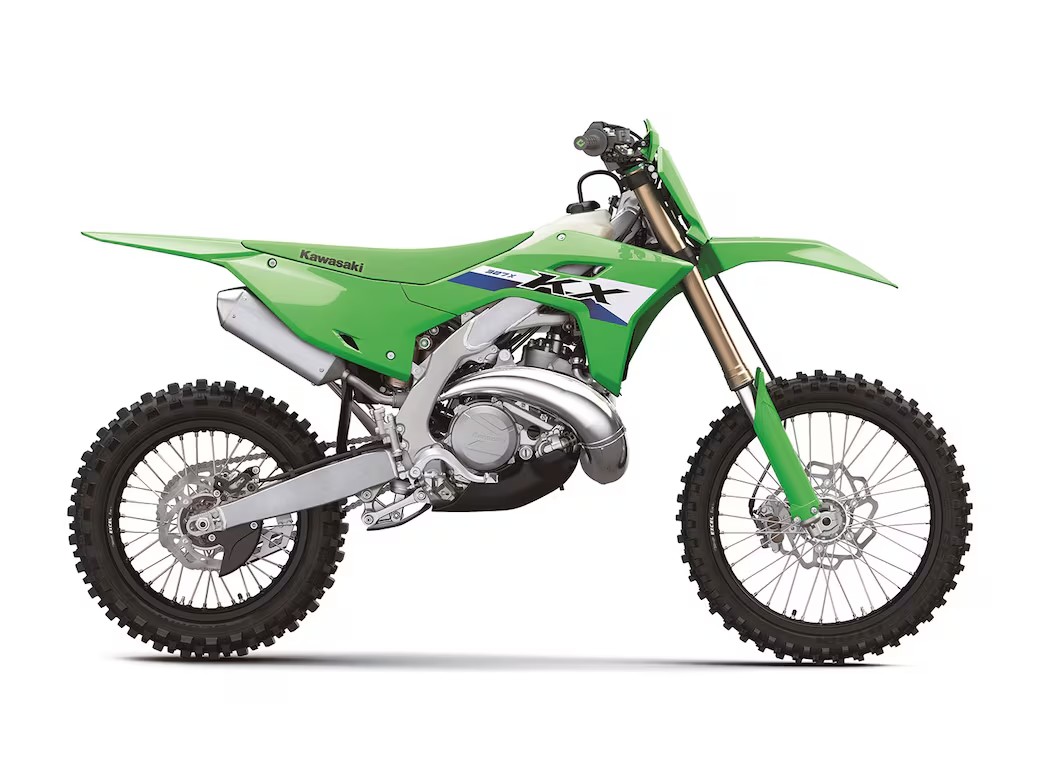
The 2005 Kawasaki KX250 was a major redesign and one of the most important late-generation KX250 models. Although its green bodywork made it look broadly similar to the previous machine, underneath Kawasaki had changed almost everything that mattered. The engine, frame, swingarm, suspension and rider layout were extensively revised, giving the KX250 a dramatic improvement in performance without abandoning the traditional steel-frame two-stroke formula.
The 249 cc engine retained Kawasaki's familiar 66.4 x 72.0 mm bore and stroke, but much of the engine around those dimensions was new. Kawasaki redesigned the cylinder and KIPS exhaust-valve system to produce a broader and more linear power delivery. The previous KX250 had developed a reputation for being relatively tame compared with its competition, so the 2005 development concentrated on restoring stronger performance without making the bike difficult to control.
Fuel continued to be supplied by a Keihin PWK38S short-body carburettor with a Power Jet. Correct jetting remains particularly important on these bikes because temperature, altitude, fuel and exhaust changes can noticeably affect a two-stroke's response. Owners replacing a worn or missing carburettor can compare replacement carburettor options when rebuilding an incomplete machine.
The chassis was equally significant. Kawasaki introduced an all-new high-tensile steel perimeter frame that was narrower through the rider's leg area and changed the steering-head angle from 27 degrees to 26 degrees. The intention was to preserve the KX's traditional straight-line stability while making it much easier to initiate and hold a turn. A revised swingarm, higher footpegs, different handlebar position and redesigned seat further changed the way the rider interacted with the motorcycle.
The front suspension was another major step. The 2005 KX250 received 48 mm Kayaba twin-chamber cartridge forks, replacing the earlier fork design. The twin-chamber arrangement separated damping oil more effectively and provided more consistent performance during hard motocross use. Front-wheel travel was approximately 300 mm, while Kawasaki's Uni-Trak rear suspension provided about 310 mm. Owners servicing the front end can use the MXOwners fork oil reference when checking oil specifications and setup information.
Despite all of the changes, the KX250 remained a traditional race-bred two-stroke. It used a five-speed gearbox, kick starter and premixed fuel, with Kawasaki specifying a 32:1 petrol-to-two-stroke-oil ratio. The MXOwners premix calculator is useful for calculating the correct oil quantity when preparing different amounts of fuel.
The 2005 model is also useful to distinguish carefully when buying parts because its major redesign means that not every component from an earlier KX250 will interchange even when the bikes look similar. The MXOwners Parts Finder can help when checking replacement components for a restoration or race-bike rebuild.
Historically, the 2005 KX250 arrived just as four-stroke motocross development was accelerating rapidly. Rather than simply letting its two-stroke fade away, Kawasaki gave the KX250 one of its biggest makeovers in years. The result was stronger power, quicker steering, improved suspension and a considerably more modern riding feel. That makes the 2005 machine an important model in the final chapter of Kawasaki's full-size production two-stroke motocross era.