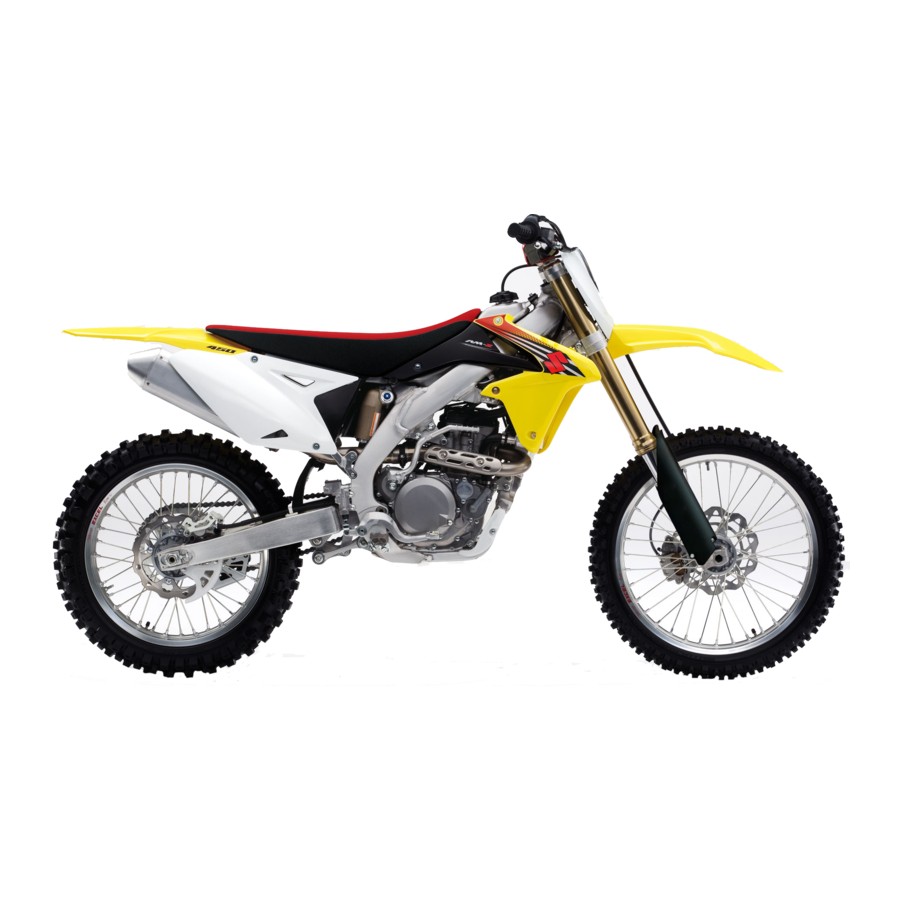
| Model | RM-Z450 |
| Year | 2005 |
| Category | Motocross |
| Engine Type | 449 cc liquid-cooled DOHC 4-stroke single-cylinder |
| Weight | 100.5 kg dry |
| Displacement | 449 cc |
| Bore x Stroke | 95.5 x 62.8 mm |
| Compression Ratio | 12.0:1 |
| Fuel System | Keihin FCR40 flat-slide carburettor | Replacement Options |
| Ignition | Electronic CDI |
| Spark Plug | NGK CR8E |
| Spark Plug Gap | 0.7-0.8 mm |
| Cooling System | Liquid cooled |
| Starting System | Kick start |
| Transmission | 4-speed constant mesh |
| Clutch | Wet multi-plate |
| Final Drive | Chain |
| Overall Length | 2170 mm |
| Overall Width | 830 mm |
| Overall Height | 1270 mm |
| Wheelbase | 1495 mm |
| Ground Clearance | 350 mm |
| Seat Height | 955 mm |
| Fuel Capacity | 6.5 L |
| Frame | Aluminium twin-spar |
| Front Tyre | 80/100-21 | Tyre Size Guide |
| Rear Tyre | 110/90-19 | Tyre Size Guide |
| Front Suspension | Showa 47 mm inverted telescopic fork, fully adjustable | Fork Oil Levels |
| Front Suspension Travel | 310 mm |
| Rear Suspension | Link-type Showa shock, fully adjustable |
| Rear Suspension Travel | 310 mm |
| Fork Oil | Showa SS-05 or equivalent suspension fluid; oil level/quantity set according to fork service procedure | Fork Oil Levels |
| Front Brake | Single hydraulic disc |
| Rear Brake | Single hydraulic disc |
| Front Wheel Size | 21 inch |
| Rear Wheel Size | 19 inch |
| Fuel Type | Premium unleaded petrol |
| Premix Information | Not applicable - 4-stroke engine |
| Gearbox Oil | Engine and transmission share the same engine oil supply |
| Air Filter | Washable oiled foam element |
| Service Notes | Competition motocross model requiring frequent engine oil, valve-clearance and air-filter inspection and maintenance |
The RM-Z450's first season also produced one of the great factory racing stories of the four-stroke era. Suzuki had signed Ricky Carmichael for 2005, but the new 450 was not yet ready for him to race through the Supercross season. Carmichael therefore raced Suzuki's RM250 two-stroke indoors while Sébastien Tortelli helped develop the RM-Z450 under race conditions. When the AMA outdoor motocross season opened at Hangtown in May, Carmichael finally lined up on Suzuki's new 450 and immediately won both motos.
That debut was the beginning of a remarkable season. Carmichael won all 12 rounds of the 2005 AMA Motocross Championship aboard the RM-Z450, taking victories from Hangtown through the season finale at Glen Helen and securing Suzuki's first premier-class AMA outdoor motocross championship since 1999. For a completely new motorcycle entering one of the toughest motocross championships in the world, the RM-Z450 could hardly have had a more successful introduction.
The 2005 Suzuki RM-Z450 was a major model for Suzuki because it marked the company's arrival in the highly competitive 450 cc four-stroke motocross class. By this stage the motocross world had changed dramatically from the era when 250 cc two-strokes dominated the premier class. Yamaha had demonstrated the potential of large four-strokes, while Honda, KTM and Kawasaki had also entered the increasingly important four-stroke market. Suzuki needed a purpose-built 450 of its own, and the first-generation RM-Z450 was the answer.
Unlike the earlier RM-Z250 project, which shared its basic design with Kawasaki's KX250F, the RM-Z450 was Suzuki's own 450-class machine. At its heart was a 449 cc liquid-cooled DOHC single-cylinder four-stroke engine fed by a Keihin FCR carburettor. Power went through a compact four-speed transmission, reflecting the relatively narrow range of gearing required for motocross competition. Riders maintaining one today can use the broader MXOwners carburettor reference and replacement information when researching fuel-system components and setup.
One of the most significant features of the 2005 RM-Z450 was its aluminium twin-spar chassis. Suzuki had traditionally been associated with steel-framed motocross machines, so the aluminium frame represented an important change in construction and design philosophy. The bike combined the new chassis with long-travel Showa suspension, including a 47 mm inverted fork and a linkage-equipped rear shock. Both ends offered extensive adjustment, making suspension condition and correct setup particularly important on surviving machines. Owners working on the front end can also consult the MXOwners fork oil and setup reference.
The RM-Z450 retained several features that now clearly identify it as an early-generation four-stroke motocrosser. It was carburetted rather than fuel injected, started by kickstarter and demanded a considerably more involved maintenance routine than Suzuki's RM two-strokes. Regular engine-oil changes, careful air-filter servicing and valve-clearance checks were important on a machine designed primarily for racing rather than casual trail use.
Its 21-inch front and 19-inch rear wheel combination followed established motocross practice, with an 80/100-21 front and 110/90-19 rear tyre fitment. Owners replacing old or incorrectly sized rubber can compare these dimensions with the MXOwners motocross tyre size guide.
The first RM-Z450 is historically interesting because it established a model name that would remain central to Suzuki's motocross range for decades. Later RM-Z450 generations gained extensive chassis revisions, fuel injection, improved starting systems and increasingly sophisticated electronics, but the 2005 machine represents the beginning of that lineage. It arrived during one of motocross's biggest technological transitions, when manufacturers were rapidly learning how to make powerful 450 four-strokes lighter, sharper and easier to race.
For an owner restoring or maintaining a 2005 example today, its first-year status makes correct model identification particularly important. Components should be checked against the exact year rather than assuming later RM-Z450 parts interchange. The MXOwners parts finder can help when researching replacement components. Kept in good mechanical condition, the 2005 RM-Z450 remains an interesting snapshot of Suzuki's first serious step into the modern 450 four-stroke motocross era.