| Model | Suzuki RM250 |
| Year | 2005 |
| Category | Motocross |
| Engine Type | 249 cc single-cylinder, two-stroke, liquid-cooled, piston reed-valve |
| Weight | 96 kg dry |
| Displacement | 249 cc |
| Bore x Stroke | 66.4 x 72.0 mm |
| Compression Ratio | 8.6:1 exhaust valve open / 10.4:1 exhaust valve closed |
| Fuel System | Keihin PWK38S carburettor | Replacement Options |
| Ignition | Electronic CDI |
| Spark Plug | NGK BR8EG |
| Spark Plug Gap | 0.5-0.6 mm |
| Cooling System | Liquid-cooled |
| Starting System | Primary kick starter |
| Transmission | 5-speed constant-mesh |
| Clutch | Wet multi-plate |
| Final Drive | Chain, 13/50 final gearing |
| Overall Length | 2,175 mm |
| Overall Width | 820 mm |
| Overall Height | 1,280 mm |
| Wheelbase | 1,470 mm |
| Ground Clearance | 350 mm |
| Seat Height | 950 mm |
| Fuel Capacity | 8.0 L |
| Frame | Single-backbone, dual-cradle chrome-molybdenum steel frame with aluminium rear subframe |
| Front Tyre | 80/100-21 51M | Tyre Size Guide |
| Rear Tyre | 110/90-19 62M | Tyre Size Guide |
| Front Suspension | 47 mm Showa inverted twin-chamber cartridge fork, adjustable compression and rebound damping | Fork Oil Levels |
| Front Suspension Travel | 310 mm |
| Rear Suspension | Showa link-type monoshock, adjustable spring preload, high/low-speed compression and rebound damping |
| Rear Suspension Travel | 310 mm |
| Fork Oil | Suzuki Fork Oil SS-05 or equivalent; standard outer chamber 350 ml per leg, inner chamber 193 ml per leg |
| Front Brake | Single hydraulic disc |
| Rear Brake | Single hydraulic disc |
| Front Wheel Size | 21 x 1.60 in |
| Rear Wheel Size | 19 x 2.15 in |
| Fuel Type | Unleaded petrol, minimum 95 RON |
| Premix Information | 30:1 fuel/oil mixture using quality two-stroke racing oil | Premix Calculator |
| Gearbox Oil | SAE 10W-40 motorcycle oil, API SF/SG or SH/SJ, JASO MA; 750 ml oil change / 850 ml overhaul |
| Air Filter | Washable polyurethane foam element, oiled with foam air-filter oil |
| Service Notes | Competition motocross machine. Inspect and service air filter, chain, brakes, controls and fluid levels frequently. Spark plug torque 20 N·m. |
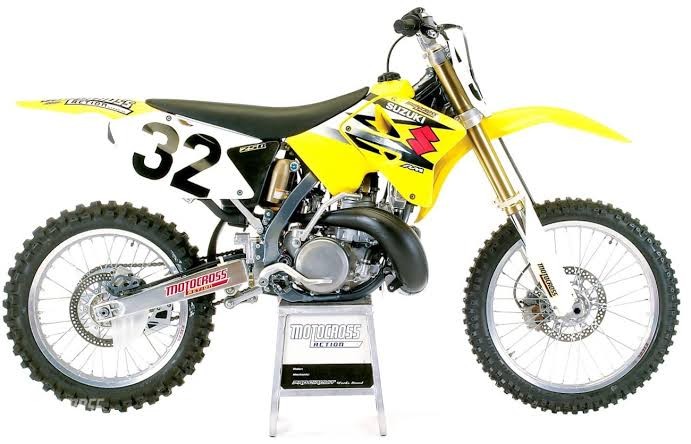
The 2005 Suzuki RM250 was more than a simple graphics update. Suzuki retained the basic platform of the successful 2004 machine but substantially refined the engine, suspension and chassis to produce a faster, more controlled version of its 250 cc two-stroke motocrosser. At a time when manufacturers were putting increasing development effort into four-strokes, Suzuki continued to invest heavily in the RM250.
The most important work was inside the engine. The 2004 RM250 was already known for immediate throttle response and strong low-to-midrange power, but it tended to sign off earlier at high rpm than some of its rivals. For 2005 Suzuki revised the engine to extend the useful power farther into the top end while retaining the aggressive response that had become an RM trademark. The result was a broader engine that could be ridden hard out of corners without requiring the rider to shift quite as urgently.
The 249 cc engine retained its 66.4 mm bore and 72.0 mm stroke and used a Keihin PWK38S carburettor. Jetting remains important on any RM250 of this era, especially when temperature, altitude, fuel or exhaust systems differ from standard. Owners rebuilding or tuning an incomplete machine can compare available replacement carburettor options when original components are worn or missing.
Suzuki also concentrated heavily on suspension development. The 47 mm Showa inverted twin-chamber fork received revised internal treatment, seals, oil flow changes and valving for smoother action and better balance. The rear shock was revised as well, while changes to the swingarm increased rigidity and helped the RM track more consistently through rough sections and whoops. Correct oil volume and condition make a major difference to these forks, so owners servicing the front end can use the MXOwners fork oil reference alongside the factory service specifications.
Handling remained one of the RM250's strongest characteristics. Its chrome-molybdenum steel frame, aluminium subframe and aluminium swingarm produced a narrow and responsive chassis that had a reputation for turning quickly. Suzuki's 2005 changes were intended to retain that agility while improving stability and suspension control. The bike remained light for a full-size 250, with a dry mass of approximately 96 kg.
The 2005 machine also received a redesigned rear brake system and a number of smaller detail improvements. These changes may not be as obvious as a completely new frame or engine architecture, but together they made the K5 noticeably different from the previous year's machine. For restorers, this also means it is worth checking model-year compatibility before assuming every 2004 or 2006 component is identical. The MXOwners Parts Finder can help when comparing replacement and service parts.
Like most competition two-strokes of the period, the RM250 uses premixed fuel rather than a separate oil-injection system. Suzuki specified a 30:1 fuel-to-oil ratio with a suitable racing two-stroke lubricant. Owners who mix fuel in different container sizes can use the MXOwners premix calculator to calculate the required oil quantity accurately.
Today the 2005 RM250 represents one of the highly developed late-generation Japanese 250 two-strokes. It combined the sharp steering for which Suzuki was known with a much broader engine and heavily revised suspension package. For riders and restorers, it sits in an interesting period just before four-strokes came to dominate the motocross market, while still benefiting from decades of development of Suzuki's RM two-stroke platform.