
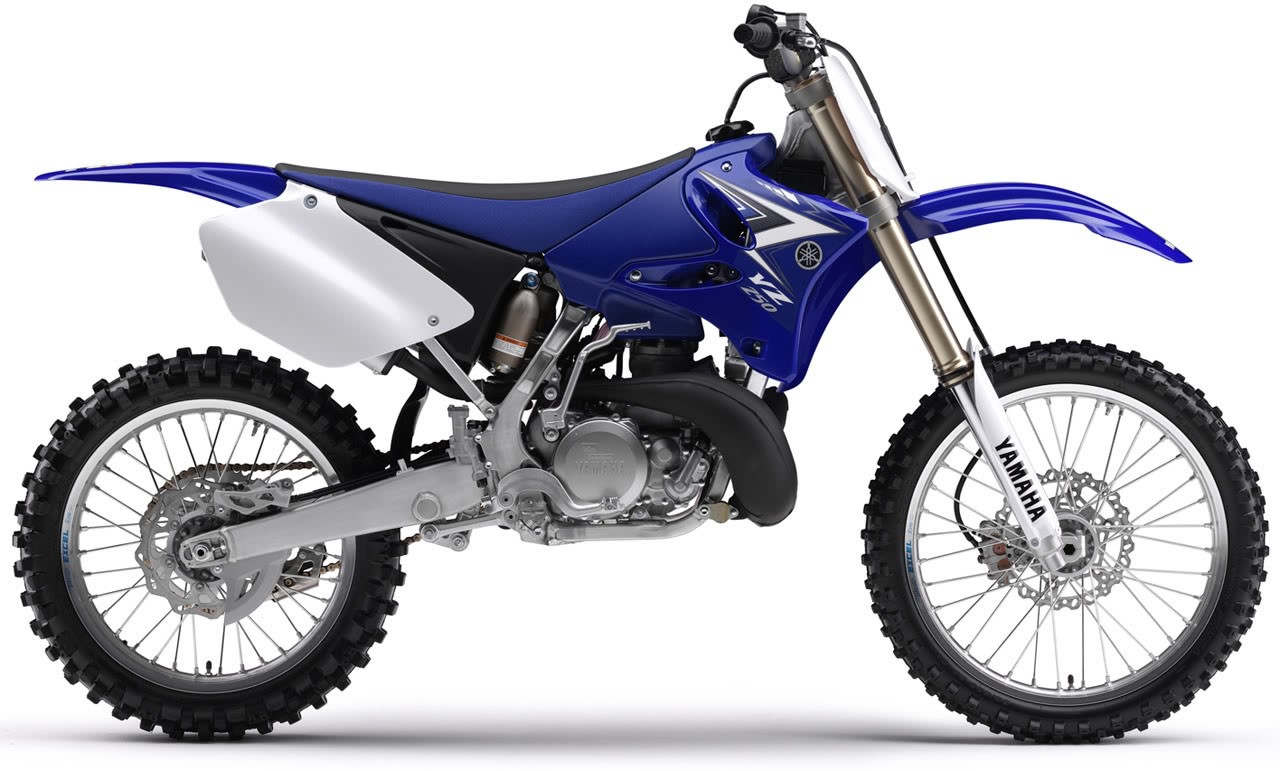
| Model | Yamaha YZ250 |
| Year | 2005 |
| Category | Motocross |
| Engine Type | Liquid-cooled 2-stroke single-cylinder, piston-reed induction with YPVS exhaust power valve |
| Weight | 96.0 kg dry |
| Displacement | 249 cc |
| Bore x Stroke | 66.4 x 72.0 mm |
| Compression Ratio | 9.0-10.6:1 |
| Fuel System | Keihin PWK38S 38 mm carburettor with reed-valve induction | Replacement Options |
| Ignition | CDI magneto |
| Spark Plug | NGK BR8EG |
| Spark Plug Gap | 0.5-0.6 mm |
| Cooling System | Liquid cooled |
| Starting System | Kickstarter |
| Transmission | 5-speed constant-mesh |
| Clutch | Wet multi-plate, coil spring |
| Final Drive | Chain; 14T/50T final gearing for USA, Australia, New Zealand and South Africa |
| Overall Length | 2,179 mm |
| Overall Width | 827 mm |
| Overall Height | 1,307 mm |
| Wheelbase | 1,481 mm |
| Ground Clearance | 383 mm |
| Seat Height | 989 mm |
| Fuel Capacity | 8.0 L |
| Frame | Aluminium semi-double-cradle frame |
| Front Tyre | 80/100-21 51M | Tyre Size Guide |
| Rear Tyre | 110/90-19 62M | Tyre Size Guide |
| Front Suspension | 48 mm KYB inverted cartridge fork with adjustable compression and rebound damping | Fork Oil Levels |
| Front Suspension Travel | 300 mm |
| Rear Suspension | KYB link-type Monocross single shock with adjustable spring preload, rebound and high-/low-speed compression damping |
| Rear Suspension Travel | 315 mm |
| Fork Oil | Yamaha Suspension Oil S1; standard outer-chamber quantity approximately 330 cc per leg, adjustable approximately 300-375 cc; damper assembly approximately 205 cc |
| Front Brake | Hydraulic single disc with twin-piston caliper |
| Rear Brake | Hydraulic single disc |
| Front Wheel Size | 21 x 1.60 in |
| Rear Wheel Size | 19 x 2.15 in |
| Fuel Type | Premium unleaded petrol, 95 RON or higher |
| Premix Information | 30:1 petrol-to-2-stroke oil using Yamalube 2-R or equivalent high-quality 2-stroke racing oil | Premix Calculator |
| Gearbox Oil | Yamalube 4 SAE 10W-30 or equivalent SAE 10W-30 motor oil; 0.75 L periodic oil change, 0.80 L total capacity |
| Air Filter | Washable oiled foam air-filter element |
| Service Notes | Competition-only 2-stroke with premix lubrication and separate transmission oil. Inspect and clean the air filter after dusty riding, maintain correct premix ratio, check spark plug condition and service the YPVS power-valve system regularly. |
The 2005 Yamaha YZ250 was a major model-year change and one of the most important steps in the long history of Yamaha's 250 cc two-stroke motocrosser. The headline development was an entirely new aluminium frame, replacing the steel chassis used by previous generations. Yamaha's goal was not simply to save weight, but to create a chassis with carefully controlled rigidity, improved mass centralisation and sharper handling while preserving the stability that had helped make the YZ250 such a respected race bike.
The new semi-double-cradle aluminium frame used a combination of cast, forged and extruded sections to place strength exactly where Yamaha wanted it. The change helped reduce overall machine weight while also allowing components to be packaged more tightly around the engine. Combined with revised bodywork and ergonomics, the 2005 machine felt slimmer and more modern than the 2004 model. It established the basic chassis direction that would define the YZ250 for many years.
The engine remained recognisably YZ250: a 249 cc liquid-cooled two-stroke with a 66.4 x 72.0 mm bore and stroke, reed-valve induction and Yamaha's YPVS exhaust power-valve system. Fuel was supplied through a 38 mm Keihin PWK carburettor, giving the bike the crisp mechanical throttle response that became one of the YZ250's defining characteristics. Owners maintaining the original induction system can use the MXOwners carburettor reference when looking at replacement or service options.
Yamaha specified a 30:1 premix ratio with Yamalube 2-R or an equivalent quality two-stroke racing oil. That remains one of the most important service details for an original 2005 machine because engine lubrication depends entirely on the fuel-oil mixture. Owners calculating fuel quantities can use the MXOwners premix calculator to avoid errors when mixing smaller or unusual fuel volumes.
Suspension continued to use KYB components, with a 48 mm inverted cartridge fork providing 300 mm of front wheel travel and a link-type Monocross rear suspension delivering 315 mm. The fork offered compression and rebound adjustment, while the rear shock provided spring preload, rebound and separate high- and low-speed compression adjustment. Correct fork-oil quantity has a direct influence on bottoming resistance and end-stroke feel, so the MXOwners fork oil reference is useful when servicing or setting up the front suspension.
The five-speed gearbox remained separate from the engine's premix lubrication, requiring its own transmission oil. Yamaha specified approximately 0.75 litres for a normal oil change and 0.80 litres total. That separation is important for new two-stroke owners: the premix lubricates the crankshaft, cylinder and piston, while gearbox oil looks after the clutch and transmission.
For modern owners, the 2005 model is particularly interesting because it combines a conventional carburetted two-stroke engine with the aluminium chassis architecture that carried the YZ250 into the modern era. Replacement bearings, suspension components and model-specific chassis parts deserve careful identification when restoring one, and the MXOwners parts finder can help when tracking down the correct components.
Historically, 2005 marks a genuine dividing line in YZ250 development. Yamaha did not abandon the proven two-stroke engine concept; instead it surrounded it with a lighter, more advanced chassis and modernised the motorcycle around it. That decision proved remarkably durable. While rival manufacturers gradually withdrew their Japanese 250 two-strokes, Yamaha continued refining the YZ250, and the aluminium-frame philosophy introduced in 2005 became the foundation of one of motocross's longest-lived and most successful production two-strokes.