
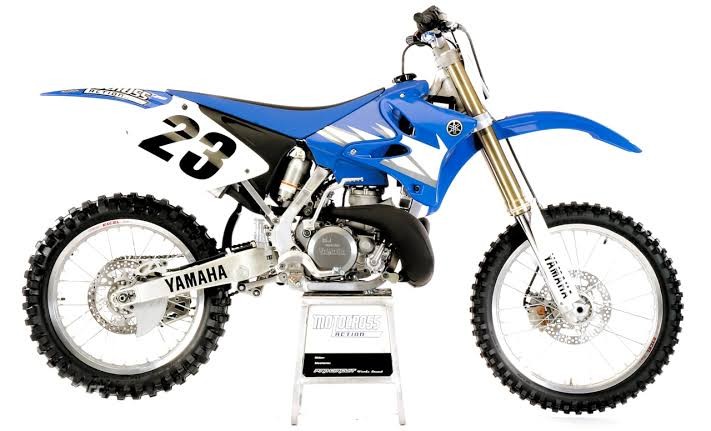
| Model | Yamaha YZ250F |
| Year | 2005 |
| Category | Motocross |
| Engine Type | Liquid-cooled, 4-stroke, DOHC, 5-valve single-cylinder |
| Weight | 93.5 kg dry |
| Displacement | 249 cc |
| Bore x Stroke | 77.0 x 53.6 mm |
| Compression Ratio | 12.5:1 |
| Fuel System | Keihin FCR-MX37 flat-slide carburettor | Replacement Options |
| Ignition | CDI magneto, revised ignition mapping for 2005 |
| Spark Plug | NGK CR8E resistance type |
| Spark Plug Gap | 0.7-0.8 mm (0.028-0.031 in) |
| Cooling System | Liquid cooled |
| Starting System | Kick starter with automatic decompression |
| Transmission | 5-speed constant-mesh |
| Clutch | Wet multi-plate |
| Final Drive | Chain, 13-tooth front / 49-tooth rear sprocket, 3.769:1 |
| Overall Length | 2,165 mm |
| Overall Width | 827 mm |
| Overall Height | 1,303 mm |
| Wheelbase | 1,475 mm |
| Ground Clearance | 382 mm |
| Seat Height | 995 mm |
| Fuel Capacity | 7.0 L |
| Frame | High-tensile steel semi-double-cradle |
| Front Tyre | 80/100-21 51M, tube type | Tyre Size Guide |
| Rear Tyre | 110/90-19 57M, tube type | Tyre Size Guide |
| Front Suspension | 48 mm KYB inverted cartridge fork with air/oil separation system, adjustable compression and rebound damping | Fork Oil Levels |
| Front Suspension Travel | 300 mm (11.8 in) |
| Rear Suspension | Link-type Monocross with KYB gas/oil shock, adjustable preload, compression and rebound damping |
| Rear Suspension Travel | 315 mm (12.4 in) rear wheel travel; shock absorber travel 132 mm |
| Fork Oil | Yamaha Suspension Oil S1; standard outer chamber oil capacity 430 cc per fork; damper assembly oil capacity 195 cc during service |
| Front Brake | Hydraulic single disc, 250 mm |
| Rear Brake | Hydraulic single disc, 245 mm |
| Front Wheel Size | 21 in aluminium spoked wheel |
| Rear Wheel Size | 19 in aluminium spoked wheel |
| Fuel Type | Premium unleaded petrol, minimum 95 RON |
| Premix Information | Not applicable - 4-stroke engine |
| Gearbox Oil | Engine and transmission share the same dry-sump engine oil supply; 1.0 L periodic oil change, 1.1 L with oil filter replacement, 1.2 L total capacity. API SG or higher non-friction-modified 4-stroke motorcycle oil; viscosity selected for ambient temperature. |
| Air Filter | Wet-type foam element |
| Service Notes | Dry-sump lubrication. Maintain frequent engine oil and filter changes, regularly check valve clearance, keep the foam air filter clean and correctly oiled, and maintain correct FCR carburettor setup. Standard tyre pressure is 100 kPa (15 psi) front and rear. The 2005 model received revised engine breathing, combustion chamber, piston, ignition and major suspension updates. |
The 2005 Yamaha YZ250F represented one of the more substantial developments of the original steel-framed YZ250F generation. Although Yamaha retained the basic 249 cc five-valve engine architecture and steel semi-double-cradle chassis, changes to the cylinder head, piston, intake system, ignition, swingarm and both ends of the suspension made the 2005 machine considerably more than a routine annual update. It was also significant historically as one of the final highly developed versions of the original steel-frame concept before Yamaha moved the YZ250F to an aluminium chassis.
The engine retained its familiar 77.0 x 53.6 mm bore and stroke and 12.5:1 compression ratio, but Yamaha redesigned the intake ports with a smoother radius to improve airflow at lower valve lift. The combustion chamber was reshaped around the intake valves and matched with a newly designed piston. A revised airbox and intake joint complemented the cylinder-head changes, while new CDI ignition mapping was introduced to make better use of the altered engine characteristics. Yamaha quoted 30.9 kW, or 42 PS, at 10,500 rpm for the Japanese-market model.
Fuel continued to be supplied by the Keihin FCR-MX37 flat-slide carburettor that defined this generation of YZ250F. When correctly set up, the FCR provides extremely crisp response, but age, worn accelerator-pump components, incorrect jetting and blocked passages can cause hesitation or difficult starting. Owners working on an original carburettor can compare components and alternatives using the MXOwners carburettor reference.
One of the biggest developments for 2005 was at the front suspension. The 48 mm KYB inverted fork adopted an air/oil separation design intended to prevent aerated oil from affecting damping consistency. Yamaha also incorporated a Transfer Control Valve system to improve damping behaviour through the middle and final portions of the fork stroke. Front travel remained a generous 300 mm, but the internal design was considerably more sophisticated than the earlier YZ250F forks. Owners rebuilding these units can use the MXOwners fork oil reference when checking service information and oil quantities.
The rear suspension also received considerable attention. Yamaha fitted a redesigned aluminium swingarm shared in concept with the contemporary YZ two-strokes. Larger arm sections and revised construction improved rigidity balance while saving approximately half a kilogram compared with the previous assembly. Changes to the Monocross linkage and shock were intended to improve suspension action and reduce harshness near full extension and compression. Rear wheel travel remained approximately 315 mm.
Despite all of these changes, the 2005 model retained the steel semi-double-cradle frame that had characterised the YZ250F since its 2001 debut. High-tensile steels were used strategically around heavily loaded areas, and Yamaha concentrated on achieving the desired rigidity balance rather than simply making the structure as stiff as possible. Combined with the lighter swingarm, aluminium handlebar and other detail changes, the Japanese-market machine was listed at only 93.5 kg dry.
The lubrication system remained dry-sump, with the engine and five-speed transmission sharing the same oil supply. Capacity was 1.0 litre for a routine change, 1.1 litres when replacing the filter and 1.2 litres total. That relatively small oil volume makes regular oil changes particularly important on a competition engine that routinely operates at high rpm. Valve-clearance inspection, clean air filtration and correct carburettor setup are equally important when keeping an early YZ250F healthy.
For owners restoring a 2005 bike, it is worth checking components carefully rather than assuming all early YZ250F parts interchange. The 2005 suspension, swingarm, intake, piston and several engine-related components differ from earlier versions, and the MXOwners Parts Finder can help when identifying replacement parts. Standard tyre sizing was 80/100-21 at the front and 110/90-19 at the rear, with alternatives easily compared through the MXOwners Tyre Size Guide.
The 2005 YZ250F therefore stands as a mature version of Yamaha's original four-stroke motocross concept. Yamaha had spent several seasons refining the revolutionary machine introduced in 2001, and by 2005 its engine response, suspension and chassis components had evolved substantially. It remains an interesting model for owners because it combines the character and simplicity of the early steel-framed YZ-F generation with many of the refinements learned during Yamaha's first years of serious 250 four-stroke motocross development.