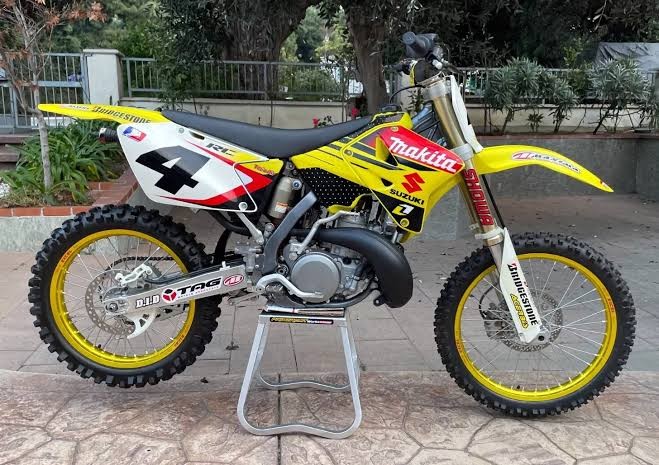
| Model | Suzuki RM250 |
| Year | 2006 |
| Category | Motocross |
| Engine Type | 249 cc single-cylinder, two-stroke, liquid-cooled, piston reed-valve |
| Weight | 96 kg dry |
| Displacement | 249 cc |
| Bore x Stroke | 66.4 x 72.0 mm |
| Compression Ratio | 8.6:1 exhaust valve open / 10.4:1 exhaust valve closed |
| Fuel System | Keihin PWK38S 38 mm carburettor | Replacement Options |
| Ignition | Electronic CDI, 4.5° BTDC at 1,000 rpm |
| Spark Plug | NGK BR8EG |
| Spark Plug Gap | 0.5-0.6 mm |
| Cooling System | Liquid-cooled |
| Starting System | Primary kick starter |
| Transmission | 5-speed constant-mesh |
| Clutch | Wet multi-plate |
| Final Drive | Chain, 13/50 final gearing |
| Overall Length | 2,170 mm |
| Overall Width | 830 mm |
| Overall Height | 1,280 mm |
| Wheelbase | 1,465 mm |
| Ground Clearance | 350 mm |
| Seat Height | 950 mm |
| Fuel Capacity | 8.0 L |
| Frame | Steel motocross frame with aluminium rear subframe and aluminium swingarm |
| Front Tyre | 80/100-21 51M | Tyre Size Guide |
| Rear Tyre | 110/90-19 62M | Tyre Size Guide |
| Front Suspension | 47 mm Showa inverted twin-chamber cartridge fork, adjustable compression and rebound damping | Fork Oil Levels |
| Front Suspension Travel | 310 mm |
| Rear Suspension | Showa link-type monoshock, adjustable spring preload, high/low-speed compression and rebound damping |
| Rear Suspension Travel | 310 mm |
| Fork Oil | Suzuki Fork Oil SS-05 or equivalent; 193 ml inner damper chamber and 350 ml outer chamber per leg with standard spring |
| Front Brake | Single hydraulic disc |
| Rear Brake | Single hydraulic disc |
| Front Wheel Size | 21 in |
| Rear Wheel Size | 19 in |
| Fuel Type | Unleaded petrol, minimum 95 RON |
| Premix Information | 30:1 fuel/oil mixture using quality two-stroke racing lubricant | Premix Calculator |
| Gearbox Oil | SAE 10W-40, API SF/SG or SH/SJ, JASO MA; 750 ml oil change / 850 ml overhaul |
| Air Filter | Washable polyurethane foam element, oiled with foam air-filter oil |
| Service Notes | Competition motocross machine. Spark plug torque 20 N·m. Cold tyre pressure 70-110 kPa (10-16 psi). Inspect air filter, chain, brakes, controls, coolant and transmission oil frequently. |
The 2006 Suzuki RM250 was not simply a carry-over model with different graphics. Suzuki made substantial engine and chassis changes aimed at broadening the power delivery, improving stability and making the already sharp-handling RM250 easier to ride quickly. The basic 249 cc two-stroke architecture remained familiar, but the number of changes makes the 2006 model one of the more significant revisions in the later RM250 lineage.
The biggest development was the engine. Earlier RM250s had become famous for an aggressive character: relatively little happening at very low rpm followed by a strong midrange hit. For 2006 Suzuki worked to fill in the bottom end without removing the lively response that made the RM250 distinctive. The exhaust ports were reshaped and their timing revised, while changes were also made to the main and side exhaust valves. Suzuki altered the valve mechanism to improve sealing and change when the exhaust valve opened, helping produce stronger torque from lower engine speeds.
The intake side received attention as well. A shorter carburettor intake pipe improved response, new carbon-fibre reed petals were fitted and internal crankcase clearance was altered to change primary compression characteristics. CDI mapping was also revised. Combined, these changes produced a noticeably smoother transition from low rpm into the midrange. Riders no longer needed to rely quite so heavily on keeping the engine directly in its strongest part of the powerband.
The 2006 RM250 retained the Keihin PWK38S carburettor, and correct jetting remains important on surviving bikes today. Temperature, altitude, exhaust changes and modern fuels can all affect carburation, so owners rebuilding an incomplete machine can also compare suitable replacement carburettor options when the original unit is damaged or missing.
Suzuki also revised the chassis. The steering-head position was altered, effectively shifting the engine and weight distribution forward to increase front-wheel bite. The RM250 had already earned a reputation as one of the quickest-turning motocross bikes of its era, so the 2006 changes did not transform it into a slow-steering machine. Instead, Suzuki refined the balance between its trademark cornering response and high-speed stability.
Both ends of the Showa suspension were revised for 2006. The 47 mm inverted twin-chamber fork received new internal settings, while the rear shock was revalved to better match the revised chassis. Both ends provide approximately 310 mm of travel. Correct servicing is particularly important with twin-chamber motocross forks, and owners can use the MXOwners fork oil reference when checking oil specifications and servicing information.
The 2006 RM250 still followed the traditional competition two-stroke formula: lightweight construction, kick starting, a five-speed gearbox and premixed fuel. Suzuki specified a 30:1 fuel-to-oil ratio using a suitable racing two-stroke lubricant. The MXOwners premix calculator is useful when preparing different quantities of fuel while maintaining that ratio accurately.
For owners restoring one today, model-year identification matters because a surprising number of engine and chassis components changed during this period even though the bikes look broadly similar. The MXOwners Parts Finder can help when comparing replacement components before ordering.
Historically, the 2006 RM250 arrived at an interesting point in motocross. Four-strokes were rapidly taking over race grids, yet Suzuki was still spending serious development effort on its 250 two-stroke. Rather than abandoning the design, Suzuki gave it a broader engine, revised frame geometry and updated suspension. That makes the 2006 RM250 an important late-generation RM: still unmistakably sharp and aggressive, but noticeably more usable than many of the earlier versions.