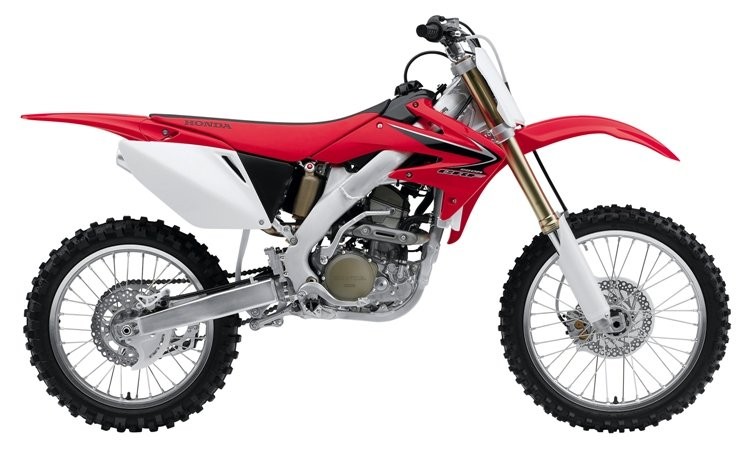
| Model | Honda CRF250R |
| Year | 2008 |
| Category | Motocross |
| Engine Type | Liquid-cooled 4-stroke single-cylinder, Unicam OHC, 4 valves |
| Weight | Approx. 93 kg dry |
| Displacement | 249.4 cc |
| Bore x Stroke | 78.0 x 52.2 mm |
| Compression Ratio | 13.1:1 |
| Fuel System | Keihin FCR 40 mm flat-slide carburettor with throttle-position sensor | Replacement Options |
| Ignition | ICM electronic ignition with electronic advance |
| Spark Plug | NGK R0409B-8; optional colder plug NGK R0409B-9 for extended high-speed use |
| Spark Plug Gap | 0.6-0.7 mm |
| Cooling System | Liquid cooled |
| Starting System | Kickstarter |
| Transmission | 5-speed constant-mesh, 1-N-2-3-4-5 |
| Clutch | Wet multi-plate, cable operated |
| Final Drive | Chain, 13T/51T final gearing |
| Overall Length | 2,172 mm |
| Overall Width | 827 mm |
| Overall Height | 1,277 mm |
| Wheelbase | 1,479 mm |
| Ground Clearance | 361 mm |
| Seat Height | 965 mm |
| Fuel Capacity | 7.3 L |
| Frame | Aluminium twin-tube frame with revised steering geometry and Honda Progressive Steering Damper |
| Front Tyre | 80/100-21 51M | Tyre Size Guide |
| Rear Tyre | 100/90-19 57M | Tyre Size Guide |
| Front Suspension | 47 mm Showa inverted twin-chamber cartridge fork with adjustable compression and rebound damping | Fork Oil Levels |
| Front Suspension Travel | 315 mm fork travel |
| Rear Suspension | Honda Pro-Link with Showa single shock, adjustable spring preload, rebound, low-speed compression and high-speed compression damping |
| Rear Suspension Travel | 318 mm |
| Fork Oil | Pro Honda HP Fork Oil 5W or equivalent; outer-chamber quantity varies with spring rate and suspension setup | Fork Oil Levels |
| Front Brake | Hydraulic single 240 mm disc with twin-piston caliper |
| Rear Brake | Hydraulic single 240 mm disc |
| Front Wheel Size | 21 in |
| Rear Wheel Size | 19 in |
| Fuel Type | Unleaded petrol, minimum 91 pump octane (R+M/2) |
| Premix Information | Not applicable - 4-stroke engine with separate lubrication |
| Gearbox Oil | SAE 10W-30 4-stroke motorcycle oil meeting JASO MA; approximately 0.60 L after draining and 0.70 L after disassembly |
| Air Filter | Washable oiled polyurethane foam air cleaner |
| Service Notes | Competition motorcycle with separate engine and transmission oil systems. Cold valve clearance: intake 0.12 ± 0.03 mm, exhaust 0.28 ± 0.03 mm. Inspect valve clearance, engine oil, transmission oil and air filter frequently under competition use. |
The 2008 Honda CRF250R represented a significant development of Honda's carburetted 250 four-stroke rather than a simple annual colour-and-graphics update. Although the familiar 249.4 cc Unicam engine and 40 mm Keihin FCR carburettor remained, Honda made substantial changes to the chassis, steering system, engine specification and suspension. The most visible engineering addition was Honda's Progressive Steering Damper, or HPSD, which appeared across Honda's motocross range for 2008.
The compact Showa steering damper was mounted behind the front number plate and connected directly to the lower triple clamp. Unlike a conventional steering damper that can provide noticeable resistance near the centre position, HPSD was designed to increase damping progressively as the handlebars moved farther away from straight ahead. Honda paired the system with revised steering geometry and different triple-clamp offset, aiming to make the CRF250R turn more willingly without sacrificing stability through fast, rough sections.
The engine also received meaningful development. Compression was raised to 13.1:1, while Honda revised the cylinder head, camshaft, intake and exhaust systems to strengthen power throughout the rev range. The 40 mm Keihin FCR remained one of the defining components of the carburetted CRF250R generation. Accurate accelerator-pump setup, jetting and cleanliness remain important on surviving bikes, and owners working on these systems can use the MXOwners carburettor reference when investigating replacement options.
Honda continued with the distinctive twin-muffler exhaust introduced two years earlier. The idea was still centred on mass centralisation: two shorter silencers allowed more exhaust weight to be positioned nearer the motorcycle's centre. By 2008 the twin-pipe system had become part of the CRF250R's identity, even though it also meant owners had twice as many muffler components to repack and maintain.
Showa suspension remained at both ends, with the 47 mm inverted twin-chamber fork offering separate compression and rebound adjustment. The rear Pro-Link shock provided spring preload together with low-speed and high-speed compression adjustment and rebound damping. Suspension setup is particularly important on these bikes because fork oil volume, spring rate and rider sag can noticeably alter cornering and bottoming resistance. The MXOwners fork oil reference is useful when checking suspension service information.
For today's owner, the 2008 CRF250R combines relatively straightforward mechanical systems with the high-performance maintenance demands of a competition four-stroke. Engine and transmission lubrication are separate, valve clearances need regular attention and the foam air filter must be kept properly cleaned and oiled. Dirt ingestion or neglected valve adjustment can quickly turn an otherwise healthy motocross engine into an expensive rebuild.
The bike is also old enough that bearings, linkage components, steering-head races and wheel bearings deserve careful inspection during restoration. The MXOwners bearing finder can help identify replacements, while the MXOwners parts finder can assist when tracking down model-specific components.
Historically, the 2008 CRF250R sits near the peak of Honda's carburetted 250 four-stroke development. It retained the familiar FCR-fed Unicam character but added HPSD, revised geometry, increased compression and further engine refinement. Those changes make it one of the more distinctive and technically interesting CRF250R models from the pre-fuel-injection era.