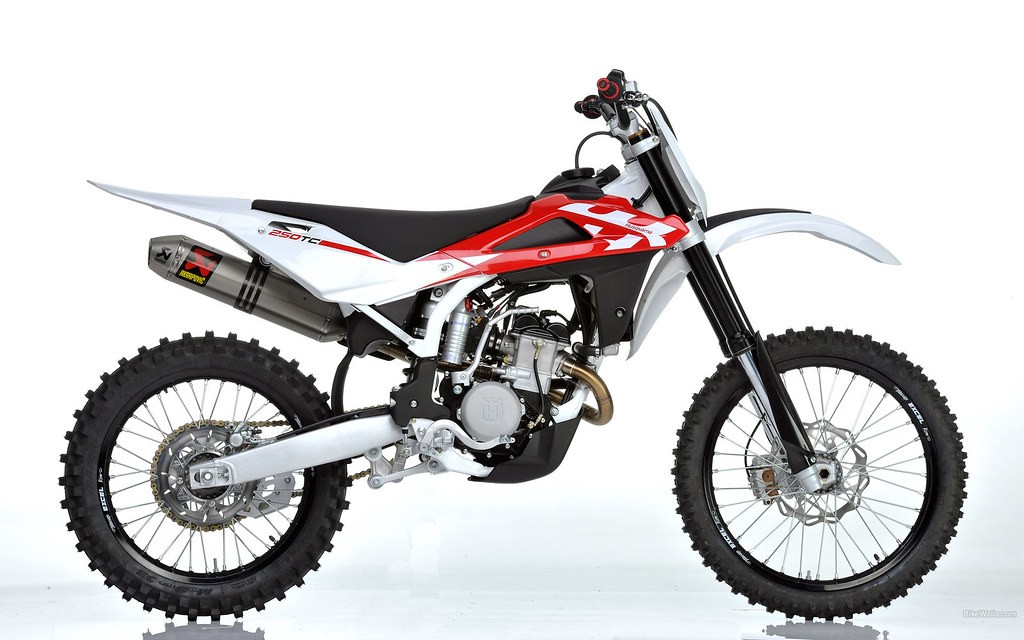
2008 Husqvarna TC250
General Specifications
| Model | Husqvarna TC250 |
| Year | 2008 |
| Category | Motocross |
| Engine Type | Single-cylinder, liquid-cooled, 4-stroke, DOHC, 4-valve |
| Weight | 100 kg dry |
Engine
| Displacement | 249.5 cc |
| Bore x Stroke | 76.0 x 55.0 mm |
| Compression Ratio | 12.9:1 |
| Fuel System | Keihin FCR-MX 37 mm flat-slide carburettor with accelerator pump and TPS | Replacement Options |
| Ignition | Electronic CDI with digitally controlled variable advance |
| Spark Plug | NGK CR8EB |
| Spark Plug Gap | 0.7 mm |
| Cooling System | Liquid cooled with pump circulation and twin radiators |
| Starting System | Kick starter with automatic decompressor |
Transmission
| Transmission | 5-speed constant-mesh manual |
| Clutch | Wet multi-plate, hydraulically operated |
| Final Drive | Chain; 12-tooth front / 50-tooth rear sprockets |
Dimensions
| Overall Length | 2207 mm |
| Overall Width | 820 mm |
| Overall Height | 1258 mm |
| Wheelbase | 1495 mm |
| Ground Clearance | 300 mm |
| Seat Height | 968 mm |
| Fuel Capacity | 7.2 L |
Chassis
| Frame | Steel single-tube cradle frame with round, rectangular and elliptical-section tubing and light-alloy rear subframe |
| Front Tyre | 80/100-21 Pirelli MT32A | Tyre Size Guide |
| Rear Tyre | 100/90-19 Pirelli MT32 | Tyre Size Guide |
Suspension
| Front Suspension | 50 mm Marzocchi upside-down hydraulic fork, adjustable for compression and rebound damping | Fork Oil Levels |
| Front Suspension Travel | 300 mm |
| Rear Suspension | Sachs hydraulic monoshock with progressive linkage, adjustable for spring preload, high/low-speed compression and rebound damping |
| Rear Suspension Travel | 296 mm |
| Fork Oil | AGIP Fork 7.5 (SAE 7.5); approximately 310 cm³ per fork leg |
Brakes & Wheels
| Front Brake | 260 mm Brembo hydraulic disc with floating 2-piston caliper |
| Rear Brake | 240 mm Brembo hydraulic disc with floating caliper |
| Front Wheel Size | 1.60 x 21 in light-alloy rim |
| Rear Wheel Size | 1.85 x 19 in light-alloy rim |
Service Data
| Fuel Type | Premium unleaded petrol, 98 RON recommended |
| Premix Information | Not applicable - 4-stroke engine |
| Gearbox Oil | Engine, gearbox and primary drive share AGIP Racing 4T SAE 10W-60; approximately 1.7 L with oil and filter replacement and 1.5 L for oil-only replacement |
| Air Filter | Oiled foam air filter |
| Service Notes | Competition motocross model with dry-sump lubrication and cartridge oil filter. Service engine oil and filter frequently, clean and re-oil the air filter after dusty riding and regularly inspect valve clearances, cam-chain condition, clutch, cooling system, drive chain, steering-head bearings, wheel bearings and suspension linkage. |
2008 Husqvarna TC250 – A Major Chassis Transformation Before the X-Light Era
The 2008 Husqvarna TC250 was a significant update rather than a routine year-to-year refresh. The familiar 249.5cc DOHC four-stroke engine carried over, but Husqvarna substantially reworked the chassis, ergonomics and suspension in an effort to address one of the previous TC250's biggest weaknesses: it felt larger and heavier than a modern 250F should. The result was a noticeably slimmer, easier-to-move-around motocross bike and an important stepping stone toward the completely new X-Light TC250 that would arrive for 2009.
The engine retained the established 76.0 x 55.0 mm bore and stroke, 12.9:1 compression ratio and five-speed motocross gearbox. Fuel continued to be delivered through a 37 mm Keihin FCR-MX flat-slide carburettor with an accelerator pump and throttle-position sensor. These carburettors provide excellent throttle response when correctly adjusted, but worn slides, blocked pilot circuits or poorly timed accelerator pumps can make an older TC250 difficult to start and hesitant off idle. Owners repairing the original fuel system can compare replacement carburettor options when parts are no longer serviceable.
The major story for 2008 was the chassis. Husqvarna revised the frame and rider interface to make the motorcycle feel considerably slimmer and more manageable. The seat, fuel tank, radiator shrouds and side panels were redesigned to allow easier rider movement, while changes to the chassis helped reduce the top-heavy feeling for which earlier TC250s had been criticised. Contemporary testing noted a substantial improvement in handling, comfort and steering compared with the previous generation.
Front suspension was upgraded to a large 50 mm Marzocchi inverted fork with around 300 mm of travel, while a Sachs rear shock replaced the Öhlins unit used on some earlier TC models. Rear-wheel travel was approximately 296 mm. Both ends were adjustable for competition use, and correct fork oil quantity remains particularly important when rebuilding the original Marzocchi units. The factory specification calls for SAE 7.5 fork oil at approximately 310 cm³ per leg, and the MXOwners fork oil reference can help when checking service information.
The TC250 continued to use a 21-inch front and 19-inch rear motocross wheel combination, with an 80/100-21 front tyre and 100/90-19 rear. Brembo hydraulic disc brakes used a 260 mm rotor at the front and 240 mm at the rear. Owners replacing old or hardened tyres can check modern equivalents using the MXOwners tyre size guide.
Maintenance remains especially important on these early high-performance four-strokes. Engine, gearbox and primary transmission share the same SAE 10W-60 lubricant, and the factory system uses dry-sump lubrication with oil pumps and a replaceable cartridge filter. Frequent oil and filter changes, accurate valve-clearance checks and meticulous foam-air-filter maintenance are essential. Wheel, steering-head and linkage bearings should also be checked carefully on machines that have spent years in motocross conditions.
Historically, the 2008 TC250 occupies an interesting position. It was the final major development of Husqvarna's original 250 four-stroke platform before the company introduced the dramatically smaller X-Light engine and new chassis for 2009. The 2008 model therefore combined the mature, established engine with a substantially improved chassis and ergonomics. For owners and collectors, it represents the most developed version of the first-generation Italian TC250 before Husqvarna took another major technological step into its X-Light era.