| Model | Honda CRF450R |
| Year | 2009 |
| Category | Motocross |
| Engine Type | Liquid-cooled 4-stroke single-cylinder, Unicam OHC, 4 valves |
| Weight | 106.5 kg curb weight, including required fluids and full fuel tank |
| Displacement | 449.4 cc |
| Bore x Stroke | 96.0 x 62.1 mm |
| Compression Ratio | 12.0:1 |
| Fuel System | Programmed Fuel Injection (PGM-FI), 50 mm throttle body |
| Ignition | Full-transistor electronic ignition with three-gear-position electronic advance |
| Spark Plug | NGK SILMAR9A9S; optional colder plug NGK SILMAR10A9S |
| Spark Plug Gap | 0.8-0.9 mm |
| Cooling System | Liquid cooled |
| Starting System | Kickstarter |
| Transmission | Close-ratio 5-speed constant-mesh, 1-N-2-3-4-5 |
| Clutch | Wet multi-plate, cable operated |
| Final Drive | #520 chain, 13T/48T sprockets |
| Overall Length | 2,193 mm |
| Overall Width | 827 mm |
| Overall Height | 1,274 mm |
| Wheelbase | 1,491 mm |
| Ground Clearance | 333 mm |
| Seat Height | 955 mm |
| Fuel Capacity | 5.7 L |
| Frame | Fifth-generation aluminium twin-spar frame |
| Front Tyre | 80/100-21 51M | Tyre Size Guide |
| Rear Tyre | 120/80-19 63M | Tyre Size Guide |
| Front Suspension | 48 mm KYB inverted Air-Oil-Separate twin-chamber fork with adjustable compression and rebound damping | Fork Oil Levels |
| Front Suspension Travel | 310 mm |
| Rear Suspension | Honda Pro-Link with KYB single shock, adjustable spring preload, low-speed and high-speed compression damping and rebound damping |
| Rear Suspension Travel | 320 mm |
| Fork Oil | KYB KHL15-11 fork oil or equivalent specified fork oil; fork damper recommended fill approximately 192 cc before bleeding, with outer-chamber quantity adjusted to spring and setup |
| Front Brake | 240 mm hydraulic single disc with twin-piston caliper |
| Rear Brake | 240 mm hydraulic single disc |
| Front Wheel Size | 21 in |
| Rear Wheel Size | 19 in |
| Fuel Type | Unleaded petrol, minimum 91 pump octane (R+M/2) |
| Premix Information | Not applicable - 4-stroke engine with separate lubrication |
| Gearbox Oil | Pro Honda GN4 4-stroke motorcycle oil or equivalent SAE 10W-30, JASO MA; approximately 0.59 L after draining |
| Air Filter | Washable oiled polyurethane foam air cleaner |
| Service Notes | Competition motorcycle with separate engine and transmission oil systems. Fuel injection requires correct idle speed of approximately 1,750 ± 100 rpm. Spark plug gap should not be adjusted; replace the plug if outside specification. Check valve clearance, oils, air filter, chain and suspension frequently under racing conditions. |
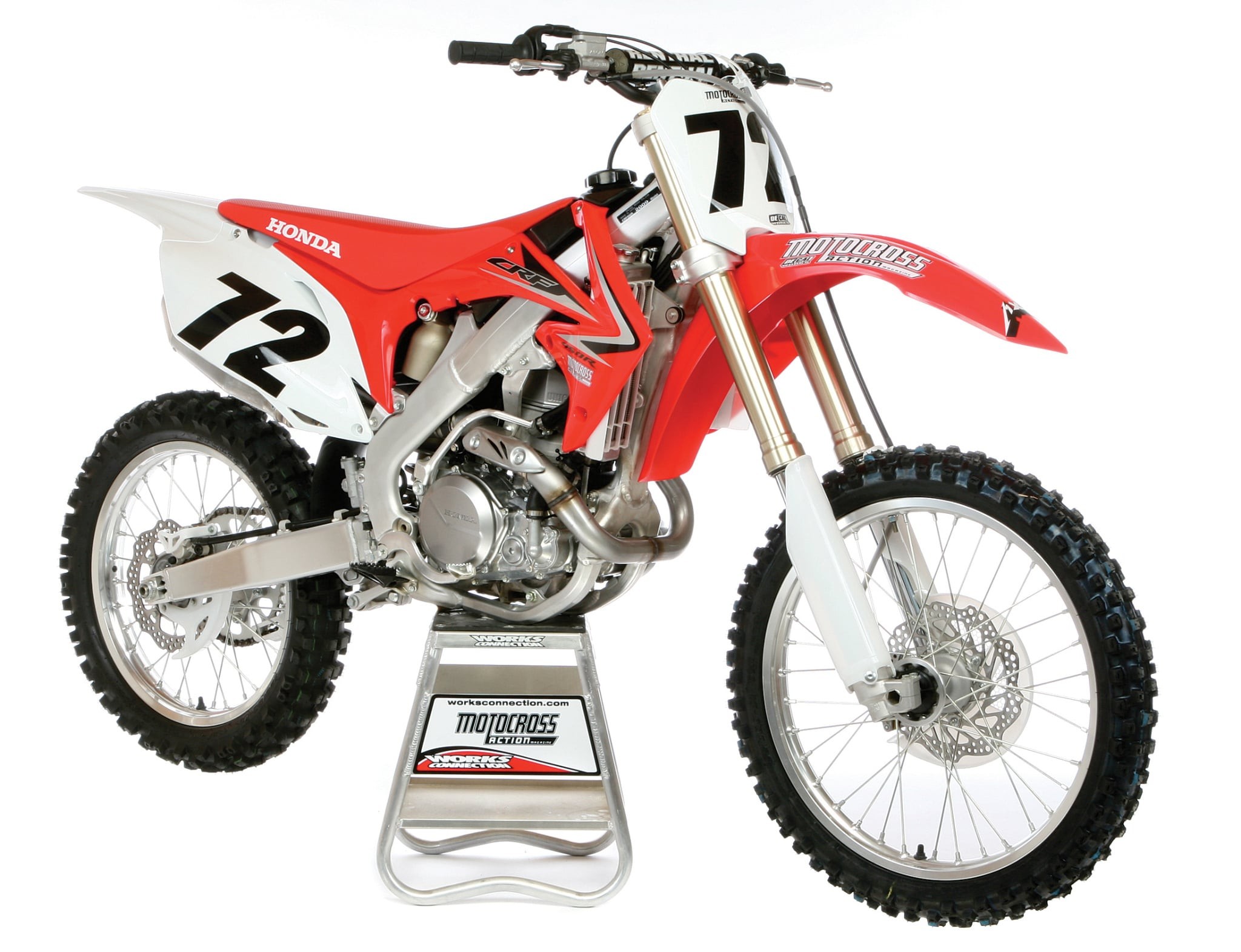
The 2009 Honda CRF450R was one of the biggest changes in the model's history. This was not a routine annual update: Honda replaced the previous carburetted platform with a substantially redesigned motorcycle featuring a new engine, a new fifth-generation aluminium frame, electronic fuel injection and KYB suspension. Very few major components were carried over unchanged from the 2008 machine, making 2009 the beginning of a distinct CRF450R generation.
The headline change was Honda's Programmed Fuel Injection system. The familiar Keihin FCR carburettor disappeared, replaced by a 50 mm throttle body, injector, fuel pump, ECU and associated sensors. Unlike road motorcycles that could rely on a battery, Honda developed a batteryless system suitable for motocross. Once the engine was turning during starting, the electrical system supplied the ECU and fuel pump. The result was much more consistent fuelling across temperature and altitude changes, as well as the ability to tune fuel delivery and ignition electronically.
Honda redesigned the 449.4 cc Unicam engine around the new chassis rather than simply adding injection to the old motor. The connecting rod was shortened, the cylinder height reduced and the cylinder head made more compact. The exhaust-valve arrangement changed to individual rocker arms, and the engine itself became narrower and lighter. These changes allowed Honda to position the engine lower and farther forward in the frame, concentrating mass closer to the centre of the motorcycle.
The chassis was equally new. Honda's fifth-generation aluminium twin-spar frame used revised geometry and a longer swingarm, while the fuel tank shrank from roughly 7.2 litres to 5.7 litres thanks in part to the improved efficiency of fuel injection. The flatter seat and slimmer bodywork made it easier for riders to move forward in corners, while improved access to the air filter addressed a long-standing complaint with earlier CRF450Rs. Owners identifying components during restoration can use the MXOwners parts finder when comparing replacement parts.
Another major break with previous CRF450R practice was the suspension. Honda moved away from the Showa fork and shock used on earlier models and fitted KYB units front and rear. The 48 mm KYB Air-Oil-Separate fork offered adjustable compression and rebound damping, while the Pro-Link rear shock retained extensive low-speed, high-speed and rebound adjustment. Correct oil quantity has a major effect on twin-chamber fork behaviour, so the MXOwners fork oil reference is useful when servicing older suspension.
The 2009 bike also retained Honda's Progressive Steering Damper concept while revising the overall steering geometry. The combination of the more compact engine, lower centre of gravity, longer swingarm and new chassis produced a motorcycle that felt noticeably lighter and turned more quickly than its predecessor, even though it remained a full-size 450 four-stroke.
For today's owner, the 2009 CRF450R is important because it marks the dividing line between Honda's carburetted era and its modern fuel-injected motocross machines. It also introduced systems that require a slightly different maintenance mindset. Fuel filters, injector condition, electrical connectors and fuel-pump health become part of ownership alongside traditional CRF jobs such as valve-clearance checks, separate engine and gearbox oil changes and regular air-filter servicing.
The 2009 CRF450R was therefore far more than an updated 2008 bike. It established a new engine and chassis architecture, introduced EFI to Honda's premier motocross machine and changed the suspension supplier at the same time. For riders and collectors, it remains one of the most historically significant CRF450R model years and an important milestone in the transition from mechanically simple carburetted 450s to the electronically managed motocross bikes that followed.