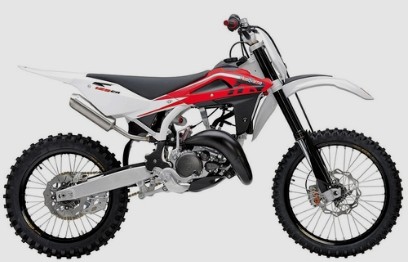
2010 Husqvarna CR125
General Specifications
| Model | Husqvarna CR125 |
| Year | 2010 |
| Category | Motocross |
| Engine Type | Single-cylinder, liquid-cooled, 2-stroke with reed-valve induction and mechanically controlled H.T.S. exhaust power valve |
| Weight | 92.0 kg kerb weight without fuel |
Engine
| Displacement | 124.8 cc |
| Bore x Stroke | 54.0 x 54.5 mm |
| Compression Ratio | 8.8:1 with exhaust ports closed |
| Fuel System | Mikuni TMX 38 mm carburettor | Replacement Options |
| Ignition | Digital capacitor-discharge ignition with variable advance |
| Spark Plug | NGK BR9EG or Champion QN84 |
| Spark Plug Gap | 0.6-0.7 mm |
| Cooling System | Liquid cooled with water-pump circulation and twin radiators |
| Starting System | Kick starter |
Transmission
| Transmission | 6-speed constant-mesh manual |
| Clutch | Wet multi-plate, mechanically operated |
| Final Drive | Chain; 13-tooth front / 50-tooth rear sprockets |
Dimensions
| Overall Length | 2215 mm |
| Overall Width | 820 mm |
| Overall Height | 1305 mm |
| Wheelbase | 1460 mm |
| Ground Clearance | 325 mm |
| Seat Height | 985 mm |
| Fuel Capacity | 7.0 L including reserve |
Chassis
| Frame | Reinforced chromium-molybdenum steel single-tube cradle frame with round-section tubing and light-alloy rear subframe |
| Front Tyre | 80/100-21 Pirelli MT32A or Dunlop D756 | Tyre Size Guide |
| Rear Tyre | 100/90-19 Pirelli MT32 or Dunlop D756 | Tyre Size Guide |
Suspension
| Front Suspension | 48 mm Kayaba upside-down sealed-cartridge AOS fork with compression and rebound adjustment | Fork Oil Levels |
| Front Suspension Travel | 300 mm |
| Rear Suspension | Sachs progressive-linkage hydraulic monoshock with separate horizontal reservoir, adjustable for spring preload, rebound and compression damping |
| Rear Suspension Travel | 295 mm |
| Fork Oil | KHL15-11 fork oil; 352 cm³ per fork leg |
Brakes & Wheels
| Front Brake | 260 mm Wave-type fixed hydraulic disc with floating caliper |
| Rear Brake | 240 mm Wave-type floating hydraulic disc with floating caliper |
| Front Wheel Size | 1.60 x 21 in Takasago Excel light-alloy rim |
| Rear Wheel Size | 2.15 x 19 in Takasago Excel light-alloy rim |
Service Data
| Fuel Type | Premium unleaded petrol, 98 RON recommended |
| Premix Information | 4% oil mixture during running-in (25:1); not less than 3% after running-in (approximately 33:1), factory oil specification Castrol A747 | Premix Calculator |
| Gearbox Oil | 0.8 L Castrol Power 1 Racing 10W-40 or equivalent wet-clutch-compatible motorcycle oil |
| Air Filter | Oiled foam air filter |
| Service Notes | Competition motocross model. The 2010 CR125 received a reinforced frame, new Kayaba suspension, revised Sachs rear shock, new exhaust pipe and silencer, stronger wheel hubs and axles, and revised plastics. Inspect the piston, rings, reed valve, H.T.S. power-valve system, air filter, transmission oil, wheel bearings and suspension linkage frequently under race use. |
2010 Husqvarna CR125 – Kayaba Suspension and a Major Chassis Update
The 2010 Husqvarna CR125 represented a significant update rather than a routine annual refresh. While the familiar Italian-built 124.8cc two-stroke engine remained at the centre of the motorcycle, Husqvarna substantially revised the chassis, suspension, exhaust and bodywork. The result was one of the most developed versions of the traditional CR125 platform and evidence that Husqvarna still considered the 125cc two-stroke a serious competition motorcycle at a time when many manufacturers were concentrating almost entirely on four-strokes.
The biggest change was the suspension. Husqvarna moved away from the Marzocchi forks used on earlier CR125s and fitted 48 mm Kayaba sealed-cartridge AOS forks. The Air-Oil-Separate design kept the damping oil and air chambers separated and was intended to provide more consistent damping, smoother action and improved stability. The forks provided 300 mm of travel and incorporated compression and rebound adjustment. New fork clamps were required for the Kayaba units, making the change considerably more substantial than a simple internal re-valve. Owners servicing these components can use the MXOwners fork oil reference when checking suspension information.
The rear suspension was revised at the same time. A new Sachs shock featured a redesigned horizontal reservoir to make more efficient use of available space, together with revised damping settings. The steel chassis was also reinforced in high-stress areas, while the geometry of the upper and lower engine mounts was altered and new chromium-molybdenum frame members were incorporated. Stronger and lighter wheel hubs and stronger wheel axles were further detail improvements aimed at durability without unnecessarily increasing weight.
The engine itself retained the established 54.0 x 54.5 mm bore and stroke, reed-valve intake, mechanical H.T.S. exhaust power valve and six-speed transmission. Fuel delivery remained through a 38 mm Mikuni TMX carburettor. Husqvarna did, however, develop a new exhaust pipe to improve power distribution, along with a new Arrow silencer. On a 125cc two-stroke, where exhaust tuning and carburetion strongly influence the powerband, these changes could noticeably alter how usable the engine felt. Owners restoring the original induction system can compare replacement carburettor options where required.
The 2010 CR125 also received stronger, more flexible plastics and Husqvarna's IPD in-mould graphics, where the decoration was incorporated into the plastic rather than applied as conventional surface stickers. Although largely cosmetic, it gave the machine a more modern appearance and helped graphics survive the punishment of motocross use.
Original motocross wheel sizing remained conventional at 21 inches front and 19 inches rear, with 80/100-21 and 100/90-19 tyres. Anyone returning an older CR125 to riding condition can compare available modern rubber using the MXOwners tyre size guide. Chassis restoration should also include careful inspection of wheel, steering-head and suspension-linkage bearings, particularly on machines that have spent years being raced and pressure washed.
Historically, the 2010 CR125 is significant because Husqvarna continued investing in the lightweight two-stroke motocross concept rather than merely keeping an ageing model in the catalogue. The Kayaba fork conversion, new Sachs shock, reinforced frame and revised exhaust made it substantially different from the 2009 machine while preserving the simple, high-revving character that defined the CR125. It remains an interesting example of Husqvarna's late Italian era and of a period when the company was determined to keep the traditional 125 two-stroke competitive.