
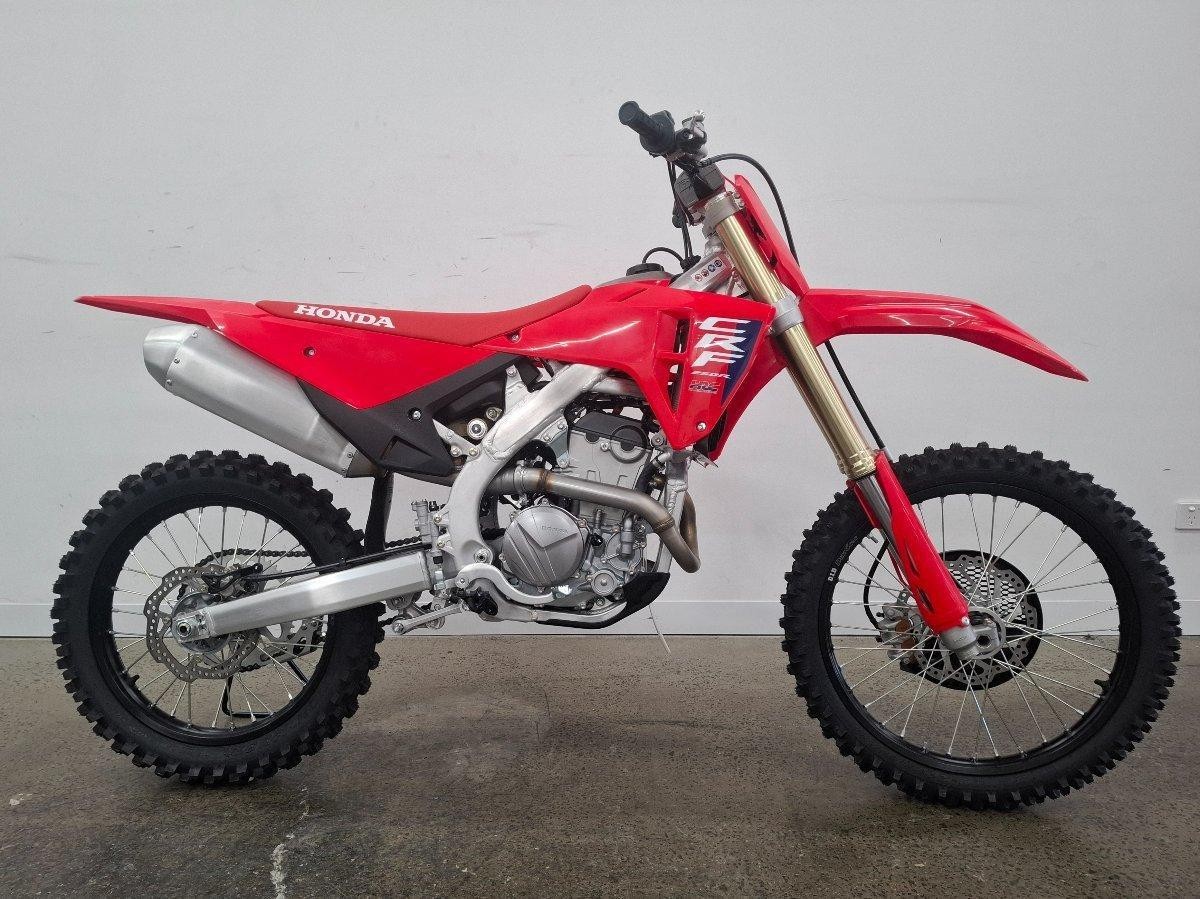
| Model | Honda CRF250R |
| Year | 2010 |
| Category | Motocross |
| Engine Type | Liquid-cooled 4-stroke single-cylinder, Unicam OHC, 4 valves |
| Weight | 102.5 kg curb weight, including required fluids and full fuel tank |
| Displacement | 249.4 cc |
| Bore x Stroke | 76.8 x 53.8 mm |
| Compression Ratio | 13.2:1 |
| Fuel System | Programmed Fuel Injection (PGM-FI), 50 mm throttle body with 12-hole injector |
| Ignition | Full-transistor electronic ignition with electronic advance |
| Spark Plug | NGK R0451B-8 |
| Spark Plug Gap | 0.6-0.7 mm |
| Cooling System | Liquid cooled |
| Starting System | Kickstarter |
| Transmission | Close-ratio 5-speed constant-mesh |
| Clutch | Wet multi-plate, cable operated |
| Final Drive | #520 chain, 13T/48T final gearing |
| Overall Length | 2,187 mm |
| Overall Width | 827 mm |
| Overall Height | 1,273 mm |
| Wheelbase | 1,493 mm |
| Ground Clearance | 325 mm |
| Seat Height | 955 mm |
| Fuel Capacity | 5.7 L |
| Frame | Twin-spar aluminium frame with Honda Progressive Steering Damper (HPSD) |
| Front Tyre | 80/100-21 51M | Tyre Size Guide |
| Rear Tyre | 100/90-19 57M | Tyre Size Guide |
| Front Suspension | 48 mm Showa inverted twin-chamber cartridge fork with adjustable compression and rebound damping | Fork Oil Levels |
| Front Suspension Travel | 273 mm front wheel travel; 310 mm fork stroke |
| Rear Suspension | Honda Pro-Link with Showa single shock, adjustable spring preload, rebound, low-speed compression and high-speed compression damping |
| Rear Suspension Travel | 320 mm |
| Fork Oil | Pro Honda HP Fork Oil SS-19; standard outer-chamber capacity 342 cc per leg with standard 4.4 N/mm spring; fork damper fill 200 cc |
| Front Brake | Hydraulic single 240 mm disc with twin-piston caliper |
| Rear Brake | Hydraulic single 240 mm disc |
| Front Wheel Size | 21 in |
| Rear Wheel Size | 19 in |
| Fuel Type | Unleaded petrol, minimum 91 pump octane (R+M/2) |
| Premix Information | Not applicable - 4-stroke engine with separate lubrication |
| Gearbox Oil | Pro Honda GN4 or equivalent SAE 10W-30 motorcycle oil meeting API SG or higher and JASO MA; 0.68 L after draining, 0.75 L after disassembly |
| Air Filter | Washable oiled polyurethane foam air cleaner |
| Service Notes | Competition motorcycle with separate engine and transmission oil systems. Cold valve clearance: intake 0.12 ± 0.03 mm, exhaust 0.28 ± 0.03 mm. Standard idle speed 2,000 ± 100 rpm. Spark plug gap should be checked with a wire-type gauge and the plug replaced rather than regapped if outside specification. |
The 2010 Honda CRF250R was a genuine new-generation model and one of the biggest changes in the history of Honda's 250 four-stroke motocrosser. Almost everything was redesigned: the engine, frame, suspension, bodywork, intake system and exhaust. Most importantly, the Keihin FCR carburettor that had defined earlier CRF250Rs disappeared, replaced by Honda's Programmed Fuel Injection system.
The new 249.4 cc Unicam engine used a 50 mm throttle body and 12-hole injector, bringing electronic fuel injection to the CRF250R for the first time. Honda designed the batteryless PGM-FI system specifically for motocross, using electrical power generated during kick starting to operate the ECU, fuel pump and injector. The result was more consistent fuelling across temperature, altitude and riding conditions, while eliminating much of the jetting work associated with the previous FCR carburettor.
The engine itself was far more than the old motor with an injector attached. Honda changed the bore and stroke to 76.8 x 53.8 mm, redesigned the cylinder head and intake layout, altered the transmission ratios and developed a more compact overall package. The new engine architecture allowed the mass to be positioned closer to the motorcycle's centre, helping the chassis turn more easily and respond more quickly to rider input.
Honda also abandoned the twin-muffler exhaust that had been a signature CRF250R feature since 2006. The 2010 machine returned to a single, shorter muffler positioned closer to the centre of the bike. The new exhaust was lighter and simpler, while helping Honda's ongoing effort to centralise mass rather than simply chase the lowest possible static weight.
The aluminium chassis was completely revised and shared much of its concept with the contemporary CRF450R. Steering geometry became sharper, triple-clamp offset changed and the fuel tank shrank to 5.7 litres. Honda retained its Progressive Steering Damper, giving the new chassis additional control as steering movement increased. The bodywork was also redesigned to provide a flatter, slimmer riding position and make it easier for the rider to move forward during cornering.
Showa supplied new suspension components specifically developed around the redesigned chassis. The 48 mm inverted twin-chamber fork offered adjustable compression and rebound damping, while the Pro-Link rear shock provided spring preload, rebound and separate high- and low-speed compression adjustment. Correct oil volume is particularly important with these forks, and owners servicing them can use the MXOwners fork oil reference when checking setup and maintenance information.
The new generation also changed what owners needed to pay attention to during maintenance. Alongside traditional CRF jobs such as valve-clearance checks, foam air-filter servicing and separate engine and transmission oil changes, owners now had an injector, fuel pump, fuel filter, sensors and electrical connectors to maintain. The fuel-injected system was mechanically simpler from a tuning perspective, but troubleshooting increasingly required attention to electrical as well as mechanical condition.
For riders restoring or maintaining one today, the MXOwners parts finder can help identify replacement components, while the MXOwners rear suspension reference is useful when working through shock setup and servicing.
Historically, the 2010 CRF250R marks the dividing line between Honda's carburetted 250F era and the electronically managed machines that followed. The move to fuel injection, the return to a single exhaust, the compact new engine and the redesigned chassis made it fundamentally different from the 2009 model. For that reason, 2010 remains one of the most significant CRF250R model years and the foundation for Honda's modern fuel-injected 250 motocross development.