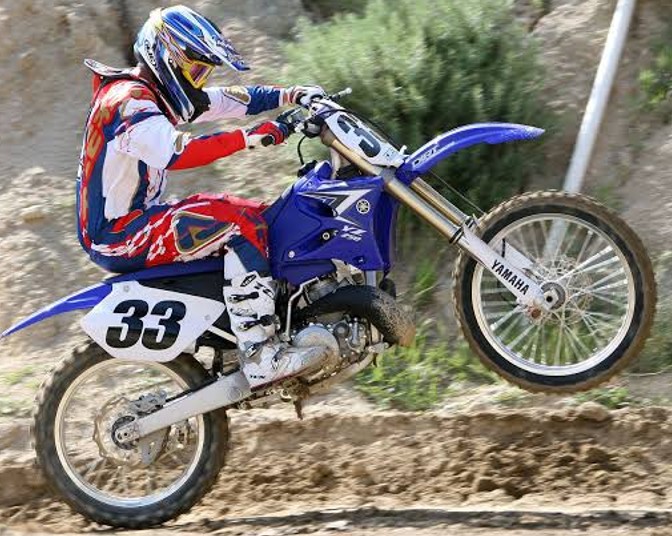
2010 Yamaha YZ250
General Specifications
| Model | Yamaha YZ250 |
| Year | 2010 |
| Category | Motocross |
| Engine Type | Liquid-cooled 2-stroke single-cylinder, reed-valve induction with Yamaha Power Valve System (YPVS) |
| Weight | 103 kg wet weight with oil and fuel |
Engine
| Displacement | 249 cc |
| Bore x Stroke | 66.4 x 72.0 mm |
| Compression Ratio | 8.9-10.6:1 |
| Fuel System | Keihin PWK38S 38 mm carburettor with reed-valve induction | Replacement Options |
| Ignition | CDI magneto |
| Spark Plug | NGK BR8EG |
| Spark Plug Gap | 0.5-0.6 mm |
| Cooling System | Liquid cooled |
| Starting System | Kickstarter |
Transmission
| Transmission | 5-speed constant-mesh |
| Clutch | Wet multi-plate, coil spring |
| Final Drive | Chain, 14T/50T final gearing |
Dimensions
| Overall Length | 2,178 mm |
| Overall Width | 827 mm |
| Overall Height | 1,306 mm |
| Wheelbase | 1,481 mm |
| Ground Clearance | 382 mm |
| Seat Height | 994 mm |
| Fuel Capacity | 8.0 L |
Chassis
Suspension
| Front Suspension | 48 mm KYB Speed Sensitive System inverted twin-chamber fork with adjustable compression and rebound damping | Fork Oil Levels |
| Front Suspension Travel | 300 mm |
| Rear Suspension | KYB link-type Monocross single shock with adjustable spring preload, rebound, low-speed compression and high-speed compression damping |
| Rear Suspension Travel | 315 mm |
| Fork Oil | Yamaha Suspension Oil S1; standard outer-chamber amount 330 cc per leg, adjustable 300-375 cc; damper assembly 199 cc |
Brakes & Wheels
| Front Brake | Hydraulic single 250 mm disc with twin-piston caliper |
| Rear Brake | Hydraulic single 245 mm disc |
| Front Wheel Size | 21 x 1.60 in |
| Rear Wheel Size | 19 x 2.15 in |
Service Data
| Fuel Type | Premium unleaded petrol, 95 RON or higher |
| Premix Information | 30:1 petrol-to-2-stroke oil using Yamalube 2-R or equivalent high-quality racing 2-stroke oil | Premix Calculator |
| Gearbox Oil | Yamalube SAE 10W-40 motorcycle oil, API SG or higher, JASO MA; 0.75 L periodic oil change, 0.80 L total capacity |
| Air Filter | Washable oiled foam air-filter element |
| Service Notes | Competition 2-stroke with premix engine lubrication and separate transmission oil. Maintain the 30:1 premix ratio, clean and oil the air filter frequently, inspect spark plug and piston condition regularly, and keep the YPVS power-valve system clean and correctly adjusted. |
2010 Yamaha YZ250: Almost Completely Unchanged and Still Going Strong
The 2010 Yamaha YZ250 was firmly a minor-update model. In mechanical terms it was essentially the same motorcycle as the 2009 version, with Yamaha limiting the year's visible changes largely to graphics. By this stage the YZ250 platform had already settled into the combination that would make it one of the longest-lived motocross bikes in production: a 249 cc two-stroke engine, aluminium frame and KYB Speed Sensitive System suspension.
The engine retained its 66.4 x 72.0 mm bore and stroke, reed-valve induction, Yamaha Power Valve System and 38 mm Keihin PWK carburettor. Its broad power delivery and relatively simple mechanical layout remained a major attraction for riders who preferred the character and maintenance simplicity of a two-stroke. Owners maintaining the carburettor can use the MXOwners carburettor reference when checking replacement and service options.
Suspension remained one of the YZ250's strongest features. The 48 mm KYB SSS fork provided 300 mm of travel, while the link-type Monocross rear suspension offered 315 mm. Correct oil quantity and damping setup make a major difference to these forks, and the MXOwners fork oil reference is useful when servicing the front end.
Yamaha continued to specify a 30:1 premix ratio using Yamalube 2-R or an equivalent racing two-stroke oil. The MXOwners premix calculator can help owners prepare accurate fuel mixtures, while the gearbox uses its own separate 10W-40 oil supply.
The significance of the 2010 YZ250 is really its continuity. While much of the motocross market had shifted heavily toward four-strokes, Yamaha chose to keep the proven YZ250 in production alongside the YZ250F. That decision gave two-stroke riders a factory-supported Japanese 250 at a time when several competing models had already disappeared.