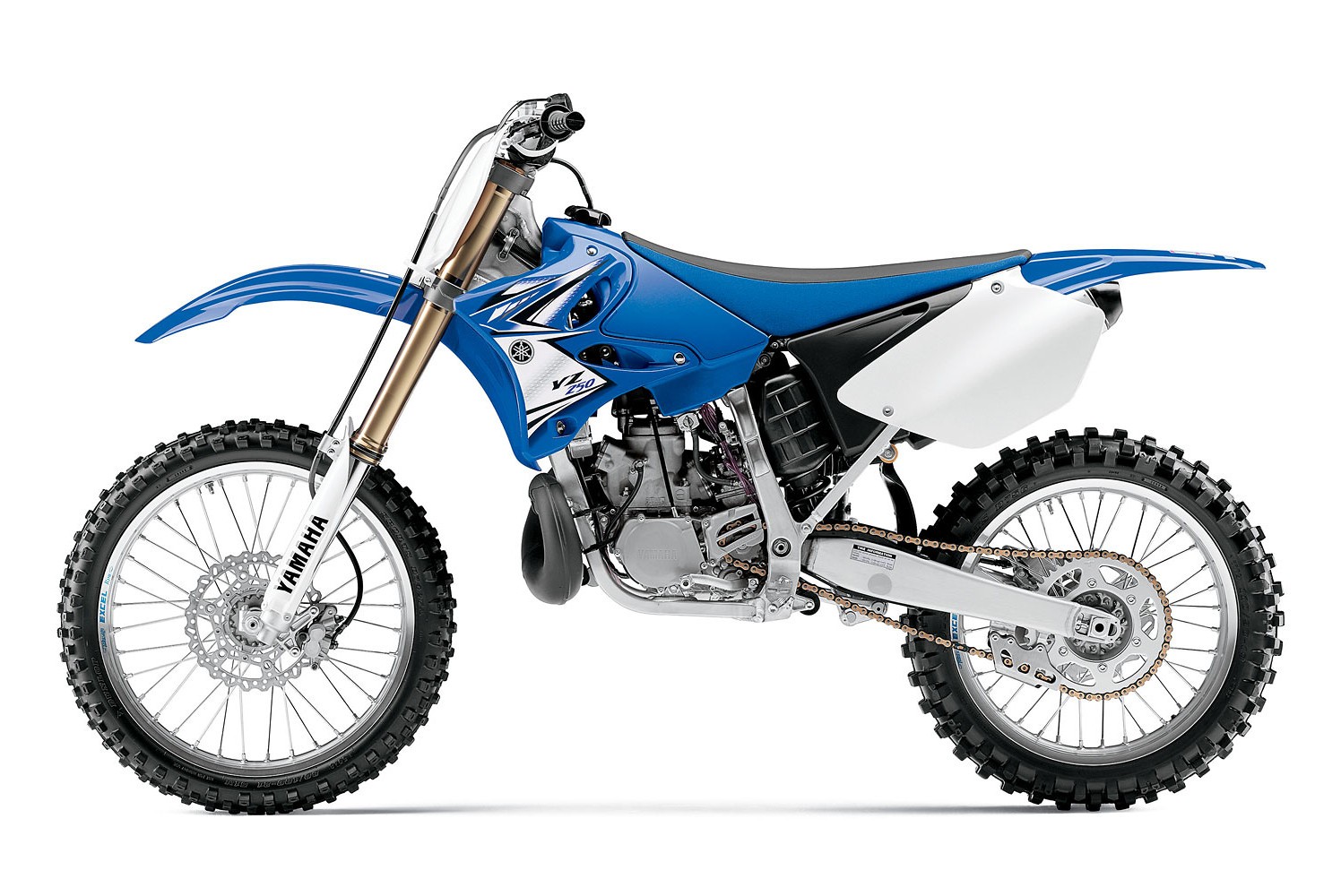
2011 Yamaha YZ250
General Specifications
| Model | Yamaha YZ250 |
| Year | 2011 |
| Category | Motocross / Competition Off-Road |
| Engine Type | Liquid-cooled, single-cylinder, 2-stroke, reed-valve induction with Yamaha Power Valve System (YPVS) |
| Weight | 103 kg (227 lb) wet / approximately 96 kg dry |
Engine
| Displacement | 249 cc |
| Bore x Stroke | 66.4 x 72.0 mm |
| Compression Ratio | 8.9–10.6:1 (variable effective ratio due to exhaust-port timing) |
| Fuel System | Keihin PWK38S, 38 mm flat-slide carburettor, reed-valve induction | Replacement Options |
| Ignition | CDI magneto ignition |
| Spark Plug | NGK BR8EG |
| Spark Plug Gap | 0.5–0.6 mm (0.020–0.024 in) |
| Cooling System | Liquid-cooled, twin radiators; coolant capacity 1.20 L |
| Starting System | Kick starter |
Transmission
| Transmission | 5-speed constant-mesh manual |
| Clutch | Wet, multi-plate, cable-operated |
| Final Drive | Chain drive; standard gearing 14T front / 50T rear |
Dimensions
| Overall Length | 2,178 mm (Australia / USA specification) |
| Overall Width | 827 mm |
| Overall Height | 1,306 mm (Australia / USA specification) |
| Wheelbase | 1,481 mm |
| Ground Clearance | 382 mm (Australia / USA specification) |
| Seat Height | 994 mm (Australia / USA specification) |
| Fuel Capacity | 8.0 litres |
Chassis
Suspension
| Front Suspension | 48 mm KYB upside-down Speed Sensitive System (SSS) cartridge forks, adjustable compression and rebound damping | Fork Oil Levels |
| Front Suspension Travel | 300 mm (11.8 in) |
| Rear Suspension | KYB gas/oil-damped Monocross shock with linkage, adjustable spring preload, compression and rebound damping |
| Rear Suspension Travel | 315 mm (12.4 in) |
| Fork Oil | Yamaha Suspension Oil S1; KYB twin-chamber forks. Inner damper: 199 mL per leg. Outer chamber: 330 mL standard per leg (adjustable 300–375 mL). Quantities apply to their respective chambers, not a single combined fill. |
Brakes & Wheels
| Front Brake | Hydraulic single disc, 250 mm rotor, twin-piston caliper |
| Rear Brake | Hydraulic single disc, 245 mm rotor, single-piston caliper |
| Front Wheel Size | 21-inch spoked wheel |
| Rear Wheel Size | 19-inch spoked wheel |
Service Data
| Fuel Type | Premium unleaded petrol, minimum 95 RON, mixed with suitable 2-stroke oil |
| Premix Information | 30:1 petrol-to-oil ratio using Yamaha Yamalube 2-R or suitable equivalent 2-stroke oil, as specified by Yamaha. Approximately 33.3 mL oil per litre of petrol | Premix Calculator |
| Gearbox Oil | Yamalube SAE 10W-40, API SG or higher, JASO MA. Periodic oil change: 0.75 L (750 mL). Total capacity: 0.80 L (800 mL). |
| Air Filter | Reusable, oil-treated foam air-filter element |
| Service Notes | Competition-use 2-stroke motorcycle. Check the air filter, drive chain, coolant, transmission oil level, brake condition and spoke tension regularly. Inspect piston, rings, reeds and YPVS components according to operating hours and racing conditions. Use the specified 30:1 premix ratio and keep the Keihin carburettor correctly jetted for temperature, altitude and fuel. Spark plug tightening torque: 20 Nm. Check fork seals, suspension linkage bearings and steering-head bearings regularly. The 2011 model received a revised silencer, lower compression and carburettor jetting changes in certain markets; verify regional specifications when ordering engine or exhaust components. |
2011 Yamaha YZ250 – The Proven Two-Stroke That Refused to Disappear
By 2011, the motocross world had become dominated by four-stroke machinery, but Yamaha was still producing one of the most respected 250cc two-strokes ever built. The 2011 Yamaha YZ250 was not a new-generation motorcycle. Instead, it continued the proven aluminium-framed platform introduced in 2005, with relatively minor refinements that preserved the character riders had come to appreciate.
Although the Australian launch information emphasised new graphics, the 2011 model also received technical revisions in certain international markets. These included a longer, quieter silencer, reduced cylinder-head compression and revised carburettor jetting. The changes were intended largely to harmonise specifications between markets and improve compliance with noise requirements rather than transform the motorcycle's performance.
The heart of the YZ250 remained its 249cc liquid-cooled two-stroke engine, fitted with Yamaha's Power Valve System and a 38 mm Keihin PWK carburettor. Unlike the increasingly complex fuel-injected four-strokes, the YZ250 offered straightforward mechanical servicing, responsive throttle characteristics and strong power delivery without the additional maintenance associated with a four-stroke valve train. Owners maintaining the original carburettor or investigating alternatives can explore the MXOwners carburettor information and replacement options.
One of the motorcycle's strongest features was its suspension. Yamaha retained the highly regarded 48 mm Kayaba Speed Sensitive System front forks, offering 300 mm of travel, together with a fully adjustable rear Monocross suspension system providing 315 mm of travel. These components gave the YZ250 a reputation for predictable handling, good bump absorption and competitive performance straight from the showroom. Correct oil quantities and suspension servicing remain important, particularly on motorcycles that have accumulated years of racing or recreational use. Owners can consult the MXOwners fork oil reference guide when planning maintenance.
For owners today, the 2011 YZ250 represents a particularly appealing period in Yamaha's two-stroke history. Its established engine and chassis design meant that many replacement and aftermarket components were shared with surrounding model years, although individual parts should always be checked against the correct model code. The basic engine construction also makes piston inspections, ring replacement and top-end maintenance comparatively accessible for experienced home mechanics.
Keeping the machine performing properly depends on sensible preventative maintenance. Fresh transmission oil, a correctly oiled air filter, suitable premix, clean carburettor circuits and properly serviced suspension are particularly important. The continued availability of replacement components and the familiarity of the YZ250 design make it a practical motorcycle to restore, maintain and race. Owners searching for maintenance components can use the MXOwners motorcycle parts finder to help locate suitable replacement items.
The 2011 Yamaha YZ250 was never intended to revolutionise motocross. Its significance lies in the fact that Yamaha continued supporting a competitive, uncomplicated two-stroke motocross motorcycle during an era when much of the industry had shifted its development attention elsewhere. With its lively engine, excellent suspension and established mechanical platform, it remains a reminder that a well-developed design does not need a complete redesign every season to stay enjoyable and capable.