
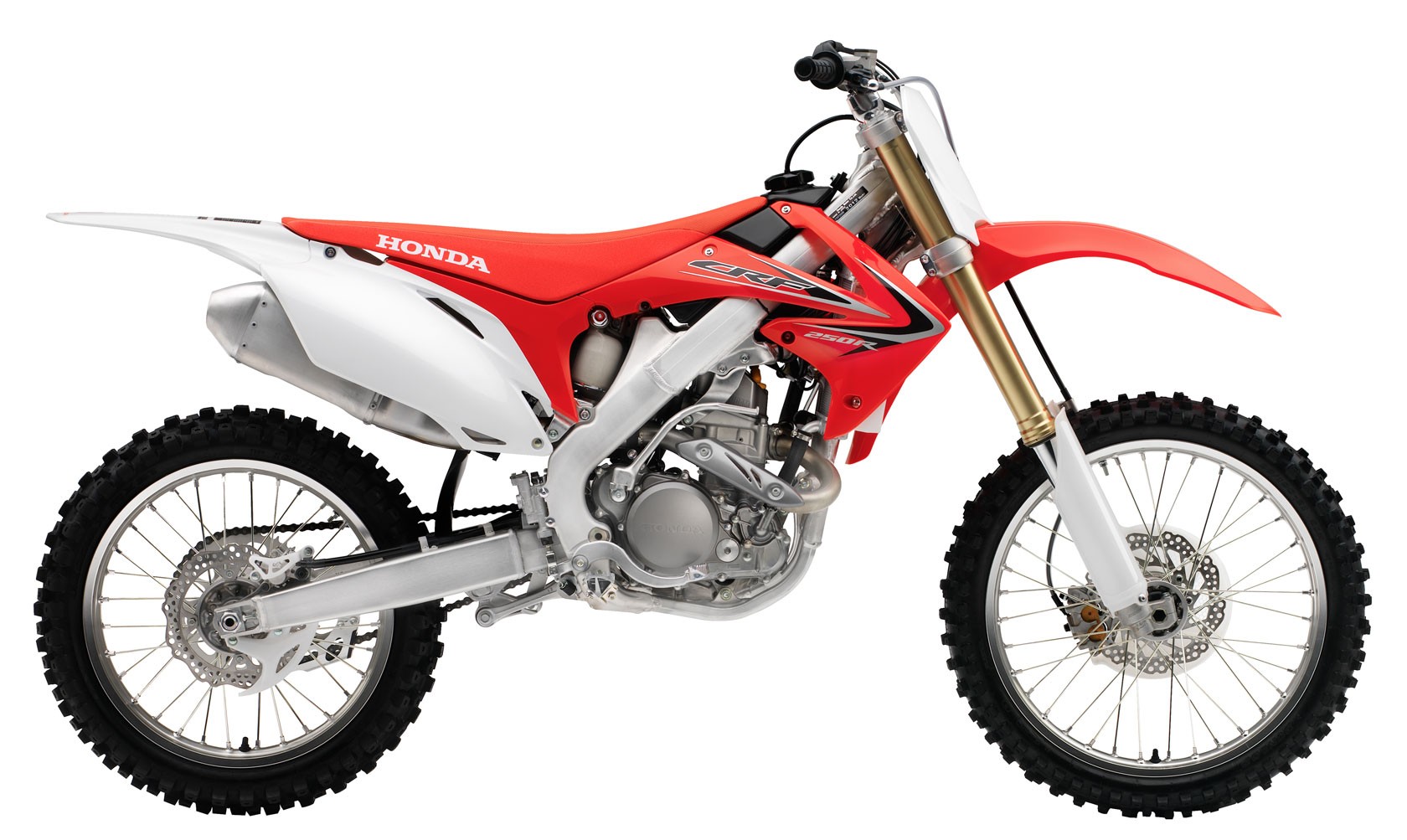
| Model | Honda CRF250R |
| Year | 2012 |
| Category | Motocross / Competition |
| Engine Type | Liquid-cooled, four-stroke, single-cylinder, SOHC Unicam, four valves |
| Weight | 103.9 kg wet / operational weight |
| Displacement | 249.4 cc |
| Bore x Stroke | 76.8 x 53.8 mm |
| Compression Ratio | 13.2:1 |
| Fuel System | Honda PGM-FI electronic fuel injection, 46 mm throttle body, 12-hole injector |
| Ignition | ECM-controlled electronic ignition |
| Spark Plug | NGK R0451B-8 |
| Spark Plug Gap | 0.6–0.7 mm (0.024–0.028 in) |
| Cooling System | Liquid-cooled, twin radiators |
| Starting System | Kickstarter |
| Transmission | 5-speed close-ratio manual, constant mesh |
| Clutch | Wet multi-plate, cable operated |
| Final Drive | 520 chain, 13-tooth front / 49-tooth rear sprocket |
| Overall Length | 2,183 mm |
| Overall Width | 823 mm |
| Overall Height | 1,273 mm |
| Wheelbase | 1,488 mm |
| Ground Clearance | 325 mm |
| Seat Height | 955 mm |
| Fuel Capacity | 5.7 litres (1.5 US gallons) |
| Frame | Aluminium twin-spar perimeter frame with Honda Progressive Steering Damper (HPSD) |
| Front Tyre | 80/100-21 51M, Dunlop Geomax MX51F original equipment | Tyre Size Guide |
| Rear Tyre | 100/90-19 57M, Dunlop Geomax MX51 original equipment | Tyre Size Guide |
| Front Suspension | 48 mm inverted Showa twin-chamber cartridge fork, adjustable compression and rebound damping | Fork Oil Levels |
| Front Suspension Travel | 310 mm (12.2 in) |
| Rear Suspension | Pro-Link Showa single shock with revised linkage, adjustable spring preload, rebound damping and high-/low-speed compression damping |
| Rear Suspension Travel | 313 mm (12.3 in) |
| Fork Oil | Honda HP Fork Oil SS-19. Standard outer-chamber capacity 372 ml per fork leg with standard 4.4 N/mm fork spring. Adjustment range 296–380 ml. Quantity excludes the sealed fork damper chamber; follow the correct service procedure when rebuilding the fork. |
| Front Brake | Single 240 mm hydraulic disc, twin-piston caliper |
| Rear Brake | Single 240 mm hydraulic disc, single-piston caliper |
| Front Wheel Size | 21-inch spoked wheel |
| Rear Wheel Size | 19-inch spoked wheel |
| Fuel Type | Premium unleaded petrol, minimum 91 PON / approximately 95 RON |
| Premix Information | Not applicable — four-stroke engine with separate engine and transmission lubrication |
| Gearbox Oil | SAE 10W-30 four-stroke motorcycle oil meeting JASO MA and API SG or higher, without energy-conserving friction modifiers. Capacity 0.68 litres after draining or 0.75 litres after disassembly. Transmission oil is separate from engine oil. |
| Air Filter | Washable, reusable oiled foam air filter element |
| Service Notes | High-performance competition motorcycle requiring frequent servicing. Engine oil capacity: 0.67 litres after draining, 0.69 litres with filter replacement and 0.85 litres after disassembly. Cold valve clearance: intake 0.12 ± 0.03 mm; exhaust 0.28 ± 0.03 mm. Idle speed: 2,000 ± 100 rpm. Clean and oil the air filter regularly. Inspect valve clearance, piston condition, coolant, chain, steering-head bearings and suspension linkage. Spark plug uses precious-metal electrodes; check with a wire-type gauge and replace if the gap is incorrect rather than bending the electrode. Check both engine and transmission oil compartments separately. Follow the 2012 Honda CRF250R competition handbook for maintenance intervals and suspension servicing. |
The 2012 Honda CRF250R continued the development of Honda's fuel-injected 250 cc four-stroke motocross platform, but it was more than a simple graphics update. Although the motorcycle retained the basic engine and aluminium twin-spar frame introduced for the 2010 generation, Honda made several meaningful improvements for 2012. A redesigned cylinder head, smaller throttle body, revised engine tuning and suspension changes were intended to deliver stronger low-to-midrange performance and more precise handling.
One of the most significant changes was the move to a 46 mm throttle body, replacing the larger 50 mm unit used on the previous model. Combined with the redesigned cylinder head and updated fuel-injection mapping, this helped improve throttle response and power delivery through the lower and middle portions of the rev range. Honda recognised that usable power when accelerating out of corners could be more valuable than concentrating entirely on maximum high-rpm output.
The engine remained a 249.4 cc liquid-cooled four-stroke single featuring Honda's Unicam cylinder-head design, four valves and a 13.2:1 compression ratio. Bore and stroke measured 76.8 x 53.8 mm. Honda's PGM-FI electronic fuel-injection system used a 12-hole injector supplied by a high-pressure fuel pump, with engine-management sensors adjusting fuel delivery to suit operating conditions. A five-speed close-ratio gearbox and wet multi-plate clutch completed the drivetrain.
Honda also concentrated on improving chassis behaviour. The 2012 CRF250R received revised front fork and rear shock damping settings, along with changes to the rear suspension linkage. These updates were designed to improve traction, chassis balance and stability over rough motocross tracks. Revised front axle collars increased front-end rigidity, contributing to more precise steering response. The existing Honda Progressive Steering Damper remained part of the package.
The suspension consisted of 48 mm inverted Showa twin-chamber cartridge forks and a Pro-Link Showa rear shock. Both ends offered extensive adjustment, allowing riders to adapt the motorcycle to changing track conditions and riding styles. Owners maintaining these components should pay particular attention to the correct fork oil quantities and specifications, especially when servicing the twin-chamber fork system. Rear shock performance also depends on the condition of the linkage bearings, seals and associated components.
Another visible improvement for 2012 was the introduction of wider and longer footpegs. These provided a larger platform for the rider's boots, helping with control when standing and moving around the motorcycle. Honda also fitted Dunlop Geomax MX51 tyres, with an 80/100-21 front and 100/90-19 rear. The standard 21-inch front and 19-inch rear wheel combination remained conventional for a full-sized motocross machine.
For owners purchasing a used 2012 CRF250R, maintenance history is particularly important. Regular engine oil and transmission oil changes are essential because the motorcycle uses separate lubrication compartments. Valve-clearance checks, air filter servicing and cooling-system maintenance also deserve close attention. Dirt entering through a damaged or poorly maintained air filter can cause expensive engine wear, while neglected suspension linkage bearings can affect handling and rear suspension movement.
The 2012 model's fuel-injection system removes the need for traditional carburettor jetting adjustments, but introduces electronic components that require proper diagnosis when problems occur. Owners investigating starting difficulties or inconsistent running should inspect fuel delivery, electrical connections, air filtration and valve clearances before replacing components unnecessarily. The MXOwners motocross parts finder can assist when identifying replacement components, while the motorcycle bearing finder is useful when researching wheel, steering-head and suspension bearings.
The 2012 Honda CRF250R occupies an interesting position in the development of Honda's modern four-stroke motocross motorcycles. It retained the established fuel-injected platform while addressing important aspects of engine response and suspension performance. The smaller throttle body, revised cylinder head, updated linkage and improved rider contact points made it a meaningful evolution of the earlier machine. Today, a properly maintained example remains a capable competition motorcycle and an appealing choice for riders interested in the development of Honda's fuel-injected CRF250R generation.