2013 Honda CRF250R
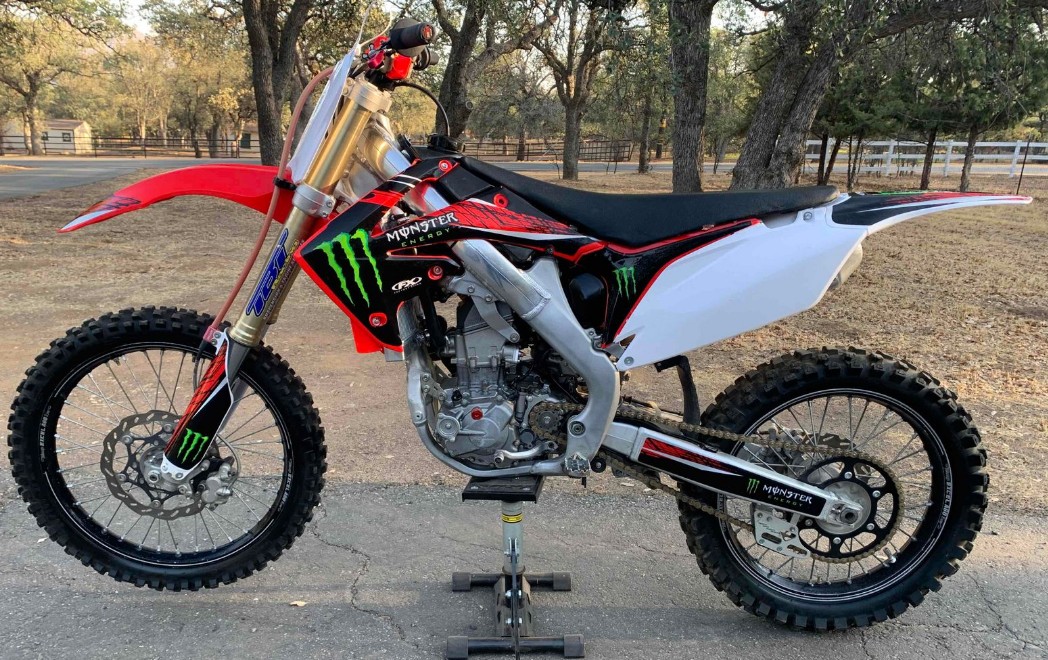
General Specifications
| Model | Honda CRF250R |
| Year | 2013 |
| Category | Motocross / Competition |
| Engine Type | Liquid-cooled, four-stroke, single-cylinder, SOHC Unicam, four valves |
| Weight | 103.0 kg kerb weight (227 lb, ready to ride) |
Engine
| Displacement | 249.4 cc |
| Bore x Stroke | 76.8 x 53.8 mm |
| Compression Ratio | 13.2:1 |
| Fuel System | Honda PGM-FI electronic fuel injection, 46 mm throttle body, revised 2013 fuel mapping |
| Ignition | ECM-controlled full-transistor electronic ignition with electronic advance |
| Spark Plug | NGK R0451B-8 |
| Spark Plug Gap | 0.6–0.7 mm (0.024–0.028 in) |
| Cooling System | Liquid-cooled, twin radiators |
| Starting System | Kickstarter |
Transmission
| Transmission | 5-speed close-ratio manual, constant mesh |
| Clutch | Wet multi-plate, cable operated |
| Final Drive | 520 chain, 13-tooth front / 49-tooth rear sprocket |
Dimensions
| Overall Length | 2,181 mm |
| Overall Width | 827 mm |
| Overall Height | 1,271 mm |
| Wheelbase | 1,489 mm |
| Ground Clearance | 322 mm |
| Seat Height | 951 mm |
| Fuel Capacity | 5.7 litres (1.5 US gallons) |
Chassis
| Frame | Aluminium twin-spar perimeter frame with Honda Progressive Steering Damper (HPSD) |
| Front Tyre | 80/100-21 51M, Dunlop Geomax MX51FA original equipment | Tyre Size Guide |
| Rear Tyre | 100/90-19 57M, Dunlop Geomax MX51 original equipment | Tyre Size Guide |
Suspension
| Front Suspension | 48 mm inverted Showa twin-chamber cartridge fork, revised 37 mm damper sub-piston, adjustable compression and rebound damping, standard 4.59 N/mm fork springs | Fork Oil Levels |
| Front Suspension Travel | 310 mm (12.2 in) |
| Rear Suspension | Pro-Link Showa single shock, adjustable spring preload, 17-position rebound damping, 13-position low-speed compression and high-speed compression adjustment |
| Rear Suspension Travel | 313 mm (12.3 in) |
| Fork Oil | Honda HP Fork Oil SS-19 or equivalent. Standard outer-chamber capacity: 363 ml per fork leg with standard 4.59 N/mm spring; adjustment range 300–384 ml. Optional 4.4 N/mm spring: 360 ml standard, 298–381 ml range. Optional 4.8 N/mm spring: 356 ml standard, 294–377 ml range. These quantities exclude the separate sealed damper chamber. Follow Honda's damper bleeding and servicing procedure. |
Brakes & Wheels
| Front Brake | Single 240 mm hydraulic disc, twin-piston caliper |
| Rear Brake | Single 240 mm hydraulic disc |
| Front Wheel Size | 21-inch spoked wheel |
| Rear Wheel Size | 19-inch spoked wheel |
Service Data
| Fuel Type | Unleaded petrol, minimum 91 PON / approximately 95 RON |
| Premix Information | Not applicable — four-stroke engine with separate engine and transmission lubrication systems |
| Gearbox Oil | SAE 10W-30 motorcycle four-stroke oil meeting JASO MA and API SG or higher, without energy-conserving or resource-conserving friction modifiers. Honda GN4 or equivalent. Capacity: 0.68 litres after draining. Transmission oil is separate from engine oil. |
| Air Filter | Washable, reusable oiled foam air filter element |
| Service Notes | Competition-use motorcycle requiring frequent maintenance. Engine oil capacity approximately 0.67 litres after draining and 0.69 litres with oil filter replacement. Inspect cold valve clearances: intake 0.12 ± 0.03 mm; exhaust 0.28 ± 0.03 mm. Check engine and transmission oil levels separately. Standard spark plug uses iridium and platinum electrodes; check with a wire-type gauge and replace if the gap is outside specification rather than bending the electrodes. Replace fork outer-chamber oil every 3 races or approximately 7.5 operating hours and damper oil every 9 races or approximately 22.5 hours under Honda's competition maintenance guidance. Inspect piston, valves, cam chain, air filter, cooling system, drive chain and suspension linkage at the prescribed intervals. Refer to the 2013 Honda CRF250R Owner's Manual and Competition Handbook for full maintenance procedures. |
2013 Honda CRF250R – Sharper Suspension and Stronger Midrange Response
The 2013 Honda CRF250R represented the final development stage of Honda's 2010-generation fuel-injected 250 cc motocross platform before the more substantial redesign introduced for 2014. Rather than replacing the established engine or aluminium frame, Honda concentrated on improving throttle response, suspension performance and traction. The changes made the motorcycle a refined version of an already competitive design.
The 249.4 cc liquid-cooled Unicam four-stroke engine retained its 76.8 x 53.8 mm bore and stroke, 13.2:1 compression ratio and 46 mm fuel-injection throttle body. Honda revised the PGM-FI mapping for 2013 to improve response at lower and middle engine speeds. The objective was stronger acceleration out of corners and better control when applying power on difficult surfaces, rather than a wholesale change to the engine's architecture.
Suspension received particularly important attention. Honda revised the internal damping circuitry of the 48 mm Showa front forks, increasing the damper sub-piston diameter from 35 mm to 37 mm. The standard fork spring rate also increased from approximately 4.4 N/mm to 4.6 N/mm. At the rear, revised Showa shock damping complemented these changes. Together, the updates aimed to improve bump absorption, steering precision and stability across rough motocross tracks. Owners servicing the suspension should consult the correct fork oil capacities and specifications, as the standard oil quantity differs according to the installed fork springs.
Honda also revised the original-equipment Dunlop Geomax MX51 tyres. The updated rear tyre construction reduced unsprung weight by approximately 0.4 kg, helping the rear wheel respond more effectively to changing track surfaces. The motorcycle retained its aluminium twin-spar frame, Honda Progressive Steering Damper, five-speed gearbox and conventional 21-inch front and 19-inch rear wheel arrangement.
For owners, regular maintenance remains essential. Engine and transmission oil are contained in separate compartments, while valve clearances, air filtration and suspension bearings require careful inspection. The MXOwners motorcycle bearing finder can assist with researching replacement bearings, and the motocross parts finder provides a starting point for identifying replacement components.
Although the 2013 CRF250R was an evolutionary update rather than a new generation, its revised fuel mapping, firmer fork springs and improved damping gave it distinctive characteristics compared with earlier models. For today's riders and restorers, it represents the mature form of Honda's original fuel-injected CRF250R generation, combining established mechanical components with improvements developed through several seasons of motocross competition.