| Model | Honda CRF250R |
| Year | 2015 |
| Category | Motocross / Competition |
| Engine Type | Liquid-cooled, four-stroke, single-cylinder, SOHC Unicam, four valves |
| Weight | 104.8 kg kerb weight (231 lb, US specification); approximately 105.4 kg European specification |
| Displacement | 249.4 cc |
| Bore x Stroke | 76.8 x 53.8 mm |
| Compression Ratio | 13.5:1 |
| Fuel System | Honda Dual-Timing PGM-FI electronic fuel injection, 46 mm throttle body, 12-hole injector, revised mapping and three selectable engine modes |
| Ignition | ECM-controlled full-transistor ignition with electronic advance and Engine Mode Select Button |
| Spark Plug | NGK R0451B-8 |
| Spark Plug Gap | 0.60–0.70 mm (0.024–0.028 in) |
| Cooling System | Liquid-cooled, twin radiators |
| Starting System | Kickstarter |
| Transmission | 5-speed close-ratio manual, constant mesh |
| Clutch | Wet multi-plate, cable operated |
| Final Drive | 520 chain, 13-tooth front / 49-tooth rear sprocket |
| Overall Length | 2,181 mm |
| Overall Width | 827 mm |
| Overall Height | 1,271 mm |
| Wheelbase | 1,489 mm |
| Ground Clearance | 322 mm |
| Seat Height | 951 mm |
| Fuel Capacity | 6.3 litres (1.66 US gallons) |
| Frame | Aluminium twin-spar frame with Honda Progressive Steering Damper (HPSD) and aluminium rear subframe |
| Front Tyre | 80/100-21 51M, Dunlop Geomax MX52F original equipment | Tyre Size Guide |
| Rear Tyre | 100/90-19 57M, Dunlop Geomax MX52 original equipment | Tyre Size Guide |
| Front Suspension | 49 mm inverted Showa Separate Function Fork, Triple Air Chamber (SFF-Air TAC); left leg pneumatic spring with inner, balance and outer chambers; right leg hydraulic damping with 16-position compression and rebound adjustment | Fork Oil Levels |
| Front Suspension Travel | 310 mm (12.2 in), published suspension travel; Honda service specifications list 305 mm fork stroke |
| Rear Suspension | Honda Pro-Link Showa single shock with adjustable spring preload, 17-position rebound damping, 13-position low-speed compression and 3.5-turn high-speed compression adjustment |
| Rear Suspension Travel | 313 mm (12.3 in) |
| Fork Oil | Honda-recommended Showa fork oil. Right fork leg: 350 ml outer chamber, excluding damper; separate right damper capacity 300 ml. Left fork leg: 310 ml outer tube and 87 ml inner chamber. Standard cold air pressures: inner chamber 1,200 kPa (174 psi); balance chamber 1,125 kPa (163 psi). Follow the 2015 Honda CRF250R service procedure for oil grade, filling, bleeding and pressure adjustment. The SFF-Air TAC fork uses different procedures for its left and right legs. |
| Front Brake | Single 260 mm wave-style hydraulic disc, twin-piston caliper |
| Rear Brake | Single 240 mm wave-style hydraulic disc, single-piston caliper |
| Front Wheel Size | 21-inch aluminium spoked wheel |
| Rear Wheel Size | 19-inch aluminium spoked wheel |
| Fuel Type | Unleaded petrol, minimum 91 AKI/PON (approximately 95 RON) |
| Premix Information | Not applicable — four-stroke engine with separate engine and transmission lubrication systems |
| Gearbox Oil | SAE 10W-30 four-stroke motorcycle oil meeting JASO MA and API SG or higher, without energy-conserving or resource-conserving friction modifiers. Honda GN4 or equivalent. Capacity: 0.68 litres after draining; 0.75 litres after disassembly. Transmission oil is separate from engine oil. |
| Air Filter | Washable, reusable oiled foam air filter element |
| Service Notes | Competition-use motorcycle requiring frequent maintenance. Engine oil capacity: 0.67 litres after draining, 0.69 litres with oil filter replacement and 0.85 litres after disassembly. Cold valve clearances: intake 0.12 ± 0.03 mm; exhaust 0.28 ± 0.03 mm. Idle speed: 2,000 ± 100 rpm. Cooling-system capacity: 0.95 litres after draining. Check engine and transmission oil separately. NGK R0451B-8 spark plug uses iridium and platinum electrodes; check its gap with a wire-type gauge and replace the plug if outside specification rather than bending the electrodes. Regularly service the air filter and inspect piston condition, valve clearances, cam chain, fuel-injection components, cooling system, drive chain and suspension linkage. Check fork air pressures with the motorcycle supported and the forks unloaded, following Honda's temperature and servicing instructions. Incorrect air pressure or oil quantity can significantly affect suspension performance. Refer to the 2015 Honda CRF250R Owner's Manual and Competition Handbook for maintenance intervals and detailed procedures. |
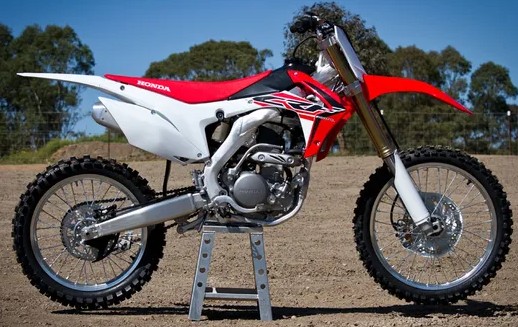
The 2015 Honda CRF250R was a significant technical update to the generation introduced in 2014. Although the motorcycle retained its aluminium twin-spar frame, Unicam engine architecture and distinctive twin-muffler exhaust layout, Honda introduced several important developments. The most notable were the new Showa air-spring front suspension, a handlebar-mounted Engine Mode Select Button and a larger front brake disc. These changes gave riders more opportunities to tailor the motorcycle's performance to different motocross tracks and riding conditions.
The introduction of the 49 mm Showa Separate Function Fork with Triple Air Chamber technology marked a major change in Honda's approach to front suspension. Previous CRF250R models used conventional steel fork springs, but the new SFF-Air TAC system replaced those springs with compressed air. The left fork leg contained the pneumatic spring chambers, while the right leg handled hydraulic compression and rebound damping. This arrangement reduced fork weight by approximately 1.3 kg compared with the previous spring-equipped assembly.
The triple-chamber design allowed riders and suspension technicians to influence spring characteristics through air pressure rather than relying entirely on different mechanical springs. The inner and balance chambers worked together to determine the fork's response through its travel, while the outer chamber contributed to its overall behaviour. Although the system provided considerable adjustment potential, it also introduced additional servicing requirements. Correct pressure settings, oil quantities and chamber sealing became essential. Owners maintaining the system should consult the appropriate fork oil specifications and servicing information before carrying out repairs or adjustments.
Another major introduction was Honda's Engine Mode Select Button, located on the handlebar. This system provided three electronic fuel-injection and ignition maps. Mode 1 delivered the standard power characteristics, Mode 2 offered smoother throttle response for slippery conditions, and Mode 3 provided a more aggressive response suited to tracks where strong acceleration was desirable. The rider could select a different setting with the engine idling, making it easier to adapt power delivery without changing mechanical components.
The 249.4 cc liquid-cooled Unicam engine retained its 76.8 x 53.8 mm bore and stroke and 13.5:1 compression ratio. Honda revised the Dual-Timing PGM-FI fuel-injection settings and increased the internal diameters of the twin mufflers to improve engine breathing and throttle response. The right-side muffler outlet increased from 22 mm to 23.8 mm, while the left increased from 23.4 mm to 26.6 mm. A lighter throttle-return spring also reduced operating effort at the throttle grip.
Braking performance received attention with a larger 260 mm front disc replacing the previous 240 mm arrangement. This provided greater braking leverage and improved control when entering corners or slowing from high speed. New wave-style brake discs and Dunlop Geomax MX52 tyres complemented the updated package. At the rear, the Pro-Link Showa shock received a lighter spring material that reduced weight without changing the standard spring rate.
The 2015 CRF250R retained the mass-centralised chassis layout developed for 2014. Its twin exhaust system, compact engine packaging and low-mounted suspension components reflected Honda's continuing focus on handling agility. The combination of the new air forks, revised rear shock and existing Honda Progressive Steering Damper gave riders a wide range of chassis adjustment, although careful setup was needed to achieve consistent results on rough tracks.
For today's owners, the Showa air forks are an especially important consideration when inspecting a used 2015 CRF250R. Worn seals, incorrect air pressures or poorly maintained internal components can affect fork performance. Steering-head, wheel and rear suspension-linkage bearings should also be checked, with the MXOwners motorcycle bearing finder providing a starting point for replacement research. Because the 2015 motorcycle differs from the 2014 version in several important areas, the motocross parts finder can also assist when investigating model-year-specific components.
Routine engine maintenance remains essential. The CRF250R is a high-performance competition motorcycle with separate engine and transmission oil compartments, a washable foam air filter and a valve train requiring regular inspection. Owners should also monitor the fuel-injection system, cooling system and twin exhaust mounting points. Maintaining the motorcycle to Honda's competition service schedule is particularly important for machines used regularly on demanding tracks.
The 2015 Honda CRF250R represents an interesting period in motocross engineering when manufacturers were exploring pneumatic suspension and increasingly sophisticated electronic engine management. Its air forks, selectable engine maps and improved braking system distinguished it clearly from the previous model, while the established aluminium chassis and Unicam engine provided continuity. For enthusiasts and restorers, it remains a distinctive example of Honda's efforts to combine electronic adjustability, reduced weight and competition-focused engineering in a modern 250 cc four-stroke motocross motorcycle.