| Model | Yamaha YZ250 |
| Year | 2015 |
| Category | Motocross / Competition Off-Road |
| Engine Type | Liquid-cooled, single-cylinder, 2-stroke, reed-valve induction with Yamaha Power Valve System (YPVS) |
| Weight | 103 kg (227 lb) wet / curb weight |
| Displacement | 249 cc |
| Bore x Stroke | 66.4 x 72.0 mm |
| Compression Ratio | 8.9–10.6:1 |
| Fuel System | Keihin PWK38S, 38 mm flat-slide carburettor with reed-valve induction and throttle-position sensor | Replacement Options |
| Ignition | CDI magneto ignition |
| Spark Plug | NGK BR8EG (resistor type) |
| Spark Plug Gap | 0.5–0.6 mm (0.020–0.024 in) |
| Cooling System | Liquid-cooled, twin radiators; coolant capacity 1.20 L |
| Starting System | Kick starter |
| Transmission | 5-speed constant-mesh manual |
| Clutch | Wet, multi-plate, cable-operated |
| Final Drive | Chain drive; standard gearing 14T front / 50T rear (3.571:1) |
| Overall Length | 2,147 mm |
| Overall Width | 827 mm |
| Overall Height | 1,299 mm |
| Wheelbase | 1,446 mm |
| Ground Clearance | 367 mm |
| Seat Height | 976 mm |
| Fuel Capacity | 8.0 litres |
| Frame | Aluminium semi-double-cradle frame |
| Front Tyre | 80/100-21 51M, Dunlop Geomax MX52, tube type | Tyre Size Guide |
| Rear Tyre | 110/90-19 62M, Dunlop Geomax MX52, tube type | Tyre Size Guide |
| Front Suspension | Updated 48 mm KYB upside-down Speed Sensitive System (SSS) twin-chamber cartridge forks with coil springs, adjustable compression and rebound damping | Fork Oil Levels |
| Front Suspension Travel | 300 mm (11.81 in) |
| Rear Suspension | KYB gas/oil-damped Monocross linkage shock, adjustable spring preload, high-speed and low-speed compression damping and rebound damping |
| Rear Suspension Travel | 315 mm (12.40 in) |
| Fork Oil | Yamaha Suspension Oil S1. KYB twin-chamber forks: inner damper oil capacity 205 mL per leg; outer chamber standard oil quantity 320 mL per leg. Inner and outer chambers are serviced separately. Outer-chamber oil quantity may be adjusted within Yamaha's specified tuning range. Confirm fork identification and regional settings before servicing. |
| Front Brake | Hydraulic single disc, 250 mm rotor, twin-piston caliper |
| Rear Brake | Hydraulic single disc, 245 mm rotor, single-piston caliper |
| Front Wheel Size | 21 x 1.60-inch aluminium spoked rim |
| Rear Wheel Size | 19 x 2.15-inch aluminium spoked rim |
| Fuel Type | Premium unleaded petrol, minimum 95 RON, mixed with suitable 2-stroke oil |
| Premix Information | 30:1 petrol-to-oil ratio using Yamaha Yamalube 2-R or suitable equivalent 2-stroke oil. Approximately 33.3 mL oil per litre of petrol | Premix Calculator |
| Gearbox Oil | Yamalube SAE 10W-40 motorcycle oil, API SG or higher, JASO MA. Periodic transmission oil change: 0.75 L (750 mL). Total transmission oil capacity: 0.80 L (800 mL). |
| Air Filter | Reusable, oil-treated foam air-filter element housed in revised 2015 airbox |
| Service Notes | The 2015 YZ250 received substantially revised bodywork, updated KYB SSS front suspension, revised triple clamps, wider footpegs, a new airbox and Dunlop MX52 tyres. The engine and five-speed transmission remained fundamentally unchanged. Maintain the specified 30:1 premix ratio and adjust carburettor jetting for altitude, temperature and fuel. Inspect piston, piston rings, reed valves and YPVS components according to competition operating hours. Spark plug tightening torque: 20 Nm (14 ft-lb). Clean and oil the foam air filter regularly. Change transmission oil frequently under racing conditions. Inspect fork seals, steering-head bearings, suspension linkage bearings, wheel bearings, coolant, brake pads and drive-chain tension. The revised 2015 plastics and airbox differ from earlier versions; verify model-year compatibility before ordering replacement parts. |
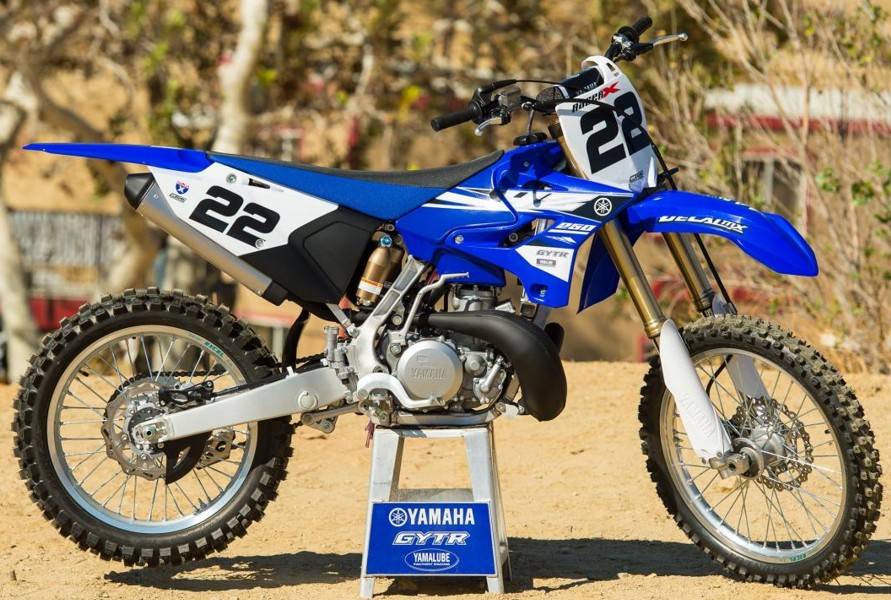
The 2015 Yamaha YZ250 represented one of the most noticeable updates to Yamaha's long-running two-stroke motocross machine in nearly a decade. Although the engine and fundamental aluminium-frame design remained familiar, Yamaha introduced substantially revised bodywork, updated suspension components and several practical improvements. For riders who had watched the YZ250 change very little since the mid-2000s, the 2015 model was a welcome sign that Yamaha remained committed to two-stroke motocross.
The timing was significant. By 2015, four-stroke motorcycles dominated professional motocross development, and several manufacturers had already abandoned their full-size two-stroke competition ranges. Yamaha, however, continued producing both the YZ125 and YZ250. Rather than developing an entirely new engine, the company concentrated on modernising the existing platform while preserving the characteristics that made the motorcycle popular.
The most immediately obvious change was the styling. Yamaha introduced new front and rear guards, radiator shrouds, side number plates, fork protectors, seat covering and a redesigned airbox. The appearance was brought much closer to the contemporary YZ250F and YZ450F four-strokes. This gave the YZ250 a considerably more modern profile without requiring an entirely new chassis.
Beyond the cosmetic changes, Yamaha updated the front suspension with a newer generation of the 48 mm Kayaba Speed Sensitive System forks. The revised components and damping settings were intended to improve suspension performance and provide a more contemporary riding feel. Updated triple clamps accompanied the changes, while wider footpegs improved rider support and control. The motorcycle also received Dunlop Geomax MX52 tyres and several smaller chassis refinements.
Despite the suspension improvements, the familiar 249cc liquid-cooled two-stroke engine remained the centrepiece of the motorcycle. The reed-valve engine retained Yamaha's Power Valve System, a 38 mm Keihin PWK carburettor and five-speed gearbox. Its quick throttle response, strong midrange performance and distinctive two-stroke power delivery remained largely unchanged. Owners maintaining the fuel system or considering replacement components can explore the MXOwners carburettor reference and replacement options.
The decision to retain the established engine had practical advantages. Experienced mechanics were already familiar with piston replacement, reed-valve inspection, power-valve servicing and carburettor tuning. A substantial aftermarket supported the motorcycle, making it possible to maintain and rebuild the engine without the complexity of modern four-stroke valve trains. For riders who preferred to perform their own maintenance, this simplicity was one of the YZ250's most attractive qualities.
The updated suspension also made correct maintenance particularly important. The KYB SSS forks use separate inner damper and outer oil chambers, requiring the correct servicing procedures and oil quantities. Owners should not assume that settings from earlier YZ250 models automatically apply to the revised 2015 fork assembly. The MXOwners fork oil levels and suspension information can assist with identifying suitable maintenance information.
Another important consideration for owners is parts compatibility. Although many engine and mechanical components remained interchangeable with earlier YZ250 models, the revised plastics, airbox and certain suspension components introduced differences. Anyone restoring a 2015 motorcycle or converting an earlier machine to the newer appearance should check individual part numbers carefully. The MXOwners motorcycle parts finder provides a starting point for investigating replacement components.
From a historical perspective, the 2015 YZ250 occupies an interesting position. It was not an entirely new generation in the same sense as the aluminium-framed 2005 model, but its substantial styling and suspension updates gave the motorcycle renewed relevance. Yamaha demonstrated that the proven two-stroke platform could continue evolving without abandoning its established mechanical design.
Today, the 2015 Yamaha YZ250 remains an appealing choice for riders seeking traditional two-stroke performance with more contemporary styling and suspension. Its combination of mechanical simplicity, strong aftermarket support and durable engine design has helped it retain a loyal following. The 2015 update was more than a fresh set of graphics: it marked an important renewal of Yamaha's commitment to keeping the full-size two-stroke motocross motorcycle alive.