| Model | Honda CRF250R |
| Year | 2018 |
| Category | Motocross / Competition |
| Engine Type | Liquid-cooled, four-stroke, single-cylinder, DOHC, four titanium valves |
| Weight | 108.1 kg kerb weight including fuel (European specification); approximately 103.3 kg without fuel |
| Displacement | 249.4 cc |
| Bore x Stroke | 79.0 x 50.9 mm |
| Compression Ratio | 13.9:1 |
| Fuel System | Honda PGM-FI electronic fuel injection with Dual-Timing injection strategy, 46 mm throttle body and three selectable engine maps |
| Ignition | ECM-controlled full-transistor electronic ignition with Engine Mode Select Button |
| Spark Plug | NGK R0451B-8 |
| Spark Plug Gap | 0.60–0.70 mm (0.024–0.028 in) |
| Cooling System | Liquid-cooled, twin aluminium radiators |
| Starting System | Electric starter with 12V lithium-ion battery; no standard kickstarter |
| Transmission | 5-speed close-ratio manual, constant mesh |
| Clutch | Wet multi-plate, cable operated, five clutch springs |
| Final Drive | 520 chain, 13-tooth front / 48-tooth rear sprocket; final reduction ratio 3.692:1 |
| Overall Length | 2,181 mm (Honda US specification); 2,183 mm European specification |
| Overall Width | 827 mm |
| Overall Height | 1,273 mm (Honda US specification); 1,274 mm European specification |
| Wheelbase | 1,486 mm |
| Ground Clearance | 327 mm |
| Seat Height | 957 mm |
| Fuel Capacity | 6.3 litres (1.66 US gallons), titanium fuel tank |
| Frame | Seventh-generation aluminium twin-spar frame with tapered main beams, lightweight extruded-aluminium subframe and mass-centralised chassis design |
| Front Tyre | 80/100-21 51M, Dunlop Geomax MX3SF original equipment | Tyre Size Guide |
| Rear Tyre | 100/90-19 57M, Dunlop Geomax MX3S original equipment | Tyre Size Guide |
| Front Suspension | 49 mm inverted Showa coil-spring cartridge fork, fully adjustable compression and rebound damping, standard 4.6 N/mm fork springs | Fork Oil Levels |
| Front Suspension Travel | 268 mm (10.6 in) listed as suspension travel in Honda's 2018 US owner's manual; fork stroke 305 mm (12.0 in) |
| Rear Suspension | Honda Pro-Link Showa single shock with spring preload adjustment and adjustable low-speed compression, high-speed compression and rebound damping |
| Rear Suspension Travel | 317 mm (12.5 in), Honda 2018 US owner's manual |
| Fork Oil | Pro Honda HP Fork Oil SS-19. Standard outer-chamber capacity: 356 ml per fork leg with standard 4.6 N/mm spring; adjustable range 307–392 ml. Separate fork damper capacity: 243 ml after the prescribed bleeding procedure. Initial damper filling procedure specifies approximately 248 ml before excess oil is expelled. Optional 4.4 N/mm spring: 361 ml standard, range 312–397 ml. Optional 4.8 N/mm spring: 357 ml standard, range 308–393 ml. Follow Honda's separate damper filling, bleeding and outer-chamber servicing procedures. |
| Front Brake | Single 260 mm wave-style hydraulic disc with twin-piston caliper |
| Rear Brake | Single 240 mm wave-style hydraulic disc with single-piston caliper |
| Front Wheel Size | 21 x 1.60-inch aluminium spoked wheel |
| Rear Wheel Size | 19 x 1.85-inch aluminium spoked wheel |
| Fuel Type | Unleaded petrol, minimum 91 AKI/PON (approximately 95 RON) |
| Premix Information | Not applicable — four-stroke engine with pressure-fed lubrication |
| Gearbox Oil | Engine and gearbox share a common oil supply. Use Pro Honda GN4 SAE 10W-30 four-stroke motorcycle oil or equivalent meeting Honda's specified API and JASO MA requirements. Combined engine/transmission oil capacity: 1.08 litres after draining, 1.12 litres after draining with oil filter replacement, or 1.35 litres after complete engine disassembly. Do not fill a separate gearbox oil compartment. |
| Air Filter | Washable, reusable oiled foam air filter element in redesigned airbox |
| Service Notes | Completely redesigned competition engine with DOHC cylinder head, electric starting and common engine/transmission lubrication. Cold valve clearances: intake 0.11 ± 0.03 mm; exhaust 0.19 ± 0.03 mm. Idle speed: 2,000 ± 100 rpm. Cooling-system capacity: 0.94 litres after draining or 1.08 litres after disassembly. Battery: HY85S lithium-ion, 12V, 2.0 Ah. Standard spark plug: NGK R0451B-8; use a wire-type gauge and do not bend the precious-metal electrodes to adjust the gap. Check oil level using the crankcase inspection window. Clean and oil the air filter frequently. Inspect piston, valve clearances, cam chain, fuel-injection components, cooling system, clutch, wheel bearings and suspension linkage according to Honda's competition maintenance schedule. The 2018 engine uses shared engine and gearbox oil, unlike the previous-generation CRF250R. Use the correct 2018-specific service procedures and replacement parts. |
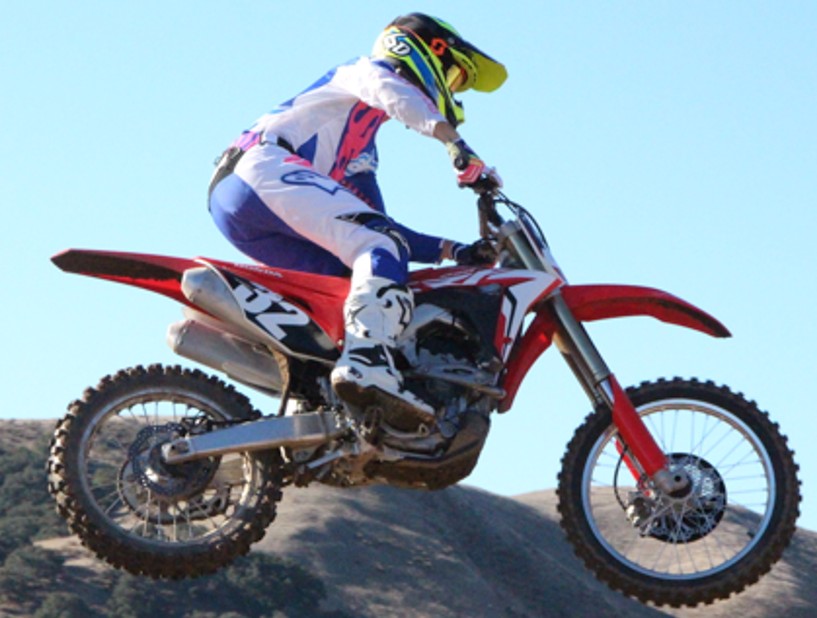
The 2018 Honda CRF250R marked one of the biggest transformations in the model's history. Honda abandoned the long-established Unicam engine architecture in favour of an entirely new double-overhead-camshaft design, introduced electric starting as standard equipment and replaced the previous Showa pneumatic forks with conventional coil-spring suspension. Combined with a new seventh-generation aluminium frame, the changes created a substantially different motorcycle from the 2017 CRF250R.
The new engine was developed with a clear emphasis on high-rpm performance, drawing heavily on Honda's experience in international MX2 competition. Although displacement remained 249.4 cc, bore and stroke changed dramatically from 76.8 x 53.8 mm to 79.0 x 50.9 mm. The larger bore and shorter stroke permitted larger valves and supported higher engine speeds. Compression increased to 13.9:1, while the cylinder was offset by 4.5 mm to help reduce internal friction.
The redesigned cylinder head incorporated two overhead camshafts operating four titanium valves. Intake valve diameter increased to 33 mm and exhaust valve diameter to 26 mm. Honda also revised the intake ports, combustion chamber and exhaust arrangement to improve airflow at high engine speeds. The result was a substantial increase in peak power, with Honda claiming approximately nine percent more maximum output compared with the previous model. The useful high-rpm power range was extended, and the engine's redline increased by approximately 900 rpm.
The new performance characteristics changed how the CRF250R delivered its power. Earlier Unicam machines were known for accessible midrange response, whereas the 2018 engine encouraged riders to maintain higher rpm and use the five-speed gearbox more actively. Experienced racers could exploit the stronger top-end performance on fast circuits and when accelerating towards jumps, although the revised power delivery required a different riding approach in slower sections.
Honda retained electronic PGM-FI fuel injection and the handlebar-mounted Engine Mode Select Button. Riders could choose between three fuel-injection and ignition maps to suit changing track conditions. The twin-muffler exhaust system also continued, but the exhaust layout was redesigned around the new cylinder head and engine configuration. Owners investigating replacement components should be aware that many engine, exhaust and electrical parts are not interchangeable with those of the previous generation.
Electric starting was another important milestone. The 2018 CRF250R became the first production CRF250R motocross model equipped with an electric starter as standard. A lightweight lithium-ion battery supplied the starting system, eliminating the need for the traditional kickstarter. This improved convenience after a stall or during difficult race conditions, although it also introduced additional electrical components requiring maintenance and diagnosis.
The chassis redesign followed Honda's mass-centralisation philosophy, using a seventh-generation aluminium twin-spar frame closely related to the contemporary CRF450R. Revised frame geometry, a lighter aluminium subframe and redesigned swingarm helped optimise rigidity, traction and steering response. A lightweight titanium fuel tank reduced mass high in the chassis, while the revised radiator positioning, narrower bodywork and flatter seating arrangement improved rider movement.
The suspension change was especially significant. Honda discontinued the Showa SFF-TAC pneumatic forks used between 2015 and 2017 and introduced 49 mm Showa coil-spring cartridge forks. The new suspension returned to conventional mechanical springs while retaining extensive compression and rebound damping adjustment. This simplified some aspects of ownership by eliminating the need to monitor multiple pneumatic spring chambers. Correct fork oil capacities and servicing procedures remained essential, particularly because the fork uses separate damper and outer-chamber oil quantities.
At the rear, Honda revised the Pro-Link suspension arrangement and repositioned the Showa shock to suit the new chassis. The motorcycle retained hydraulic disc brakes, with a 260 mm front rotor and 240 mm rear rotor. Dunlop Geomax MX3S tyres were fitted as original equipment, using the familiar 21-inch front and 19-inch rear wheel combination. These changes helped bring the suspension and braking package into line with the demands of the more powerful engine.
For owners and restorers, one of the most important mechanical differences is the lubrication system. Previous CRF250R models used separate engine and transmission oil compartments, but the 2018 DOHC engine adopted a common oil supply for both. The combined system requires approximately 1.12 litres after draining and replacing the oil filter. Following an older CRF250R service procedure could therefore result in incorrect oil servicing. Owners should always use the maintenance instructions specifically written for the 2018 generation.
Regular servicing remains vital because the CRF250R is a high-performance competition motorcycle. The engine's titanium valves, high compression ratio and increased operating speeds place considerable importance on clean oil, effective air filtration and scheduled valve-clearance inspection. The MXOwners motocross replacement parts finder can assist with researching compatible maintenance parts. During a chassis inspection, the motorcycle bearing finder provides another starting point for identifying wheel, steering-head and suspension-linkage bearings.
The 2018 Honda CRF250R established a new direction for Honda's 250 cc four-stroke motocross range.