2020 Honda CRF250R
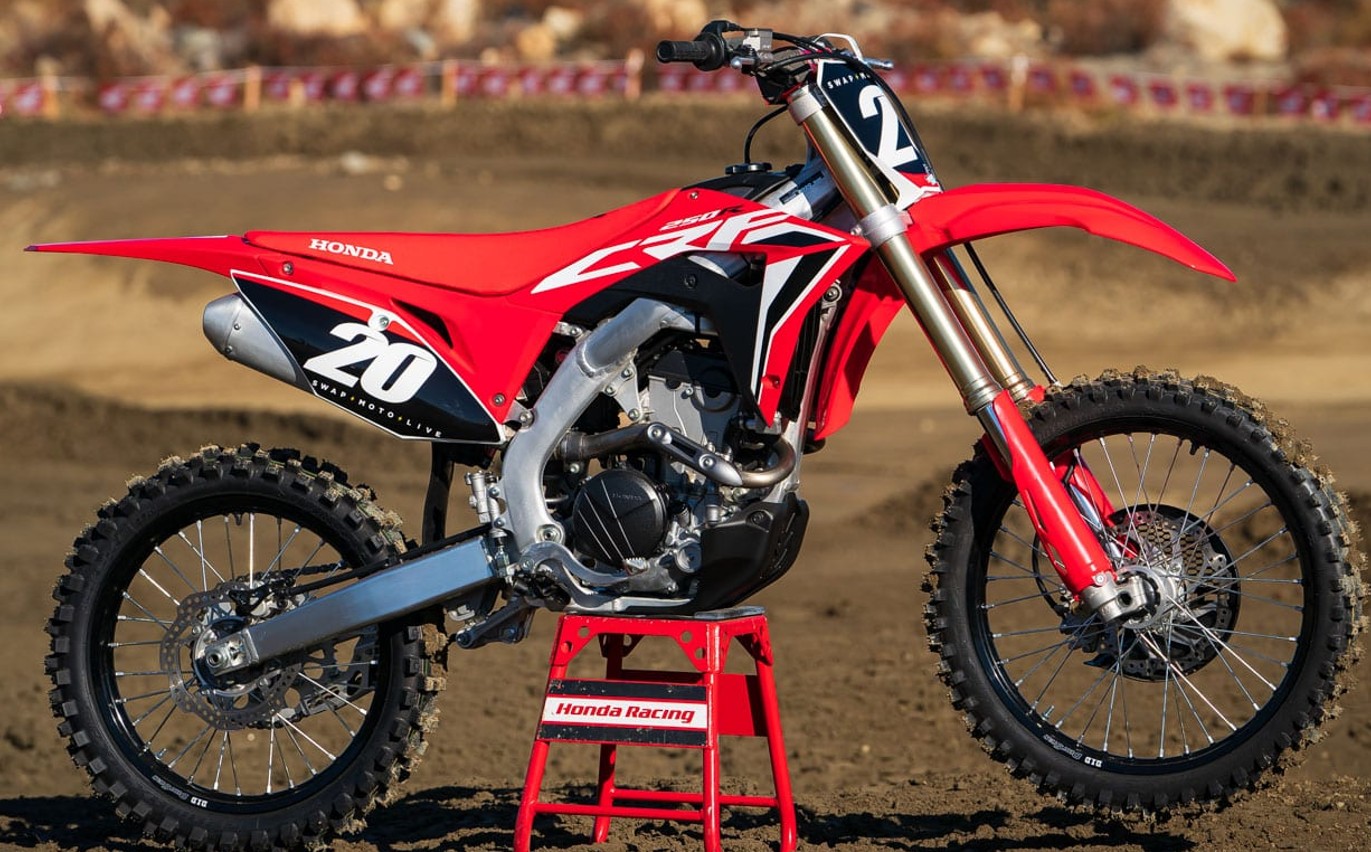
General Specifications
| Model | Honda CRF250R |
| Year | 2020 |
| Category | Motocross / Competition |
| Engine Type | Liquid-cooled, four-stroke, single-cylinder, DOHC, four valves with titanium intake and exhaust valves |
| Weight | 107.8 kg kerb weight, ready to ride (European specification); approximately 108 kg |
Engine
| Displacement | 249.4 cc |
| Bore x Stroke | 79.0 x 50.9 mm |
| Compression Ratio | 13.9:1 |
| Fuel System | Honda PGM-FI electronic fuel injection, 44 mm throttle body, revised 2020 mapping and gear-position-dependent ignition control |
| Ignition | ECM-controlled electronic ignition with three selectable engine maps and three-level HRC Launch Control |
| Spark Plug | NGK R0451B-9 |
| Spark Plug Gap | 0.60–0.70 mm (0.024–0.028 in) |
| Cooling System | Liquid-cooled, twin aluminium radiators with enlarged left-side radiator |
| Starting System | Push-button electric starter, 12V lithium-ion battery; no standard kickstarter |
Transmission
| Transmission | 5-speed close-ratio manual, constant mesh; revised second-gear ratio for 2020 |
| Clutch | Wet multi-plate, cable operated, strengthened clutch assembly with revised springs and increased torque capacity |
| Final Drive | 520 chain, 13-tooth front / 48-tooth rear sprocket |
Dimensions
| Overall Length | 2,181 mm |
| Overall Width | 827 mm |
| Overall Height | 1,260 mm |
| Wheelbase | 1,486 mm |
| Ground Clearance | 327 mm |
| Seat Height | 957 mm |
| Fuel Capacity | 6.3 litres (1.66 US gallons), lightweight titanium fuel tank |
Chassis
| Frame | Revised seventh-generation aluminium twin-spar frame with optimised rigidity, lighter aluminium swingarm and rear subframe, lower-mounted battery and mass-centralised design |
| Front Tyre | 80/100-21 51M, Dunlop Geomax MX3SF original equipment | Tyre Size Guide |
| Rear Tyre | 100/90-19 57M, Dunlop Geomax MX3S original equipment | Tyre Size Guide |
Suspension
| Front Suspension | 49 mm inverted Showa coil-spring cartridge fork, fully adjustable compression and rebound damping, revised 2020 valving, standard 4.8 N/mm fork springs | Fork Oil Levels |
| Front Suspension Travel | 268 mm (10.6 in) as listed in Honda's 2020 competition manual; fork stroke 305 mm (12.0 in) |
| Rear Suspension | Honda Pro-Link Showa single shock with revised 2020 damping, adjustable spring preload, rebound damping and separate high-/low-speed compression adjustment |
| Rear Suspension Travel | 317 mm (12.5 in), Honda 2020 competition manual |
| Fork Oil | Pro Honda HP Fork Oil A15-00. Standard outer-chamber capacity: 343 ml per fork leg with standard 4.8 N/mm fork spring. Adjustable outer-chamber range: 311–396 ml. Separate fork damper capacity: 243 ml. Standard quantity is for a correctly serviced fork; allow for residual oil when refilling. Follow Honda's separate damper filling, bleeding and outer-chamber service procedures. |
Brakes & Wheels
| Front Brake | Single 260 mm wave-style hydraulic disc with twin-piston caliper using 30 mm and 27 mm pistons |
| Rear Brake | Single 240 mm wave-style hydraulic disc with single-piston caliper and revised 2020 brake-pad material |
| Front Wheel Size | 21 x 1.60-inch aluminium spoked wheel, black DID rim |
| Rear Wheel Size | 19 x 1.85-inch aluminium spoked wheel, black DID rim |
Service Data
| Fuel Type | Premium unleaded petrol, minimum 91 AKI/PON (approximately 95 RON) |
| Premix Information | Not applicable — four-stroke engine with common engine and transmission lubrication system |
| Gearbox Oil | Engine and gearbox share a common oil supply. Use Pro Honda GN4 SAE 10W-30 four-stroke motorcycle oil or equivalent meeting API SJ or higher and JASO MA requirements, excluding energy-conserving or resource-conserving oils. Combined engine/transmission oil capacity: 1.08 litres after draining, 1.12 litres after draining with oil filter replacement, or approximately 1.35 litres after engine disassembly. No separate gearbox oil compartment. |
| Air Filter | Washable, reusable oiled foam air filter element, approximately 10% larger filter surface area for 2020 |
| Service Notes | High-performance competition motorcycle requiring frequent maintenance. Cold valve clearances: intake 0.09 ± 0.03 mm; exhaust 0.19 ± 0.03 mm. Idle speed: approximately 2,000 ± 100 rpm. NGK R0451B-9 spark plug uses precious-metal electrodes; inspect using a wire-type feeler gauge and replace if the gap is outside specification rather than bending the electrodes. Engine and transmission share the same oil supply. Inspect valve clearances, piston condition, cam chain, air filter, cooling system, fuel-injection components, clutch, drive chain and suspension linkage regularly. The 2020 engine includes revised camshaft timing, strengthened clutch components and revised second-gear components; confirm model-year compatibility before ordering replacement parts. Maintain the electric-start system and lithium-ion battery according to Honda instructions. Service Showa forks using the prescribed oil quantities and damper bleeding procedure. Refer to the 2020 Honda CRF250R Owner's Manual and Competition Handbook for maintenance intervals and detailed servicing instructions. |
2020 Honda CRF250R – Stronger Midrange Power, Revised Chassis and Improved Race Performance
The 2020 Honda CRF250R received a substantial package of engine and chassis improvements while retaining the double-overhead-camshaft platform introduced in 2018. Rather than launching a completely new generation, Honda concentrated on strengthening low-to-midrange power, improving traction and making the motorcycle more predictable through corners. The updates followed Honda's success in the 2019 AMA 250SX East Region Supercross Championship with Chase Sexton and reflected the continuing development of its four-stroke motocross programme.
The 249.4 cc liquid-cooled DOHC engine retained its 79.0 x 50.9 mm bore and stroke, 13.9:1 compression ratio and 44 mm electronic fuel-injection throttle body. Honda revised the camshaft profiles to delay exhaust-valve opening and reduce valve overlap, improving combustion efficiency and engine response between approximately 6,000 and 10,000 rpm. The combustion chamber was reshaped, while ignition timing was optimised to increase torque around 8,000 rpm. These changes addressed the need for stronger acceleration without forcing riders to keep the engine at extremely high rpm.
Engine-management improvements included a gear-position sensor that allowed the electronic control unit to use dedicated ignition settings for individual gears. Honda also removed the exhaust-header resonator and revised the twin mufflers to improve the motorcycle's response during acceleration, particularly when shifting from second to third gear. A redesigned air filter provided approximately ten percent more filter area, while the enlarged left radiator helped manage the additional heat associated with increased engine performance.
Transmission and clutch durability also received attention. Second gear gained a higher ratio, while second and third gears received a surface treatment intended to reduce friction and improve durability. Honda increased clutch capacity by approximately eighteen percent and fitted revised clutch springs to handle the engine's stronger torque delivery. These mechanical changes were particularly relevant to riders competing on demanding tracks where repeated acceleration, heavy clutch use and rapid gear changes are common.
The chassis was revised using developments already applied to the CRF450R. Honda introduced a lighter aluminium twin-spar frame with carefully adjusted rigidity characteristics, accompanied by a lighter aluminium swingarm. The aim was to maintain precise cornering response while increasing stability and improving the motorcycle's ability to follow the intended line over rough ground. Engineers