
| Model | Desmo250 MX |
| Year | 2026 |
| Category | Motocross |
| Engine Type | Single-cylinder, 4-stroke, DOHC, 4-valve Desmodromic, semi-dry sump, liquid-cooled |
| Weight | 103 kg wet without fuel |
| Displacement | 249.7 cc |
| Bore x Stroke | 81 x 48.4 mm |
| Compression Ratio | 14.5:1 |
| Fuel System | Electronic fuel injection, Keihin injector with 44 mm Mikuni throttle body |
| Ignition | Electronic engine management with ride-by-wire, Riding Modes, Ducati Traction Control and Engine Brake Control |
| Spark Plug | |
| Spark Plug Gap | |
| Cooling System | Liquid cooled |
| Starting System | Electric start |
| Transmission | 5-speed manual with upshift Quick Shift |
| Clutch | Multiplate clutch with hydraulic control |
| Final Drive | DID DMS 520 chain, 13-tooth front / 51-tooth aluminium rear sprocket |
| Overall Length | |
| Overall Width | |
| Overall Height | |
| Wheelbase | 1499 mm |
| Ground Clearance | |
| Seat Height | 970 mm |
| Fuel Capacity | 7.2 litres |
| Frame | Welded aluminium frame with cast, forged and extruded components |
| Front Tyre | Pirelli Scorpion MX32 Mid Soft 80/100-21 | Tyre Size Guide |
| Rear Tyre | Pirelli Scorpion MX32 Mid Soft 100/90-19 | Tyre Size Guide |
| Front Suspension | Showa 49 mm fully adjustable upside-down fork with Kashima-coated outer tubes | Fork Oil Levels |
| Front Suspension Travel | 310 mm |
| Rear Suspension | Showa fully adjustable monoshock |
| Rear Suspension Travel | 301 mm |
| Fork Oil |
| Front Brake | 260 mm Galfer single disc with Brembo 2-piston floating caliper |
| Rear Brake | 240 mm Galfer single disc with Brembo 1-piston floating caliper |
| Front Wheel Size | 21 x 1.60 inch Takasago Excel aluminium rim |
| Rear Wheel Size | 19 x 2.15 inch Takasago Excel aluminium rim |
| Fuel Type | Premium unleaded petrol |
| Premix Information | Not applicable - 4-stroke engine |
| Gearbox Oil | Shared engine/transmission lubrication system; refer to Ducati competition service specifications for approved oil grade and quantity |
| Air Filter | Washable oiled foam air filter |
| Service Notes | Competition motocross motorcycle. Oil and oil filter service every 15 hours; piston replacement every 45-60 hours; valve clearance inspection every 45 hours; main engine service every 90-120 hours. |
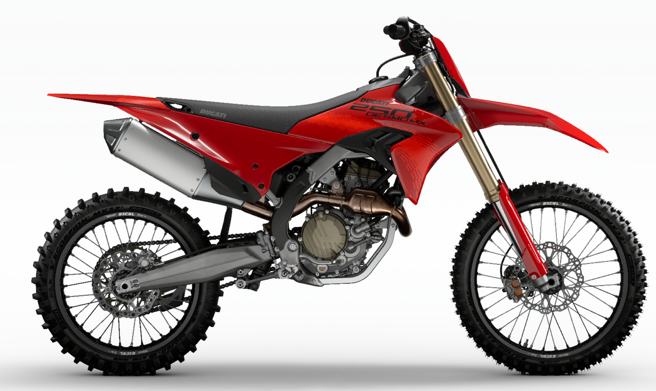
The 2026 Ducati Desmo250 MX is a completely new model and another major milestone in Ducati's expansion into motocross. Following the Desmo450 MX, Ducati turned its attention to the intensely competitive 250 four-stroke class with a purpose-built machine developed through racing rather than a scaled-down road motorcycle. The Desmo250 MX was tested in competition before reaching production, including development work with Alessandro Lupino in the Italian Prestige MX2 Championship. It also became Ducati's weapon for international MX2 competition, making 2026 an important model year in the company's rapidly developing off-road history.
At the centre of the bike is a new 249.7 cc single-cylinder engine using Ducati's signature desmodromic valve system. With an 81 mm bore, very short 48.4 mm stroke and high 14.5:1 compression ratio, it is designed to rev exceptionally hard. Ducati quotes 44.5 hp at 12,500 rpm and 28.3 Nm of torque at 8,800 rpm, while the engine can reach 15,000 rpm. The ability to hold a gear over a wide rev range is particularly valuable in a 250 four-stroke, where maintaining momentum and avoiding unnecessary shifts can make a significant difference on the track.
Fuel delivery uses a Keihin injector and 44 mm Mikuni throttle body. A five-speed gearbox includes an upshift Quick Shift system, while the hydraulic multiplate clutch and DID DMS 520 chain transmit power through 13/51 final gearing. Ducati also brought a substantial electronics package to the 250 class, including Riding Modes, Ducati Traction Control, Engine Brake Control, Power Launch and Ducati Fall Detection. An optional WiFi module and X-Link application further extend the ability to configure and monitor the motorcycle.
The chassis follows the competition-focused philosophy established by Ducati's larger motocross machine. A welded aluminium frame uses cast, forged and extruded components to combine low weight with carefully controlled rigidity. The Desmo250 MX weighs 103 kg wet without fuel, has a 1,499 mm wheelbase and a 970 mm seat height. Owners comparing Ducati's new 250 against established machines can use the MXOwners motocross bike specifications to compare dimensions, engine layouts and chassis specifications across different manufacturers and model years.
Showa supplies the suspension at both ends. The front uses a fully adjustable 49 mm upside-down fork with Kashima-coated outer tubes and 310 mm of wheel travel. A fully adjustable Showa monoshock controls the rear through 301 mm of wheel travel. Owners maintaining or setting up competition suspension can also use the MXOwners fork oil reference when researching fork service information.
The wheel and brake package is equally competition focused. Takasago Excel rims measure 21 x 1.60 inches at the front and 19 x 2.15 inches at the rear. They are fitted with Pirelli Scorpion MX32 Mid Soft tyres in 80/100-21 front and 100/90-19 rear sizes. Braking comes from Brembo calipers working with 260 mm front and 240 mm rear Galfer discs. Alternative tyre dimensions and fitment information can be compared using the MXOwners motocross tyre size guide.
Like any serious modern race bike, the Desmo250 MX has an hour-based maintenance schedule. Ducati specifies engine oil and filter servicing every 15 hours, valve-clearance inspection every 45 hours, piston replacement at 45 to 60 hours and a main engine service at 90 to 120 hours. Those intervals underline that this is a competition motorcycle designed around performance rather than low-maintenance recreational riding.
Historically, the 2026 Desmo250 MX is significant because it turns Ducati's motocross project from a single 450-class experiment into a genuine multi-class programme. The Desmo450 proved that Ducati was serious about dirt; the Desmo250 takes that commitment into MX2 and one of motocross racing's toughest development categories. With a 15,000 rpm desmodromic single, aluminium chassis, Showa suspension and sophisticated electronics, Ducati has created a 250 that is technically distinctive rather than simply imitating the established formula.